
|
|
|
|



Duct Banks
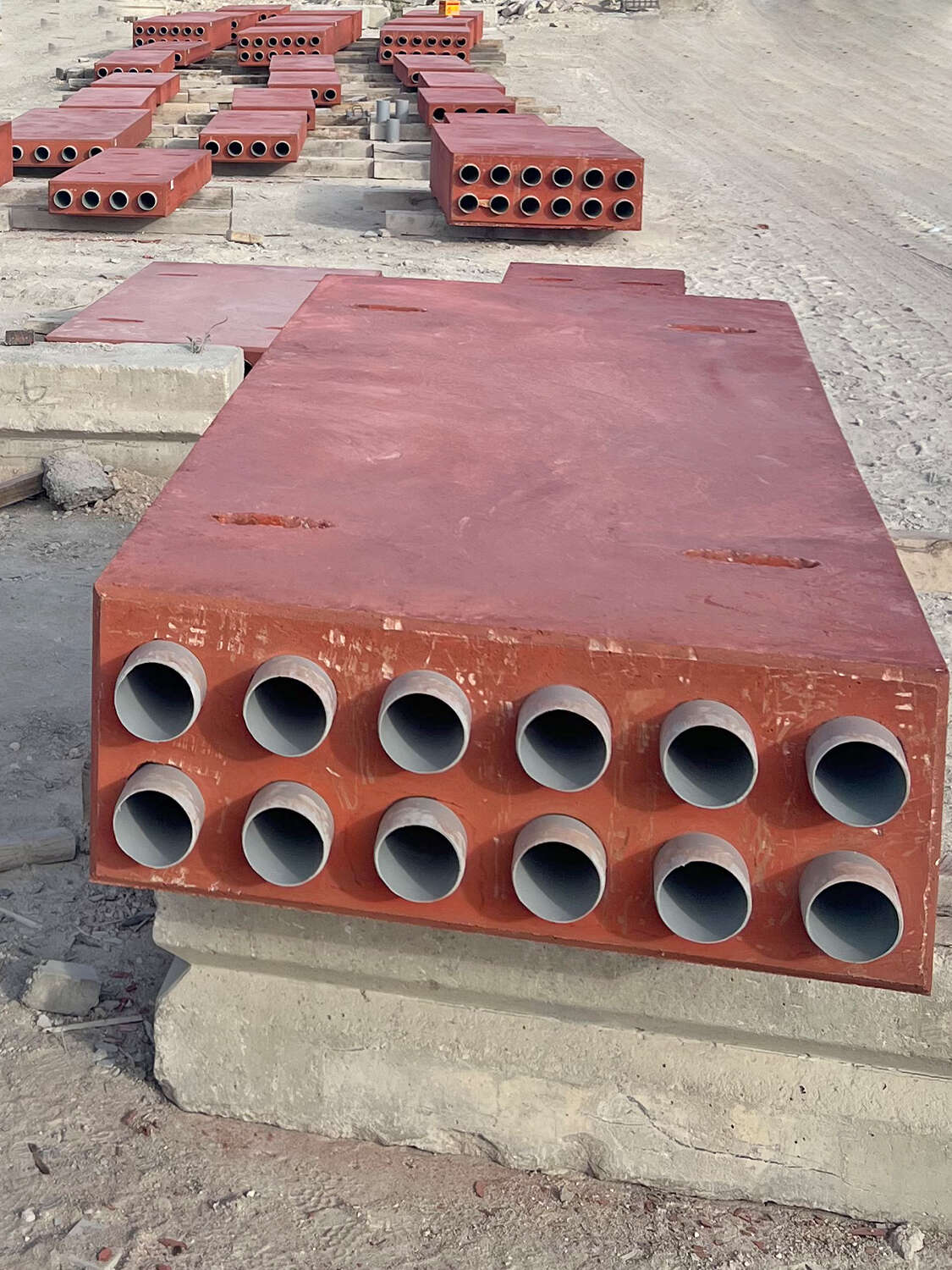
Heldenfels Enterprises precast duct banks provide a durable, efficient solution for housing and protecting underground electrical and communication conduits in industrial, commercial, and utility applications.
Manufactured in a controlled plant environment, these precast systems deliver consistent conduit alignment, proper concrete cover, and reliable spacing—helping reduce installation time and minimize on-site labor compared to field-built duct banks.
Precast duct banks can be configured in a wide range of conduit layouts, from smaller runs supporting light service to large, high-density banks designed for heavy electrical loads and future expansion. Built to project specifications and delivered ready to install, Heldenfels Enterprises duct banks support safer construction practices, improved schedule certainty, and long-term performance for critical underground infrastructure.
Product Information
Technical Specs
| Configuration (H × W) | # of Conduits (max) | Typical Use / Notes |
| 1H × 2W | 2 conduits | Light service runs, small circuits, minimal conduit requirement |
| 1H × 3W | 3 conduits | Modest electrical service, small installations |
| 1H × 4W | 4 conduits | Small-to-medium service, extra conduit capacity for future growth |
| 1H × 5W | 5 conduits | Service with some growth allowance, redundant conduit, small systems with future expansion in mind |
| 2H × 2W | 4 conduits | Medium capacity runs where vertical stacking helps reduce trench width |
| 2H × 3W | 6 conduits | Medium service / power feeder bank, often used where a single row isn’t enough |
| 2H × 4W | 8 conduits | Larger service runs, feeder circuits, more capacity for growth or redundancy |
| 2H × 5W | 10 conduits | Heavier electrical needs, possibly multiple feeders or mixed services |
| 3H × 2W | 6 conduits | Compact vertical stacks — useful when trench width is limited but depth allows stacking. |
| 3H × 3W | 9 conduits | Common “medium-large” duct bank for campus / facility power distribution. |
| 3H × 4W | 12 conduits | Larger feeder banks, industrial/commercial distribution, reserved spare conduits. |
| 3H × 5W | 15 conduits | Heavy-duty runs — good for large facilities or future-proofing. |
| 4H × 2W | 8 conduits | Deep vertical stack — useful when space is very limited horizontally. |
| 4H × 3W | 12 conduits | Large installations where trench width is constrained but depth is available. |
| 4H × 4W | 16 conduits | Substantial conduit bank — heavy service/feeder infrastructure. |
| 4H × 5W | 20 conduits | Very large installations: data centers, large industrial facilities, campus-scale electrical distribution. |
| 5H × 2W | 10 conduits | Deep stack for heavy capacity where trench width is limited. |
| 5H × 3W | 15 conduits | High-capacity central duct bank for major infrastructure. |
| 5H × 4W | 20 conduits | High-density conduit bank, good for future expansion, redundancy. |
| 5H × 5W | 25 conduits | Maximum typical capacity per single 116″ precast section (standard manufacturer max) — used for large scale installations. |
Delivery & Installation
On average, duct banks take about 6-8 weeks before they are ready to leave our facility. Our delivery network makes shipping fast and easy! Each project is different and your timeline will be discussed when the order is placed.
Applications & Use Cases
Notes / Caveats
Product Information
Technical Specs
| Configuration (H × W) | # of Conduits (max) | Typical Use / Notes |
| 1H × 2W | 2 conduits | Light service runs, small circuits, minimal conduit requirement |
| 1H × 3W | 3 conduits | Modest electrical service, small installations |
| 1H × 4W | 4 conduits | Small-to-medium service, extra conduit capacity for future growth |
| 1H × 5W | 5 conduits | Service with some growth allowance, redundant conduit, small systems with future expansion in mind |
| 2H × 2W | 4 conduits | Medium capacity runs where vertical stacking helps reduce trench width |
| 2H × 3W | 6 conduits | Medium service / power feeder bank, often used where a single row isn’t enough |
| 2H × 4W | 8 conduits | Larger service runs, feeder circuits, more capacity for growth or redundancy |
| 2H × 5W | 10 conduits | Heavier electrical needs, possibly multiple feeders or mixed services |
| 3H × 2W | 6 conduits | Compact vertical stacks — useful when trench width is limited but depth allows stacking. |
| 3H × 3W | 9 conduits | Common “medium-large” duct bank for campus / facility power distribution. |
| 3H × 4W | 12 conduits | Larger feeder banks, industrial/commercial distribution, reserved spare conduits. |
| 3H × 5W | 15 conduits | Heavy-duty runs — good for large facilities or future-proofing. |
| 4H × 2W | 8 conduits | Deep vertical stack — useful when space is very limited horizontally. |
| 4H × 3W | 12 conduits | Large installations where trench width is constrained but depth is available. |
| 4H × 4W | 16 conduits | Substantial conduit bank — heavy service/feeder infrastructure. |
| 4H × 5W | 20 conduits | Very large installations: data centers, large industrial facilities, campus-scale electrical distribution. |
| 5H × 2W | 10 conduits | Deep stack for heavy capacity where trench width is limited. |
| 5H × 3W | 15 conduits | High-capacity central duct bank for major infrastructure. |
| 5H × 4W | 20 conduits | High-density conduit bank, good for future expansion, redundancy. |
| 5H × 5W | 25 conduits | Maximum typical capacity per single 116″ precast section (standard manufacturer max) — used for large scale installations. |
Delivery & Installation
On average, duct banks take about 6-8 weeks before they are ready to leave our facility. Our delivery network makes shipping fast and easy! Each project is different and your timeline will be discussed when the order is placed.
Applications & Use Cases
Notes/Caveats:
- These numbers assume use of standard conduit sizes (4″ or 6″) as in common precast systems.
- The “height × width” refers to how conduits are stacked in the cross-section, not physical dimensions — actual outside dimensions depend on conduit outer diameter, spacing between conduits, and concrete cover/encasement.
- Many precast sections are built to a standard length (for example, 116 inches ~ 9.6 ft) for modularity.
- For large conduit banks (many conduits), it’s common to “stack or side-by-side” these standard sections to build up the needed capacity or geometry.
Our Locations
Heldenfels Enterprises
5700 IH-35 South. San Marcos, TX 78666
Tel: (512) 396-2376
Fax: (512) 396-2381
Heldenfels Enterprises
2222 Laredo St. Corpus Christi, TX 78405
Juan Aguirre: (361) 533-1031
Heldenfels Headquarters
Heldenfels Corpus Christi
Frequently Asked Questions
What are the main advantages of precast duct banks over cast-in-place systems?
Precast duct banks offer faster installation, consistent quality control, reduced labor costs, and less disruption to surrounding areas compared to cast-in-place construction.
Are precast duct banks customizable for my project needs?
Yes, precast duct banks can be manufactured in various sizes, configurations, and conduit layouts to meet specific project requirements and utility standards.
How durable are precast duct banks in different environments?
They are designed to withstand heavy loads, harsh weather conditions, and corrosive environments, making them suitable for urban, industrial, and transportation applications.
What is the typical installation process and timeline?
Installation is usually quicker than traditional methods, often completed in days rather than weeks, since the units arrive on-site ready to place and connect.
Do precast duct banks meet industry codes and utility specifications?
Most precast duct banks are manufactured to comply with local, state, and national codes, as well as specific utility and DOT requirements, but it’s important to confirm compliance before purchasing.
What applications are precast duct banks best suited for?
Precast duct banks are commonly used in utility corridors, data centers, substations, transportation projects, commercial developments, and renewable energy installations.

Larry Miller, PE
VP of Pre Construction & Business Development
Speak with a Precast Duct Bank Expert Today!
Direct message an experienced Precast Duct Bank expert about your project. We are happy to discuss your project’s goals and expectations.