
What’s the Difference Between LNG and RLNG, and How Is It Stored?
Natural gas is easy to talk about in broad strokes, but the infrastructure behind LNG and regasified liquid natural gas is far more complex.
Natural gas is easy to talk about in broad strokes, but the infrastructure behind it is not simple. Liquefied natural gas, or LNG, is natural gas cooled into liquid form so it can be stored and transported more efficiently. Regasified liquid natural gas is LNG after it has been warmed back into a gaseous state and delivered for use in power plants, industrial facilities, pipelines, and distribution systems.
LNG and RLNG matter because each creates different infrastructure demands. LNG needs cryogenic handling, insulated storage, and specialized shipping, while regasified liquid natural gas depends on terminals, vaporizers, pipelines, metering systems, and durable support structures. For Heldenfels Enterprises, the stronger point is that LNG plants, power facilities, petrochemical sites, and other industrial energy projects rely on the precast and prestressed concrete systems Heldenfels builds, including foundations, wall systems, trenches, duct banks, and structural components.
Understanding LNG and Regasified Liquid Natural Gas
LNG stands for liquefied natural gas. It is mostly methane that has been cooled to about -260°F, or about -162°C. At that temperature, natural gas becomes liquid and takes up about 1/600 of the volume it would occupy as gas. That volume reduction makes LNG practical for long-distance transport, especially where pipelines are not available or economical. The U.S. Energy Information Administration’s overview of liquefied natural gas is a useful reference for this basic technical definition.
Regasified liquid natural gas is created when LNG reaches an import terminal, storage facility, or floating regasification unit and is warmed back into gas. Once regasified, it can enter a pipeline system or serve major users such as power plants, manufacturing sites, and local gas networks.
A simple way to remember it: LNG is the compact transport-and-storage form. Regasified liquid natural gas is the usable gas form after LNG is converted back.
How LNG is Produced
LNG production starts with natural gas treatment. Before liquefaction, producers remove water, carbon dioxide, sulfur compounds, heavier hydrocarbons, and other impurities that could freeze, corrode equipment, or create safety problems during storage and transport.
After treatment, the gas is cooled in stages until it reaches cryogenic temperature. At that point, it becomes LNG and can be stored in insulated tanks or loaded onto LNG carriers. The process is energy-intensive, but it allows gas to move across oceans and into markets that pipeline networks cannot easily reach.
This is where the original draft needed a harder technical cleanup. Cryogenic tanks do not magically “make” LNG cold; liquefaction systems cool the gas, and cryogenic tanks are designed to maintain the required low temperature and manage boil-off safely. That distinction matters because engineers, EPC teams, and industrial readers will notice vague language immediately.
Why is LNG Liquefied for Transportation?
Natural gas is liquefied because, in its gaseous form, it takes up too much space for efficient overseas transport. By reducing its volume by roughly 600 times, LNG makes it possible to move large amounts of energy through specialized ships and storage systems. Once it reaches its destination, it can be converted into regasified liquid natural gas and distributed to power plants, industrial facilities, utilities, and other end users.
This gives LNG strategic value beyond the fuel itself. It gives buyers more supply options and reduces dependence on a single pipeline route or production region.
- Greater transport efficiency: LNG allows large volumes of natural gas to move across oceans where pipelines are not practical.
- More supply flexibility: Regions with LNG import capacity can source gas from multiple supply basins.
- Improved energy security: LNG can help reduce exposure to pipeline disruptions, weather-related shortages, or geopolitical pressure.
- Better market access: Once converted into regasified liquid natural gas, it can enter local pipeline networks and serve end users directly.
- Not a full shield from volatility: LNG improves flexibility, but it does not eliminate price swings or supply risk.
How LNG is Stored
LNG storage must keep the product extremely cold, stable, and safely controlled. Storage systems are designed to limit heat transfer, manage boil-off gas, maintain safe pressure, and protect nearby equipment and personnel. Common options include above-ground full-containment tanks, below-grade systems, and smaller cryogenic tanks for satellite facilities.
- Temperature control: LNG must remain cold enough to stay in liquid form.
- Boil-off gas management: Storage systems must safely handle vapor created by heat entering the tank.
- Pressure safety: Tanks need systems that prevent unsafe pressure buildup.
- Structural protection: Outer containment helps protect the facility if leaks or equipment issues occur.
- Site conditions: Soil, seismic loads, drainage, fire protection, and access must be considered.
- Long-term maintenance: Storage systems need to support inspections, repairs, and reliable operation over time.
This is where Heldenfels belongs in the conversation. LNG and RLNG facilities are not only process-mechanical projects. They are heavy civil and structural projects. Our industrial precast concrete solutions are relevant to the support systems around LNG plants, power facilities, and industrial energy sites.
How Regasified Liquid Natural Gas is Created from LNG
The regasification process reverses the liquefaction step. LNG is pumped from storage, pressurized, and warmed through vaporizers or heat exchangers until it returns to gaseous form. The result is regasified liquid natural gas that can be measured, conditioned, and delivered through pipelines or directly to large users.
Different facilities use different vaporizer technologies. Open-rack vaporizers use seawater as the heat source. Submerged combustion vaporizers use fuel to generate heat. Ambient air vaporizers use surrounding air. The right choice depends on site location, environmental rules, energy demand, utility access, water availability, and operating cost.
Regasified liquid natural gas is not chemically different from pipeline natural gas in the way some readers assume. It is natural gas that was liquefied for transport and then returned to gas for use. That clarification should stay in the article because it removes a common point of confusion.
Onshore Terminals vs. Floating Regasification Units
Regasification can be handled through fixed onshore terminals or floating storage and regasification units, known as FSRUs. Both convert LNG back into usable gas, but they differ in cost, deployment speed, capacity, and infrastructure needs.
| Category | Onshore Terminals | Floating Regasification Units |
|---|---|---|
| Basic setup | Permanent land-based facilities built for LNG import, storage, regasification, and delivery. | Specialized vessels that store LNG and regasify it onboard. |
| Best use case | Long-term markets with high and steady gas demand. | Markets that need faster gas access or a temporary bridge while permanent infrastructure is developed. |
| Typical components | Marine unloading systems, LNG storage tanks, pumps, vaporizers, utility systems, control buildings, fire protection, roads, and pipeline connections. | LNG storage onboard the vessel, regasification equipment, mooring systems, marine connections, and pipeline tie-ins. |
| Deployment speed | Slower to develop because of permitting, land acquisition, engineering, and construction requirements. | Faster to deploy because the main regasification system is vessel-based. |
| Capacity | Usually better suited for large-volume, long-term demand. | Capacity depends on vessel size and port conditions, so it may be more limited. |
| Capital requirements | Higher upfront investment due to permanent infrastructure and large civil works. | Lower initial infrastructure burden, though long-term leasing or operating costs can add up. |
| Flexibility | Less flexible once built because the facility is fixed in place. | More flexible because the vessel can potentially be relocated or used as a temporary solution. |
| Limitations | Requires significant land, permitting, construction time, and supporting infrastructure. | Can be affected by vessel capacity, weather exposure, port limitations, and long-term economics. |
| Infrastructure needs | Requires strong foundations, pipe racks, equipment pads, utility trenches, control buildings, and pipeline systems. | Still needs reliable shore-side infrastructure, including tie-ins, equipment supports, utility corridors, and pipeline connections. |
| Bottom line | Best for permanent, high-capacity LNG import and regasification projects. | Best for faster, flexible regasification needs where speed matters more than maximum long-term capacity. |
Infrastructure Needed for LNG and Regasified Liquid Natural Gas Facilities
LNG and RLNG projects can include marine unloading arms, storage tanks, pumps, vaporizers, compressors, metering stations, electrical systems, fire protection, drainage, access roads, pipeline tie-ins, and control buildings.
We fabricate and install precast and prestressed concrete structures for highway, marine, industrial, and building markets, and our industrial work is positioned for demanding applications such as LNG plants and power facilities.
Relevant Heldenfels precast applications include equipment foundations, wall panels, structural columns, beams, caps, piling, precast trenches, duct banks, and pipe-support infrastructure. For deeper relevance, you can also refer to our page about precast solutions for LNG.
Applications of Regasified Liquid Natural Gas
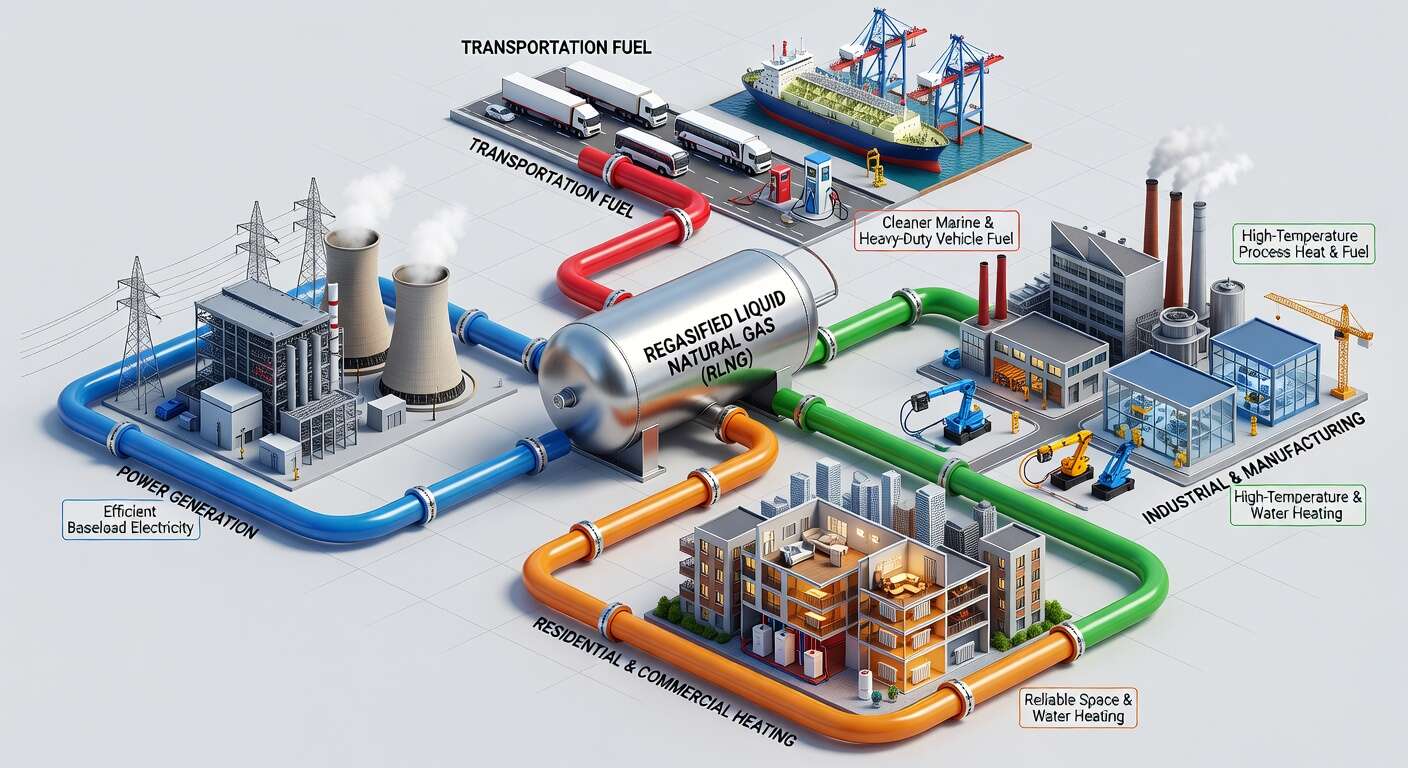
RLNG supports a wide range of energy uses, from reliable power supply and building heat to heavy-duty transport and industrial process operations.
Regasified liquid natural gas is useful because it can serve the same role as pipeline-quality natural gas once LNG has been converted back into gas. Its main applications are in power generation, industrial operations, petrochemical production, commercial heating, and local gas distribution.
Power Generation
Regasified liquid natural gas can fuel gas turbines and combined-cycle power plants. Compared with coal-fired generation, natural gas combustion generally produces less carbon dioxide per unit of electricity, along with lower levels of sulfur dioxide and particulate matter.
That advantage is real, but it should not be exaggerated. Liquefaction, shipping, regasification energy use, and methane leakage can all affect the full lifecycle emissions profile.
Industrial Heating and Manufacturing
In industrial facilities, regasified liquid natural gas can provide steady process heat for manufacturing, refining, chemicals, food processing, and other high-demand operations. It is especially valuable in regions where domestic pipeline gas is limited but LNG import capacity is available.
Petrochemical and Commercial Use
Regasified liquid natural gas can also support petrochemical production, commercial heating, and local gas distribution networks. Once it enters the gas system, it can be used much like conventional pipeline natural gas across a wide range of end-use applications.
Energy Security and Market Expansion
LNG expands the reach of natural gas beyond fixed pipeline networks. Once imported and converted into regasified liquid natural gas, it can support electric grids, industrial production, and local distribution systems.
This matters because energy security is not only a fuel contract. It is terminal capacity, storage, regasification equipment, pipeline access, redundancy, and durable construction. A country or region may have access to LNG on paper, but if the receiving terminal, civil works, and downstream systems are weak, that supply will not translate into reliable energy.
From a construction perspective, this is where durable precast infrastructure becomes part of the energy-security conversation. Reliable gas supply depends on facilities that can operate safely and consistently, not just on molecules arriving by ship.
What This Means for Industrial Construction
The LNG-to-RLNG value chain is full of specialized process equipment, but civil and structural systems are what make the facility buildable, maintainable, and safe. Heavy equipment must stay aligned. Utility corridors must stay protected. Walls and foundations must perform under industrial loads. Access systems must support maintenance and emergency response.
That is where precast concrete earns its place. Factory-controlled production can improve consistency, reduce site congestion, limit weather delays, and help contractors work around aggressive schedules. For industrial owners and EPC teams, that schedule certainty can be just as important as material strength.
Heldenfels Enterprises brings its precast and prestressed concrete experience to the infrastructure side of energy projects. For LNG plants, power facilities, petrochemical sites, and other industrial projects, our value is not in producing gas. It is in delivering the concrete systems that help those facilities get built and stay operational.
Build Stronger Industrial Infrastructure
Heldenfels Enterprises supports LNG, power, petrochemical, and industrial projects with precast and prestressed concrete systems built for demanding environments.
Contact Heldenfels