Preferred Building Systems NH Contractors Choose: Precast vs Traditional
A practical comparison of precast concrete and traditional cast-in-place or steel-frame construction, tuned to New Hampshire’s short building season, freeze-thaw climate, and commercial cost pressures.
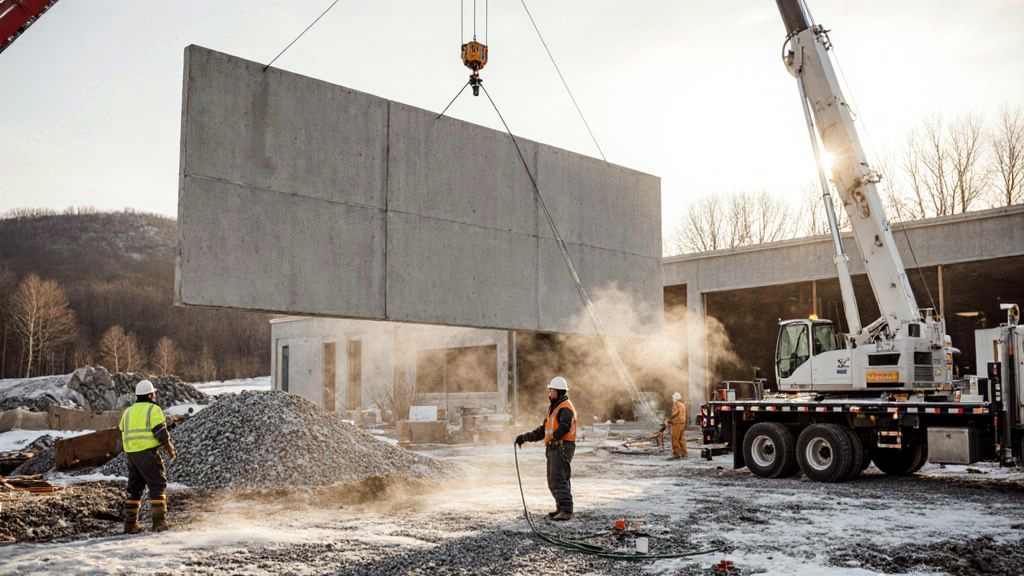
A precast wall panel being set on a cold-weather NH commercial site, where every weather-resilient week of erection matters.
When New Hampshire developers, general contractors, and facility owners price out a commercial build, the structural system gets chosen before almost anything else, and that one decision sets the cost, the schedule, and the long-term maintenance profile for the entire project. The conversation about preferred building systems NH builders are actually using has shifted noticeably over the last decade, with precast concrete moving from a niche choice for parking decks and prisons into mainstream commercial, multifamily, and industrial work. This guide compares precast concrete to traditional cast-in-place and steel-frame construction on the terms NH owners actually care about: dollars, weeks, and how the building will perform after twenty winters.
Our goal is not to pitch one method over the other. Some projects are clearly better off with cast-in-place. Some are clearly better off with structural steel. And some, increasingly, are better off with precast. The honest answer almost always comes down to project type, site constraints, and how exposed the schedule is to weather. We will walk through each variable in plain language.
Why the Preferred Building Systems NH Builders Trust Are Shifting
Three pressures have changed the math on NH commercial construction in the past several years. Labor availability tightened sharply after 2020, and skilled cast-in-place crews, masons, and steel erectors all became harder and more expensive to book on a predictable timeline. Material costs swung wildly through the same period, which made fixed-price subcontracts harder to negotiate. And owner expectations on schedule compressed, especially for industrial users and multifamily developers who lose real revenue for every month a building is not occupied.
Precast concrete responds to all three pressures at once. Components are fabricated off-site in a controlled plant, which means a much smaller field crew can erect a building that a cast-in-place team would need months to form, pour, and cure. The fabrication labor is concentrated where it can be supervised consistently, and the price is locked in earlier in the procurement cycle. For NH owners who watched a twelve-month build turn into eighteen months because of weather or trade availability, those advantages are no longer theoretical.
How Precast Concrete Actually Works
Precast concrete components are cast in reusable steel or fiberglass molds inside a manufacturing plant. Structural columns, beams, double tees, hollowcore plank, insulated wall panels, and architectural facade pieces are all produced this way. Each component is engineered to meet the project’s specific structural and dimensional requirements, then cured under controlled temperature and humidity until it reaches the specified release strength. From there, components are trucked to the job site and lifted into place by crane in a pre-planned erection sequence.
The result is a building that takes shape in the field at a pace that traditional methods cannot match. A typical commercial floor that might take three to four weeks to form, pour, and strip with cast-in-place can be erected in a few days with precast hollowcore or double tees. The frame goes up, the building dries in, and the interior trades start work weeks earlier than they otherwise would. This is the schedule lever that drives most of the precast adoption we see across the Northeast.
For owners new to the system, the simplest mental model is this: traditional construction asks a site to behave like a factory, with skilled labor, weather protection, and quality control improvised under tarps and heaters. Precast asks the factory to behave like a factory, and the site to behave like an assembly point. That separation is what makes the schedule and quality numbers move.
Precast vs Traditional: The Honest Side-by-Side
| Factor | Precast Concrete | Cast-in-Place Concrete | Structural Steel |
|---|---|---|---|
| Field erection speed | Fastest, weather-tolerant | Slowest, weather-sensitive | Fast, weather-tolerant |
| Up-front material cost | Moderate to high | Moderate | Volatile (market-driven) |
| Cold-weather construction | Largely unaffected | Slowed; heat and enclosures required | Largely unaffected |
| Fire rating | Inherent, no added assembly | Inherent, no added assembly | Requires applied protection |
| Long-term maintenance | Low | Low | Moderate (coatings, corrosion) |
| Design flexibility for tight spans | Moderate | High | High |
| Site labor required | Smallest crew | Largest crew | Moderate |
The table is a useful starting point, but every project has a couple of factors that dominate the rest. For an NH self-storage developer with a tight return window, schedule wins and precast usually pencils out. For a one-of-a-kind architectural building with curved cast-in-place features, the answer is different. The point of an honest comparison is to identify which two or three factors actually drive your decision, not to score every category equally.
The Cost Equation for New Hampshire Commercial Projects
Sticker-price comparisons mislead almost every first-time owner. Precast components sometimes show a higher unit cost than equivalent cast-in-place or steel members on a line-item basis, and that is where the conversation often stops. It should not. The full cost picture has to include field labor, weather mitigation, schedule, formwork, scaffolding, crane time, interior finish start dates, and the carrying cost of capital while the building is incomplete.
In our experience supplying commercial building systems across the Northeast, precast typically lands within five to fifteen percent of cast-in-place on total project cost for buildings where its strengths are a fit: parking structures, warehouses, distribution centers, multifamily wraps over a precast podium, schools, correctional facilities, and a growing list of office and mixed-use mid-rises. When the schedule savings are converted into earlier occupancy revenue or earlier rent collection, the picture often flips in precast’s favor outright.
The cost ranges that matter most to NH owners are not the raw material costs, which fluctuate. They are the predictable line items: a fixed-price precast contract, a predictable erection schedule, and a smaller field crew. Owners who have been burned by cost overruns on previous traditional builds tend to value that predictability more than the lowest sticker price.
The cheapest building system on paper is rarely the cheapest building. Total cost includes time, weather risk, financing carry, and the start dates of every trade that comes after the structure. Precast wins more of those columns than its line-item price suggests.
Schedule Compression in a Short Building Season
New Hampshire’s outdoor construction season is short, and every honest scheduler builds the calendar around it. Frost, snow loads, and below-freezing temperatures stretch cast-in-place pours into longer cure cycles, force the use of heated enclosures, and routinely push pours from late November through March off the calendar entirely. A traditional building that breaks ground in early fall can lose a full quarter to weather before the slab is even complete.
Precast erection is largely insulated from those constraints. Because the components arrive at the site already cured to their full design strength, the field operation is essentially heavy assembly, not concrete work. Crews can erect panels and frame components at temperatures and in weather conditions that would shut down a cast-in-place pour. For an NH owner trying to dry the building in before winter so interior trades can work in heated conditions, precast routinely wins the schedule by four to eight weeks on a mid-sized commercial project, sometimes more on larger industrial builds.
That schedule advantage compounds. Every week of erection saved is a week earlier the roof is on, a week earlier the building is enclosed, a week earlier mechanical and electrical rough-in can start, and a week earlier the owner is using the space. On an industrial tenant who needs to be operating by a fixed date, the schedule advantage is often what makes the project feasible at all.

Hollowcore floor plank installation continues through frost mornings that would shut down a traditional pour.
Durability in NH’s Freeze-Thaw Climate
New Hampshire winters are hard on buildings. Freeze-thaw cycles drive water into hairline cracks and expand it, deicing salts attack steel embeds, and roof and wall assemblies move with thermal swings of more than a hundred degrees over the course of a year. Structural system choice has a measurable effect on how the building ages.
Plant-cured precast concrete is exceptionally well suited to freeze-thaw environments. The controlled mix design, lower water-to-cement ratio, and consistent curing produce a denser, less permeable concrete than typical field pours. The same density and proper cover protect embedded reinforcing from corrosion. Decades of field performance data from PCI-certified producers across the Northeast support this. For owners weighing fifty-year ownership costs rather than first-year construction costs, the durability case for precast is strong.
Steel framing in NH still performs well, but it requires diligent fireproofing, coatings, and corrosion management, particularly in coastal areas or in buildings exposed to road salt. Cast-in-place concrete performs well when batched and cured under good conditions, but variable winter pours can produce variable results. The narrower the variability, the longer the building lasts without maintenance surprises.
Where Traditional Construction Still Makes Sense
Precast is not the right answer for every NH project. Buildings with highly irregular geometries, deep cantilevers, or one-of-a-kind architectural concrete features may be better suited to cast-in-place. Long-span clear interiors, tall warehouses without intermediate columns, and structures with heavy crane runs often favor structural steel. Small infill projects in dense urban areas with no laydown room and tight crane access can make precast logistics impractical.
The decision is rarely binary. Many of the most efficient NH commercial buildings combine systems: a precast podium with steel framing above, a precast envelope around a cast-in-place core, or precast double tees on steel girders for a clear-span warehouse roof. A precast supplier that engineers and produces a full catalog of structural building components can sit in the schematic design conversation early and help an owner and design team find the right hybrid.
Choosing the Right System for Your Build
If you are evaluating preferred building systems NH owners and contractors are choosing today, work through these questions before you commit:
- What is the schedule penalty for missing the target opening date? If it is large, precast usually earns its place.
- How exposed is your project to a winter pour window? The more exposed, the bigger the case for off-site fabrication.
- What is the structural typology? Repeated bays and standard spans favor precast; bespoke geometries may favor cast-in-place.
- What does total cost look like, not unit cost? Run the numbers including weather, labor, financing carry, and occupancy date.
- What is the long-term ownership horizon? Longer holds usually favor the lower-maintenance system.
- Is there a hybrid approach that captures the best of two systems? Often yes, and the precast engineer should be in the room when you ask.
The Precast/Prestressed Concrete Institute publishes extensive third-party research on precast performance, durability, and code compliance, and its certification program is the industry’s primary quality benchmark. Reviewing the resources there is a good starting point for owners and design teams who want to compare systems on data rather than on supplier marketing.
The honest framing is this: preferred building systems NH contractors keep returning to are the ones that protect schedule, lock in cost, and age well in a hard climate. Precast does all three on a wide and growing range of project types. Cast-in-place and steel each still own categories where precast is not the best fit. The right answer for any given project starts with the project, not with the system.
Planning a Commercial Build in New Hampshire?
Our team has spent decades engineering and fabricating precast structural components for projects across the Northeast. If you are weighing precast against traditional methods on an upcoming NH build, we can sit in the early design conversation and help you compare systems on the numbers that actually drive your project.
Start the Conversation