
Wick Building Systems vs Precast Concrete: A Smart Builder’s Definitive Guide
Choosing between wick building systems and precast concrete shapes everything that follows on a commercial project, from foundation design and erection schedule to insurance premiums and the building’s useful life. Both approaches solve real problems for real owners, but they answer very different questions about how a structure should perform over the decades that follow ribbon-cutting. This guide breaks down how the two compare on speed, structural capacity, durability, resilience, and lifecycle economics so your team can match the right system to the right project.
Understanding Wick Building Systems and Their Commercial Niche
Wick building systems use a post-frame approach: pressure-treated laminated wood columns set into concrete piers or footings, with engineered wood trusses spanning the roof and steel cladding on the walls and roof deck. The category grew out of agricultural construction and has expanded into light commercial uses such as equipment storage, equestrian arenas, riding facilities, fleet maintenance shops, light retail showrooms, and rural community buildings. Erection is fast because the structural skeleton is relatively light, and clear-span widths can be generous for the cost.
For owners who need a heated, weather-tight envelope over a large unobstructed floor and have a modest budget, wick building systems are a sensible answer. Insulation can be sprayed or batted between purlins, mechanical systems are easy to route along the underside of the trusses, and the structures can be reroofed or recladded decades later without disturbing the structural frame. The trade-offs come in fire performance, long-span limits, point-load capacity, and how the structure ages in humid or coastal environments.
How Precast Concrete Takes a Different Path
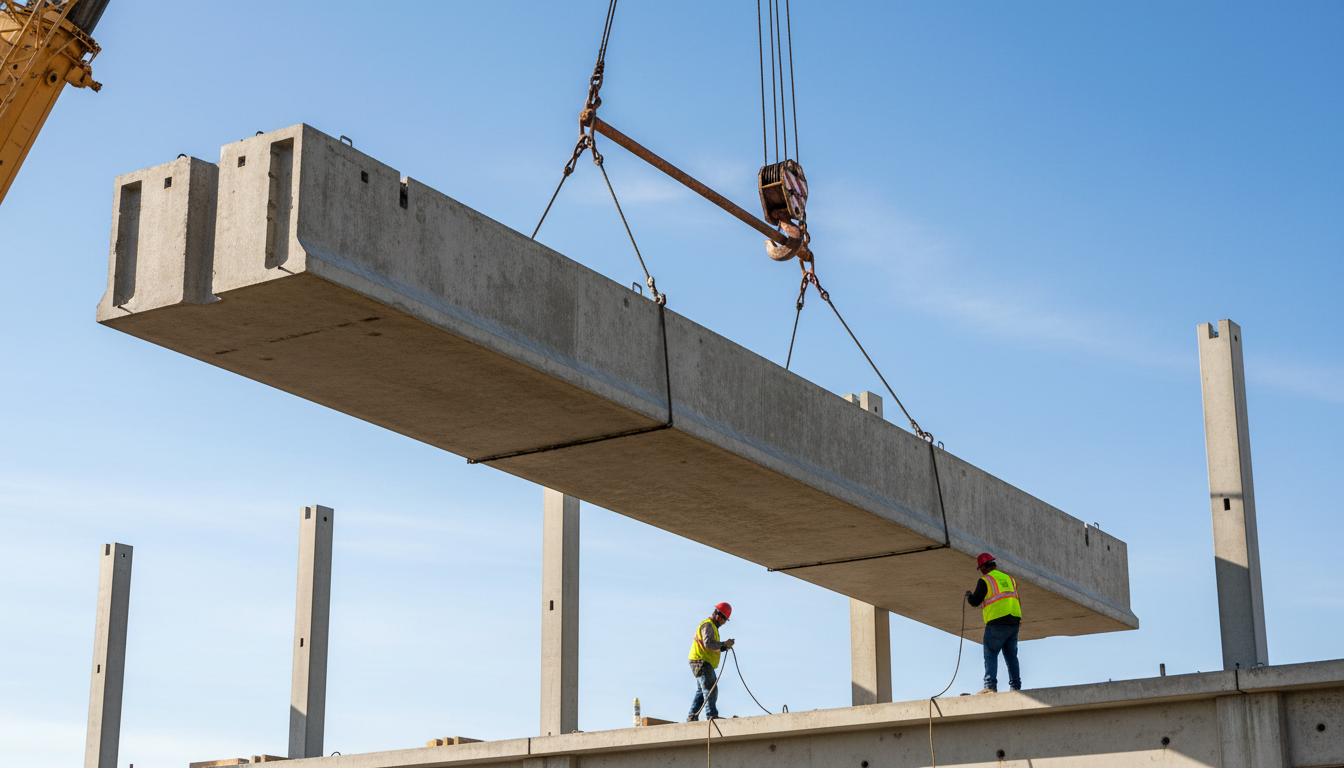
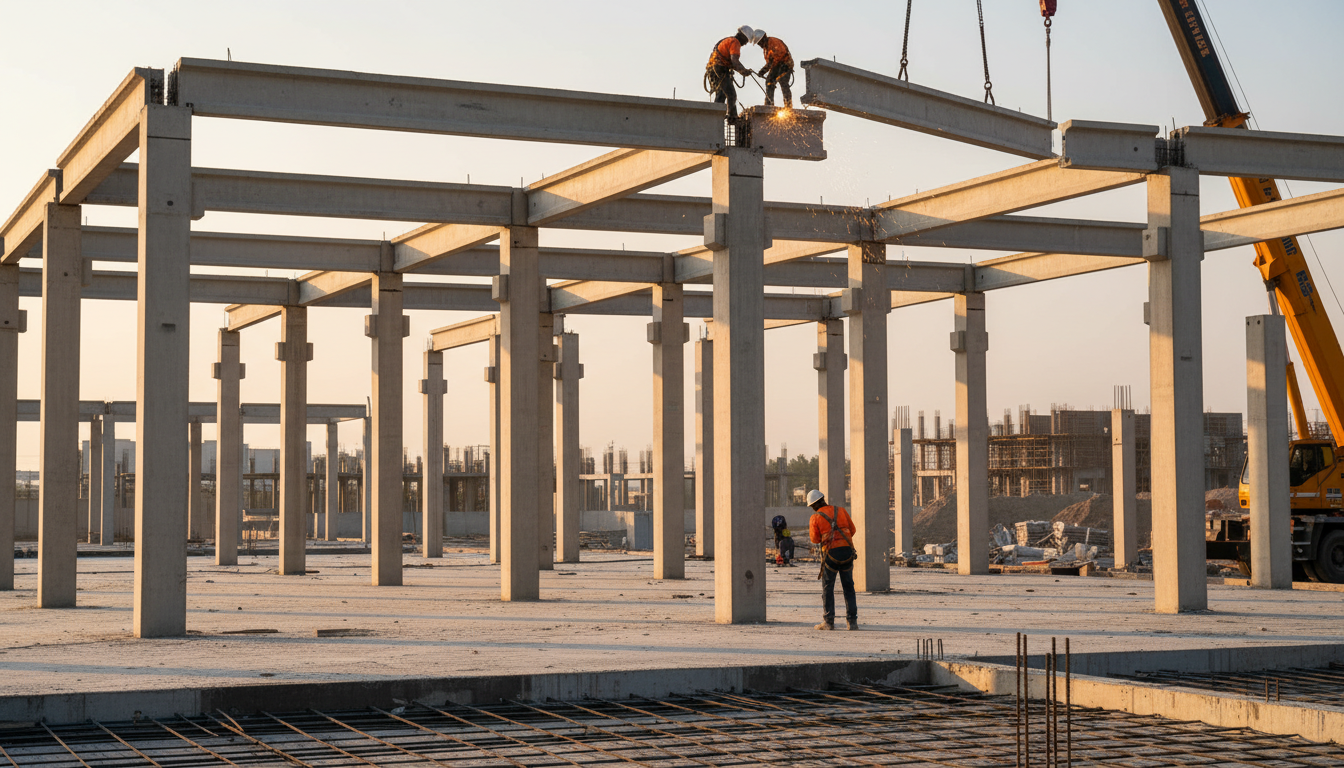
Precast concrete is fabricated in a controlled plant under PCI-certified quality programs and delivered to the site as finished structural pieces: columns, beams, double tees, hollow-core planks, shear walls, and architectural panels. Casting happens in steel forms with engineered reinforcement and high-strength concrete mixes, cured under temperature and humidity control. The pieces arrive on a flatbed, are craned into position, and connected with engineered welded plates, grouted sleeves, or post-tensioned tendons. The result is a structure that performs more like a finished, hardened shell on day one than a frame that still needs cladding and fireproofing.
Precast is the workhorse of parking structures, multi-story office and medical buildings, schools, distribution centers, stadiums, correctional facilities, and any project where fire rating, sound attenuation, or wind and seismic resilience matters. It is also the structural system of choice when owners want a hundred-year asset rather than a thirty-year one. The cost-per-square-foot is higher than a post-frame approach for a simple shed, but the value calculation shifts dramatically once you weight in insurance, energy, maintenance, and replacement timelines.
Wick Building Systems vs Precast on Speed and Schedule
Schedule is where the two systems are most often compared, and the honest answer depends on how you define “fast.” A wick building system can go up quickly on a flat pad because the columns are light and a small crew with a basic crane or even a telehandler can stand the frame in days. Trusses follow, then purlins, then cladding. For a one-story 8,000 square foot equipment shed, an experienced post-frame crew can dry-in the envelope inside a few weeks.
Precast moves differently. The plant produces components in parallel with sitework, so foundations, underground utilities, and slab prep are happening while columns, beams, and panels are being cast. Once the site is ready, erection is dramatically faster than cast-in-place concrete and often faster than steel because the pieces arrive finished. A 60,000 square foot single-story building can be topped out in a matter of weeks of crane time. The overall calendar is compressed by the parallel work streams, and weather is much less of a constraint than for site-built systems.
The fastest-feeling project is not always the soonest-finished project. Post-frame wins on raw erection days for small simple buildings. Precast wins on overall delivery for medium and large structures because plant fabrication runs concurrently with sitework.
Structural Capacity, Span, and Loadings
Post-frame buildings typically span 40 to 80 feet with engineered wood trusses, and longer spans are possible with deeper trusses or interior columns. The structure is excellent for distributed roof loads and snow loads when designed properly, but it is not the right choice for heavy point loads, suspended mezzanines stacked with inventory, overhead cranes, or roof-mounted mechanical equipment above modest weights. Reinforcing those concentrated demands inside a post-frame skeleton means adding steel or transferring loads through specialty connections, which erodes the cost advantage.
Precast double tees and hollow-core planks routinely span 60 to 90 feet uninterrupted, and prestressed double tees can carry the live loads of a multi-story parking deck, warehouse rack systems, or industrial floors. Column capacities and shear wall stiffness are engineered to carry vertical and lateral loads simultaneously. For projects that need to support heavy mechanical penthouses, bridge cranes, equipment foundations, or future expansion in any direction, precast simply has more structural headroom. We work with owners regularly on equipment foundations for building systems where load paths and vibration matter as much as the enclosure above them.
Durability, Maintenance, and Lifecycle Cost
This is the comparison most owners underestimate at bid time. A post-frame building, well-built and maintained, can last fifty years or more. The roof and wall cladding will typically need replacement once or twice in that span, sealants and trim need periodic attention, and the wood columns at grade are vulnerable to moisture, termites in some regions, and rot if the protective treatment is breached. Insurance carriers price the wood structure and steel cladding accordingly, and energy performance depends entirely on how aggressively the envelope was insulated and air-sealed.
Precast concrete is dimensionally stable, non-combustible, and does not rot, rust, warp, or feed insects. PCI-certified plants produce components engineered for triple-digit-year service lives. Architectural finishes are integral to the panel rather than applied as a wear surface. Maintenance over fifty years is overwhelmingly cosmetic: sealant joints get replaced on a schedule, and that is largely it. The total cost of ownership tilts sharply in favor of precast on any project the owner expects to hold long-term.
| Performance Factor | Wick / Post-Frame | Precast Concrete |
|---|---|---|
| Typical Service Life | 40 to 60 years | 75 to 100+ years |
| Fire Rating | Combustible frame; rating depends on assemblies | Non-combustible; 2 to 4 hour ratings standard |
| Clear Span Range | 40 to 80 feet typical | 60 to 90 feet typical, longer with prestressing |
| Wind Resistance | Good when engineered to code; cladding vulnerable | Excellent; mass and connections resist uplift |
| Insurance Posture | Type V combustible classification | Type I or II non-combustible classification |
| Maintenance Profile | Cladding, sealants, column protection | Sealant joints; cosmetic only |
Fire, Wind, and Seismic Resilience
Resilience is increasingly a board-level question, not just an engineering one. The Insurance Institute for Business and Home Safety has documented the gap in post-event performance between combustible and non-combustible structures across hurricane and wildfire regions, and underwriters are rewriting policies accordingly. Owners in Texas, Florida, the Carolinas, and the Gulf Coast face hardening insurance markets where the choice of structural system directly affects whether coverage is available and at what premium.
Post-frame buildings can be engineered to current wind codes and perform well in ordinary storms. In design events with sustained high winds, wind-driven debris, or fire exposure, the gap between a Type V wood structure and a Type I precast structure widens considerably. Precast shear walls and connections behave predictably in seismic regions, with significant research backing through the Precast/Prestressed Concrete Institute and decades of in-service performance data. For mission-critical facilities and any structure that needs to function as a recovery asset after a hazard event, precast is the more conservative choice.
Choosing the Right Commercial Building System for the Project
The smart way to read this comparison is not as a verdict but as a fit question. There are projects where wick building systems are absolutely the right answer: a horse arena on a working ranch, a maintenance shop on a small municipal site, a hangar for a private aviation operator, a packing shed for a regional farm. The economics are tight, the loads are predictable, the program is single-story, and the owner is comfortable with a 40 to 60 year horizon and Type V insurance treatment.
For projects with multi-story programs, heavy live loads, mechanical penthouses, parking, public assembly, hospitality, healthcare, education, distribution at scale, manufacturing with equipment foundations, or any structure in a hardening insurance market, precast simply gives the owner more building. Our team helps developers, GCs, and architects evaluate commercial building systems at the conceptual stage, so the structural decision drives the architecture instead of the architecture forcing a compromised structure.
Pick Post-Frame When
The program is single-story, loads are distributed, the budget is tight, and a 40 to 60 year service life fits the owner’s horizon.
Pick Precast When
The project is multi-story, mission-critical, fire-rated, in a coastal or seismic zone, or held as a long-term real estate asset.
Insurance and Underwriting
Precast’s non-combustible classification typically delivers lower premiums and broader carrier participation over the building’s life.
Future Flexibility
Precast frames more readily accommodate added floors, equipment loads, and changing tenants without structural rebuilds.
How Heldenfels Approaches the Comparison
We have spent decades engineering and erecting precast structures across Texas and the Gulf Coast, and we are pragmatic about where precast belongs and where it does not. If a project’s program genuinely fits a post-frame approach, that is the conversation worth having. When the program asks for span, span depth, fire performance, hurricane resilience, or a hundred-year asset, precast is what we build, and we will lay out the lifecycle math next to the bid math so the comparison is honest. That is the discipline behind every commercial precast package we deliver, from initial concept through final on-site erection.
Compare Your Project Side by Side
Our engineering team will model your commercial program against both approaches and show you where the dollars and the years actually land. Bring us a concept, a site, and a timeline, and we will bring the numbers.
Start the Conversation