
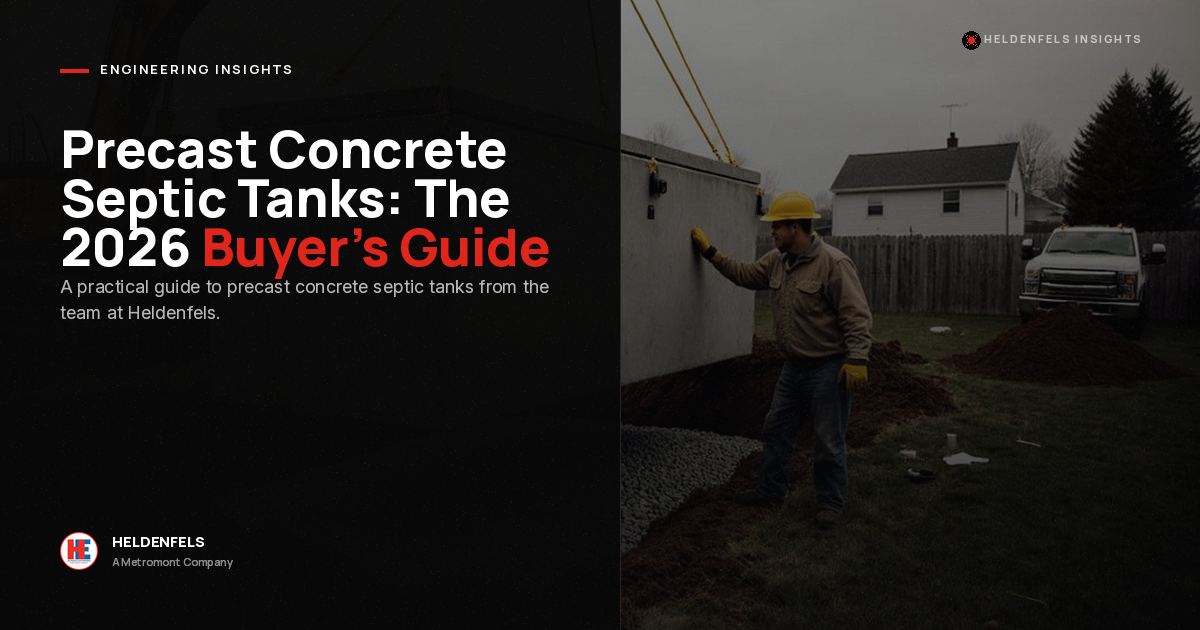
Precast Concrete Septic Tanks: The Proven Buyer’s Guide for 2026
Why these tanks keep outlasting plastic and fiberglass, what installation actually requires, how to size them correctly, and what they really cost over a fifty-year service life.
When a property needs a wastewater system that holds up for half a century or more, precast concrete septic tanks are the option installers, engineers, and county permitting offices keep coming back to. They are heavier, stiffer, and more chemically resilient than plastic or fiberglass alternatives, and the controlled casting process that produces them is essentially the same process that produces the structural elements holding up bridges, parking garages, and equipment platforms. This guide walks through how these tanks are built, what proper installation looks like, how to size them for the site, what they cost across their actual service life, and how to evaluate the precaster before signing a contract.
Why Precast Concrete Septic Tanks Outperform Plastic and Fiberglass
The three materials most often considered for an on-site wastewater system, concrete, fiberglass, and high-density polyethylene, all do the same job in principle: they hold sewage long enough for solids to settle and effluent to leave for the drain field. In practice, the long-run performance of each material is very different. Concrete has roughly four times the density of polyethylene, which matters enormously in saturated soils where lighter tanks can float, lift, and crack their inlet plumbing. Concrete walls do not deform under lateral earth pressure, which keeps the internal baffles and outlet tees in their designed positions decades after backfill. And the mineral surface of concrete resists the swelling and stress-cracking that plastic tanks develop over time when exposed to detergents and aggressive groundwater chemistry.
The U.S. Environmental Protection Agency estimates that more than one in five American households relies on a private septic system, and concrete has remained the dominant material for those installations for the better part of a century. Industry data consistently shows precast tanks lasting forty to sixty years or longer in well-maintained systems, compared with twenty to thirty for many polyethylene units. For a buyer thinking past the first cost line on the invoice, that lifespan difference is the entire economic story.
Won’t Float in Wet Soils
Concrete weighs roughly 8,000 to 12,000 pounds empty for a 1,000-gallon tank. Plastic equivalents weigh under 300 pounds. When the water table rises after heavy rain, weight is what keeps the tank anchored.
Holds Its Shape Under Load
Reinforced walls and a monolithic top slab resist the lateral pressure of backfilled soil and the vertical load of a vehicle passing overhead. No oval deformation, no separation at the inlet baffle.
Chemically Resilient
The cement matrix shrugs off the surfactants, fats, and household cleaners that slowly degrade plastic. Hydrogen sulfide gas in the headspace can erode unprotected concrete, but modern mixes and coatings address that directly.
Non-Combustible and Inspector-Friendly
Permitting offices in most counties have decades of approved-plan history for concrete tanks. Inspectors recognize the components, fittings, and access risers, which speeds final sign-off on the septic permit.
How Precast Concrete Septic Tanks Are Manufactured
A modern precast plant produces these tanks the same way it produces structural elements destined for commercial construction. The forms are heavy steel, machined to tolerances that keep wall thicknesses within a quarter inch across the production run. A reinforcing steel mat, typically 6-by-6 inch grade-60 welded wire fabric with additional rebar at the corners and at the top slab penetrations, is positioned in the form before any concrete is placed.
The mix design itself is engineered for low permeability rather than just compressive strength. A water-to-cement ratio in the 0.40 to 0.45 range, combined with a well-graded aggregate and often a pozzolan such as fly ash or slag cement, produces a dense matrix that resists the slow penetration of effluent and gas. Standard ASTM C1227 governs the structural and material requirements; quality plants regularly test cylinders for the specified 4,000 to 5,000 psi compressive strength at twenty-eight days.
Once cast and cured, each tank is stripped from the form, finished, and pressure-tested or vacuum-tested for water tightness before it leaves the yard. The same casting beds, the same QA cycle, and the same documented mix designs are what underpin Heldenfels’ broader precast manufacturing capabilities for structural projects. The discipline that produces a watertight wastewater tank is the same discipline that produces a structural beam.

Inside the precast plant: a 1,500-gallon tank is stripped from its steel form after curing. The same casting and QA discipline applies to structural precast.
Installation Requirements: What Actually Happens on Site
Installation begins long before the tank arrives. The site needs a percolation test to confirm soil suitability, a survey to establish setback distances from wells, property lines, and surface water, and an approved permit drawing showing the tank location, drain field, and any required pump or distribution box. Most jurisdictions require a minimum of fifty feet from a private well and ten feet from a foundation, with larger separations in wellhead protection areas.
The excavation itself needs to be sized for at least one foot of clearance on every side of the tank for backfill and compaction. The base is critical: four to six inches of compacted, well-graded crushed stone or coarse sand provides a level bearing surface and drainage layer. A tank set on disturbed native soil, or worse on a frozen mound, will settle unevenly and crack the inlet plumbing within the first few seasons.
Setting the tank is a crane operation. A 1,500-gallon unit can weigh eight to twelve tons depending on wall thickness, so the rigging, lift points, and ground bearing for the crane outriggers all have to be planned. The tank is leveled within a quarter inch across the inlet-to-outlet span, the inlet and outlet baffles are inspected, the riser collars and access lids are sealed to the top slab, and the inlet and outlet plumbing is connected with flexible boots rather than rigid joints. Backfill is placed in lifts and compacted, with no rocks larger than two inches against the tank walls. The same fundamentals, level base, controlled lifts, sealed penetrations, govern Heldenfels’ precast equipment foundations for industrial sites.
Sizing, Capacity, and Configuration
Sizing is the single most consequential decision in the system. Undersized tanks fail prematurely because solids don’t have time to settle before effluent moves on to the drain field, which then clogs and shortens the life of the entire system. The International Residential Code and most state environmental codes base minimum tank size on the number of bedrooms in the home, with 1,000 gallons for one to three bedrooms, 1,250 for four, and 1,500 for five.
Modern residential installations almost universally use a two-compartment design. The first compartment, typically two-thirds of the total volume, captures the bulk of the settleable solids and floating scum. The second compartment polishes the effluent before it leaves through the outlet baffle. Two-compartment tanks measurably reduce the suspended solids reaching the drain field, which extends drain field life and reduces the long-term cost of the system.
- 1,000 gallon: 1 to 3 bedrooms, typical residential default
- 1,250 gallon: 4 bedrooms or homes with high-flow fixtures and large soaking tubs
- 1,500 gallon: 5 bedrooms or properties with frequent guests, in-law suites, or laundry-heavy uses
- 2,000 to 5,000+ gallon: small commercial sites, multi-family, agritourism, and rural restaurants, often paired with pump chambers
Commercial and multi-family installations require a flow calculation rather than a bedroom count. The general rule of thumb is to size the tank for one and a half times the projected daily flow, providing the retention time needed for solids separation under design loading.
Long-Term Durability: What Fifty Years Looks Like
Concrete continues to gain strength for years after it cures. A tank cast to 4,500 psi at twenty-eight days will measure substantially higher at five years and beyond. The walls, typically three to four inches thick with a steel mat, are engineered to outlast the home they serve. The two failure modes worth understanding are hydrogen sulfide corrosion at the gas zone just above the waterline, and joint or penetration leakage at risers and inlets.
Hydrogen sulfide gas forms naturally as anaerobic bacteria break down sewage. The gas dissolves at the concrete surface and slowly converts to sulfuric acid, which etches the cement matrix. Two modern responses keep this in check: a denser, lower-permeability mix design that physically slows the chemistry, and a sacrificial coating or calcium-aluminate liner in the headspace for high-loading applications. For typical residential flows, neither is usually necessary, but for commercial septic tanks handling restaurant or food-processing waste, both should be specified.
Riser and penetration leakage is almost always an installation issue rather than a manufacturing one. Properly sealed access risers with butyl rubber or polyurethane gaskets, and flexible boot connectors at the inlet and outlet, eliminate this category of problem. Pumping the tank every three to five years removes accumulated solids before they migrate into the drain field, and that single maintenance habit is responsible for most of the difference between a thirty-year system and a sixty-year one.
Real Cost Over the System’s Lifetime
Sticker-shock comparisons between concrete and plastic tanks usually ignore the long-term math. A residential precast tank in the 1,000 to 1,500-gallon range typically runs $1,500 to $3,500 delivered, depending on local hauling distance and lid configuration. A polyethylene tank of equivalent capacity often lands between $900 and $1,500. On day one, plastic looks cheaper by a thousand dollars or more.
| Factor | Precast Concrete | Fiberglass | Polyethylene |
|---|---|---|---|
| Typical Service Life | |||
| Resists Soil Flotation | |||
| Structural Stability | |||
| Upfront Installed Cost | |||
| Cost per Year of Service |
Spread across an honest service life, the cost per year tells a different story. Add the cost of replacement excavation, drain-field disturbance, and permitting on a tank that fails in year twenty-five, and concrete becomes the cheaper option, not the more expensive one. Home appraisers and inspectors recognize this, which is why concrete tanks tend to be a non-issue at resale while older plastic tanks frequently surface as a buyer concern.
The most consequential decision in any septic project happens before the tank shows up. Sizing it to actual household or commercial flow, specifying a two-compartment design, and insisting on a compacted aggregate base will determine more of the system’s eventual lifespan than the brand name on the side of the tank.
How to Evaluate a Precast Manufacturer
Not every concrete tank coming off a flatbed is built to the same standard. A few questions sort the serious manufacturers from the rest.
Plant Certification and Standards
Look for plants certified under the National Precast Concrete Association (NPCA) program or that operate to ASTM C1227. Certified plants follow documented procedures for mix design, reinforcement placement, curing, and dimensional QA. Without that paper trail, you’re trusting word of mouth on the most important variables.
Logistics and Delivery
These tanks are heavy. Hauling cost compounds quickly with distance, and most precasters serve a delivery radius of one hundred to two hundred miles before freight becomes the dominant line item. Ask the supplier about their delivery footprint, their lift equipment, and whether they coordinate with the site installer on arrival timing.
Customization and Configuration
Standard residential tanks are inventory items. Anything non-standard, oversized capacity, custom inlet locations, pump chamber integration, knock-out penetrations for specific drain field layouts, requires a manufacturer comfortable working from project-specific shop drawings. Plants that produce structural precast for commercial work generally have this capability built in.
The Bottom Line on Precast Concrete Septic Tanks
For nearly every site condition outside of remote, no-crane-access locations, a properly sized and installed concrete tank is the lowest-risk, longest-service-life option available. The upfront premium over plastic is real but small relative to the cost of replacing a tank twenty-five years from now, and the structural and chemical resilience of concrete simply doesn’t have an equivalent in alternative materials at residential price points.
The decisions that matter most are made before the tank is poured: correct sizing for actual flow, a two-compartment design, an experienced installer who knows the bedding and backfill discipline, and a manufacturer with the certifications and engineering depth to back the product. Get those four right, and the system will quietly do its job for the next half-century.
Planning a Precast Project?
Whether the project is a residential tank, a commercial wastewater installation, or structural precast for a larger build, our team can talk through sizing, specifications, and lead times for your site.
Start the Conversation →