
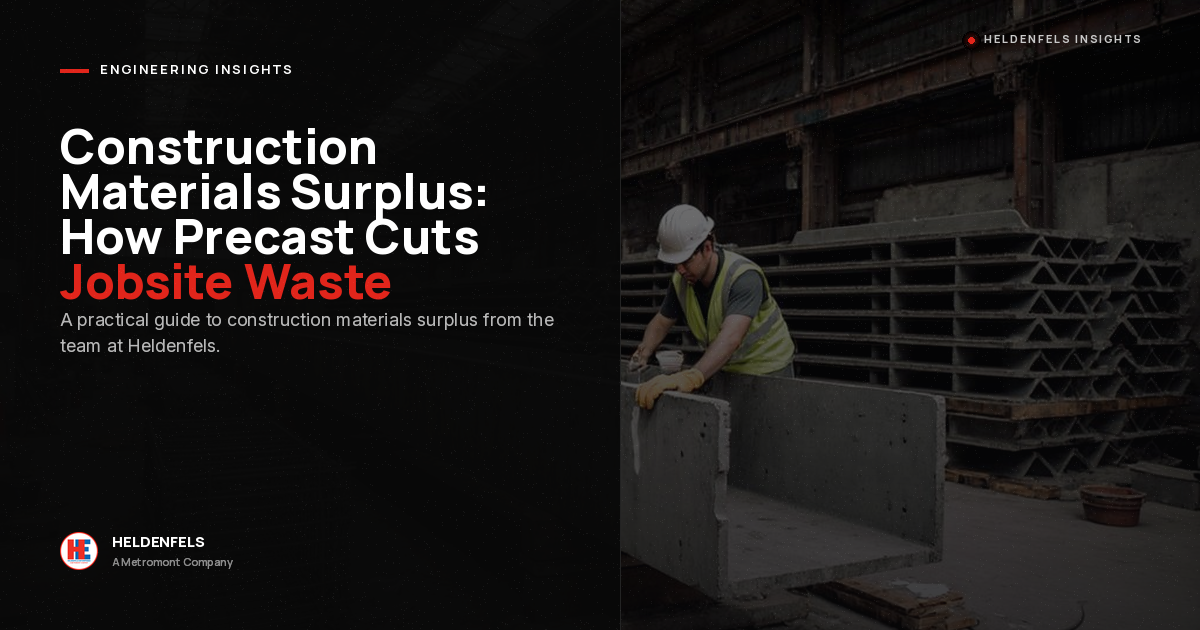
Construction Materials Surplus: How Precast Manufacturing Cuts Jobsite Waste
Leftover lumber, over-ordered block, and rain-ruined pallets are not just clutter. They are purchased money headed for a dumpster. Here is how moving the work into a controlled plant designs most of that waste out before the first yard of concrete is mixed.
Walk past almost any active jobsite and you will spot the same picture: a dumpster spilling over with cut lumber, a stack of pallets nobody quite remembers ordering, and half a load of block slowly weathering in the rain. That leftover pile has a name in the trade. It is construction materials surplus, and it represents money that was quoted, purchased, delivered, and then thrown away. Multiply it across every project running in the country right now and the scale is genuinely staggering. At Heldenfels, we have spent more than a century (we started in 1909) watching exactly where materials go to waste, and the single biggest lever we have found is deceptively simple: move the work off the open jobsite and into a controlled plant. Precast concrete manufacturing does not clean up surplus after the fact. It engineers most of it out of the process entirely.
In This Guide
Where Construction Materials Surplus Really Comes From
Before you can reduce waste, it helps to be honest about where it originates. On a conventional site, construction materials surplus is rarely the result of carelessness. It is baked into how site-built work has to be ordered and managed.
The first source is the buffer. When a crew is framing, forming, and pouring in the open air, nobody wants to shut the job down waiting on a short delivery, so estimators pad the order. Extra lumber, extra rebar, extra bags of mix, all bought as insurance. Whatever the crew does not consume becomes surplus. The second source is single-use formwork. Traditional cast-in-place work builds temporary wood forms, pours into them, then strips and often discards the lumber after a handful of uses. The third is the weather itself: stored drywall, insulation, and bagged material that sits in the rain or sun until it is no longer usable. Add off-cuts, damaged deliveries, and the rework that follows field measurement errors, and the pile grows fast.
None of this is trivial in aggregate. Federal environmental data puts construction and demolition debris in the United States at more than 600 million tons a year, more than twice the volume of everyday household trash, according to the U.S. Environmental Protection Agency. A meaningful share of that is not demolition at all. It is brand-new material that was ordered and never installed.
How Precast Manufacturing Designs the Waste Out

In the plant, each element is batched to a known volume and cast into a reusable steel form, so spillage and over-order are engineered out.
Start with formwork, the biggest single difference. Instead of building throwaway wood forms on every job, our precast manufacturing capabilities rely on precision steel and fiberglass molds that are cleaned, re-oiled, and cast again hundreds of times. One form serves dozens of projects across its life. The lumber that would have been stripped and dumped on a site simply never enters the equation.
Next is batching. Concrete in the plant is proportioned by computer-controlled equipment to a known volume for each specific element, not eyeballed and topped off by the truckload. The little concrete that is left over does not harden in a chute and go to landfill. It is captured, and the aggregate and process water are reclaimed through a washout system and cycled back into the next mix. Reinforcing steel follows the same logic: bars are cut and bent to a nested schedule that minimizes off-cuts, and the scrap that does result is fully recyclable rather than jobsite trash.
Then there is the roof over everything. Manufacturing indoors, under temperature and humidity control, removes the weather losses that plague outdoor storage. Nothing warps, rusts prematurely, or dissolves in a downpour before it can be used. Just as important, the controlled setting holds every component to tight, repeatable tolerances. When a piece arrives on site machined to spec, it fits the first time, which eliminates the cut-to-fit rework that quietly generates a surprising amount of surplus on conventional jobs. These same disciplines carry directly into large industrial construction projects, where a single rework loop can waste both material and weeks of schedule.
| Waste source | Traditional on-site build | Precast plant |
|---|---|---|
| Formwork | Wood forms, few reuses, often discarded | Steel & fiberglass molds reused hundreds of times |
| Material ordering | Padded to buffer against site delays | Batched to exact element volume |
| Leftover concrete | Hardens in chutes and truck drums | Aggregate and water reclaimed and reused |
| Weather loss | Stored material exposed to rain and sun | Produced indoors, climate controlled |
| Rework | Field cut-to-fit, measurement errors | Tight tolerances, fits first time |
| Steel off-cuts | Scattered scrap, mixed into debris | Nested cutting, scrap recycled |
Buying to a Schedule, Not to a Guess
There is a subtler benefit hiding inside all of this. Because components are made to a production schedule and shipped in the sequence the crew will install them, the site receives only what it needs for the work directly ahead. There is no need to stockpile a month of material in a muddy laydown yard where it can be damaged, stolen, or forgotten. The just-in-time rhythm that precast makes possible is one of the most effective ways to keep a surplus pile from ever forming, because the material shows up, goes up, and is gone.
Turning Surplus Into a Resource, Not a Landfill Problem

Elements are staged and shipped in erection sequence, so the jobsite never has to stockpile a surplus that weathers and goes to waste.
Reducing construction materials surplus is only half the story. The material that a plant does part with tends to be recovered rather than buried. Concrete that is returned, tested out, or trimmed can be crushed and reground into aggregate for road base and future mixes. Steel scrap goes back into the recycling stream at essentially full value. Process water runs in a closed loop rather than down a drain. The goal is a workflow where very little leaves the gate as true waste in the first place.
Durability compounds the effect over a much longer horizon. A precast structure engineered for a long service life is a structure that does not have to be torn out and rebuilt in a generation, which is the single largest avoided source of future debris. If you want to dig into that side of the equation, we cover it in detail in our guide to how precast concrete is sustainable and why the material keeps earning its place on long-horizon builds. Building it once, and building it to last, is the ultimate form of waste reduction.
The cheapest material to dispose of is the one you never had to buy, store, or throw away. Precast wins on surplus not because anyone is more careful, but because a controlled process gives waste far fewer places to appear.
What Lower Surplus Means for Your Budget and Schedule
Tighter budgets
Material you never over-order is material you never pay for, and disposal fees for surplus debris shrink alongside the pile. The savings land in the estimate, not the dumpster.
Faster schedules
Off-site fabrication runs in parallel with site prep, and components that fit first time remove the rework loops that stall conventional pours. Fewer surprises, fewer delays.
Safer, cleaner sites
A site that is not buried under surplus stockpiles and offcut piles is a site with fewer trip hazards, cleaner access lanes, and less material handling for crews to manage.
Predictable outcomes
Plant-controlled quality means what you specified is what arrives. That predictability is what lets owners commit to a budget and a delivery date with real confidence.
The Bottom Line on Construction Materials Surplus
Surplus is not a mystery, and it is not inevitable. On a conventional site it is the predictable result of buying against uncertainty, forming with throwaway lumber, and storing material in the weather. Precast concrete manufacturing attacks every one of those root causes at once by moving the work into a controlled plant where forms are reused, mixes are measured, off-cuts are recycled, and finished pieces arrive in the exact sequence they are installed.
The result is a build that costs less to feed, moves faster, and sends far less brand-new material to a landfill. For any team weighing how to keep a project lean, reducing construction materials surplus at the source is one of the most reliable wins available, and it is exactly the kind of resource efficiency we have been refining since 1909.
Building Something Big? Let’s Keep It Lean.
Heldenfels turns precast precision into less waste, tighter budgets, and predictable schedules. Tell us about your project and we will show you where the surplus disappears.
Start the Conversation →