
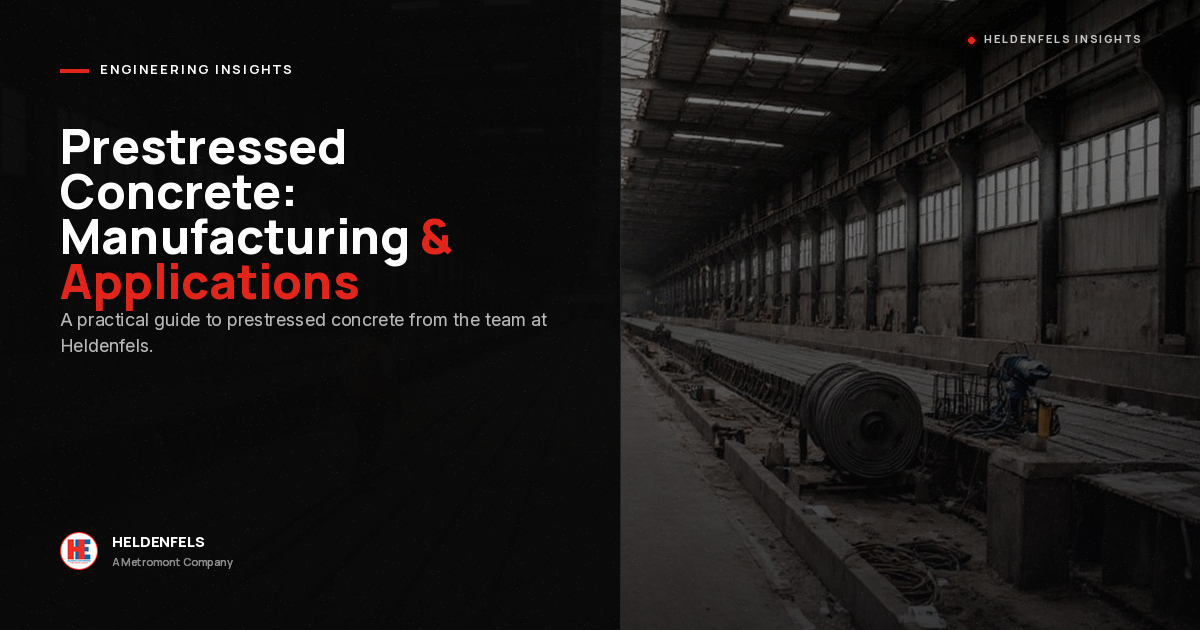
Prestressed Concrete: Expert Guide to Manufacturing and Applications
What it actually is, how it gets made on the casting bed, why it beats ordinary reinforced concrete, and where it earns its place in modern structures.
In This Guide
Ask a structural engineer what makes today’s long-span bridges, slim parking decks, and tall building floors possible, and the answer almost always comes back to prestressed concrete. At Heldenfels Enterprises, we have spent decades manufacturing it at our San Marcos, Texas plant, and we hear the same question from owners, contractors, and curious site visitors alike: what exactly is prestressed concrete, how is it made, and why does it outperform the ordinary reinforced concrete most people picture when they think of the material? This guide answers all three, from the simple physics behind the idea to the casting bed where strands are stretched, all the way to the finished structures it makes possible.
What Is Prestressed Concrete?
Prestressed concrete is a structural material in which internal compression is deliberately built into a member before it ever carries a load. To understand why that matters, start with a basic property of concrete: it is enormously strong in compression but weak in tension. Pull on it, and it cracks at a fraction of the force it can withstand when pushed. Steel is the opposite, with excellent tensile strength. Conventional reinforced concrete simply embeds steel bars where tension is expected and lets the steel take over once the concrete cracks.
Prestressing takes a smarter approach. Instead of waiting for cracks, engineers stretch high-strength steel strands or tendons and lock that tension into the concrete. When the stretching force is released, the strands try to return to their original length and squeeze the surrounding concrete into a permanent state of compression. That built-in squeeze counteracts the tensile stresses a beam or slab will later experience under its own weight, traffic, wind, or stored loads. The result is a member that resists bending without cracking, deflects less, and uses material far more efficiently.
Think of it like a row of books carried under your arm. Press the ends together hard enough and the whole row lifts as one rigid unit, even though nothing connects the individual books. Relax the pressure and they sag and fall apart. The compression is what gives the row its strength, and that is precisely what prestressing does to a concrete element.
How Prestressed Concrete Is Manufactured
Pretensioning: Tension First, Then Cast
Pretensioning is the workhorse of plant-based precast production, and it is how the majority of our standard products are made. The process runs along a long casting bed, often several hundred feet, anchored by heavy abutments at each end. High-strength seven-wire steel strands are threaded down the length of the bed and stretched with hydraulic jacks to a precise, calculated force, sometimes tens of thousands of pounds per strand.
With the strands held under tension, crews place reinforcing cages, set the side forms, and cast the concrete directly around the live strands. The member then cures under controlled conditions until it reaches a specified release strength. Only then are the strands cut free at the ends. As they relax, friction and bond transfer their pull into the concrete as compression. Because the bed can be hundreds of feet long, a single pour can yield several members at once, which is a major reason pretensioned production is so efficient.

Inside the forms: concrete placed around the reinforcing cage and the live strands, the heart of pretensioned production.
Post-Tensioning: Cast First, Then Tension
Post-tensioning flips the sequence. The concrete is cast first with hollow ducts cast into it, following the path the tendons will take. After the concrete hardens and gains strength, strands are threaded through the ducts and stretched against the now-solid member itself, then anchored at the ends. The ducts are typically grouted afterward to protect the steel from corrosion.
This method shines where members are too large to ship, must be tensioned in place, or need a curved tendon profile to match a complex load path. Cast-in-place bridge segments, large transfer beams, and post-tensioned floor slabs all rely on it. Many projects combine both methods, using pretensioned components delivered from the plant alongside post-tensioned connections made on site.
Pretensioning vs. Post-Tensioning at a Glance
| Factor | Pretensioning | Post-Tensioning |
|---|---|---|
| When steel is stressed | Before concrete is cast | After concrete hardens |
| Where it happens | Controlled precast plant | Plant or on the job site |
| Tendon path | Typically straight | Straight or curved (draped) |
| Best suited for | Repetitive standard members | Large or cast-in-place elements |
| Typical products | Piles, girders, double tees, panels | Transfer beams, slabs, bridge segments |
Why It Outperforms Ordinary Reinforced Concrete
The difference between prestressed and conventional reinforced concrete is not a minor refinement, it is a fundamentally different way of using the same two materials. Because compression is engineered in from the start, the member works harder and smarter under load. For a closer comparison, our team has written about how prestressed beams differ from reinforced concrete beams in detail. The headline advantages show up on nearly every project.
Longer, Slimmer Spans
By neutralizing tension before it can crack the section, the system carries the same load over a longer distance with a thinner profile. That means fewer columns, more open floor plans, and lighter structures overall.
Crack Control & Durability
Keeping the concrete in compression closes the micro-cracks that let water and chlorides reach the steel. Less cracking means slower corrosion, less spalling, and a longer service life with minimal maintenance.
Material Efficiency
High-strength strand and concrete do more with less. Using less raw material per unit of capacity trims weight, lowers shipping and foundation costs, and reduces the embodied carbon of the structure.
Factory Quality & Speed
Casting in a controlled plant rather than the open site yields consistent strength, tight tolerances, and members that arrive ready to erect, compressing the construction schedule dramatically.
Those gains compound. A slimmer girder reduces the dead load the foundation has to carry, which can shrink the foundation itself. Tighter crack control extends the maintenance interval, which lowers lifecycle cost. Faster erection shortens the schedule, which cuts financing and overhead. Each advantage feeds the next, which is why owners increasingly specify the material on schedule-driven and durability-critical projects.
Where It Delivers the Most Value
Deep foundations. Driven piles take a brutal beating during installation and spend their lives in soil and water that punish ordinary concrete. The built-in compression helps resist driving stresses and aggressive environments alike, which is why prestressed concrete piles are a foundation standard for bridges, piers, and waterfront structures, routinely outlasting timber and steel in the kind of demanding ground conditions that quickly degrade lesser materials.
Bridges. The long, clean spans of modern highway and pedestrian bridges are a showcase for the material. Our prestressed bridge girders carry traffic loads across distances that would otherwise demand far more piers, and they arrive at the site ready to set, shrinking the time crews spend working over live roadways or water.

A finished girder, cast and cured at the plant, lifted into position over the lanes below in a single crane pick.
Buildings and industrial walls. Double tees, hollow-core planks, and wall panels let architects open up floor plans and enclose buildings quickly. Prestressed concrete wall panels in particular deliver structure, insulation, and finish in a single component, as we explain in our look at why these panels suit modern industrial walls. Parking structures, stadiums, and data centers all lean on the same span-and-speed advantages.
The standards that govern how these members are designed, produced, and certified come from the Precast/Prestressed Concrete Institute (PCI), whose plant certification programs are the benchmark we hold our own production to.
The Bottom Line
Prestressed concrete is not a different material so much as a smarter way to use concrete and steel together. By locking compression into a member before it carries a load, engineers turn a brittle material into one that spans farther, cracks less, lasts longer, and goes up faster. Whether the tension is introduced before the pour on a long casting bed or after the concrete hardens through post-tensioning, the goal is the same: put the steel and the concrete to work in the conditions where each performs best.
That is the quiet logic behind so much of the infrastructure around us, from the piles below the waterline to the girders carrying the lane overhead. Understanding it makes the difference between specifying a structure that merely stands and one that performs for generations.
Planning a Project With Precast?
Heldenfels Enterprises has manufactured prestressed and precast components for Texas infrastructure for decades. Tell us about your spans, loads, and schedule, and we will help you build it right.
Start the Conversation →