
Construction Materials Tester: A Complete, Proven Guide to Essential Precast Quality Control
Behind every precast girder, pile, and wall panel is a battery of tests that decide whether a part ships or gets scrapped. Here is how the testing works, which standards define pass or fail, and why a factory setting makes the difference.
In This Guide
What a Construction Materials Tester Does
A construction materials tester is the person who proves, with numbers rather than assumptions, that a concrete component is strong enough and built accurately enough to do its job for decades. In a precast plant, that work happens long before anything leaves the yard: sampling fresh concrete at the casting bed, breaking hardened cylinders in a compression machine, measuring finished parts against the shop drawings, and signing off only when the data clears the specification. The role is part lab technician, part inspector, part recordkeeper, and it is the quiet backbone of structural safety.
The job matters because concrete is unforgiving. A beam that is a few hundred PSI short of its design strength, or a strand that sits a half inch out of position, will not announce the problem on delivery day. It will reveal it years later under load, when correcting it is expensive or dangerous. Catching those issues on the plant floor, while a part can still be repaired or recast, is the entire point. As an experienced precast concrete company, our team treats testing as a condition of production, not a formality tacked on at the end.
The Core Tests Behind Precast Quality Control
Fresh concrete sampling
Before a single element hardens, the tester pulls samples straight from the pour. A slump test gauges workability, because concrete that is too stiff will not consolidate around the reinforcement and concrete that is too wet loses strength. Air content is measured to confirm the mix will resist freeze and thaw cycles, and temperature is logged because it drives how the material cures. These few minutes at the casting bed set the baseline for everything that follows.

A slump test on fresh concrete at the casting bed, the first checkpoint in precast quality control.
Compressive strength
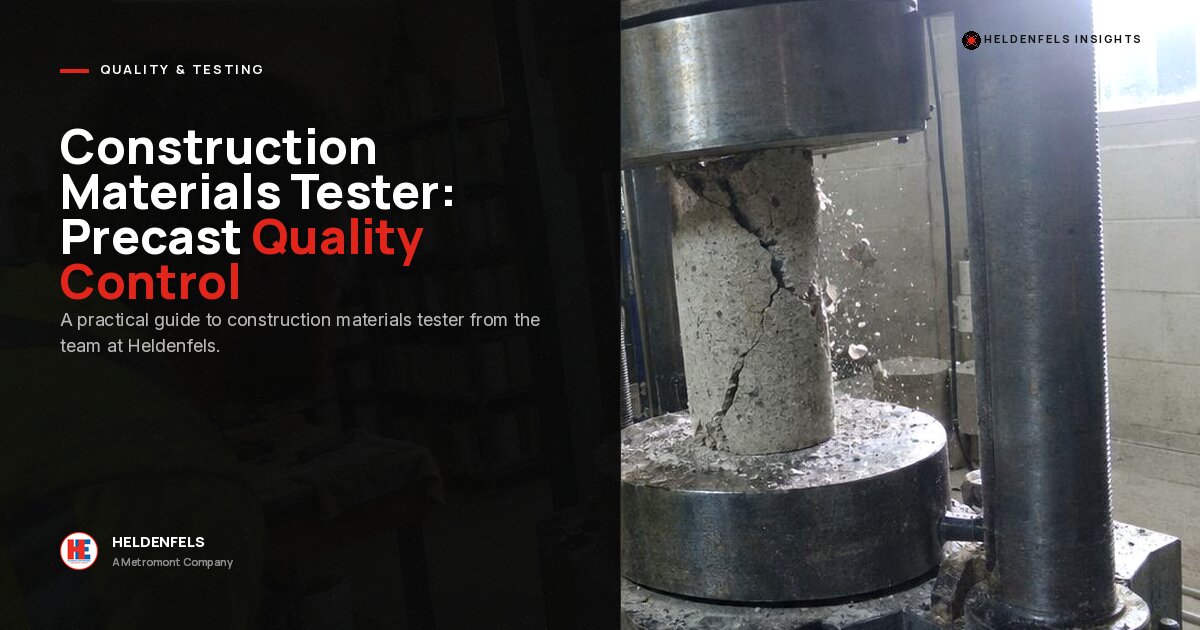
The headline number for any concrete is how much compression it can take, reported in pounds per square inch. The tester casts cylinders from the same batch as the production element, cures them alongside it, and crushes them in a compression machine. Two moments matter most: the release strength, which must be reached before a prestressed element can be stripped and detensioned, and the 28 day strength that confirms the part met its full design value. A cylinder that fractures below the required load stops the part from shipping.
Dimensional and cover checks
Strength means nothing if the geometry is wrong. Once an element is stripped, the tester measures it against the drawings: overall length, camber, squareness, and the position of every embed and connection. A cover meter confirms the reinforcement and strand sit at the specified depth, because steel too close to the surface will corrode and steel too deep will not develop its strength. On precast, tolerances are tight, often within an eighth of an inch, so the part fits its neighbors perfectly on site.

Dimensional and cover verification on a stripped bridge girder before it is cleared for release.
Prestressing force
In pretensioned products, the strands are tensioned before the concrete is cast, and that force is what gives the finished member its remarkable span and crack resistance. The tester verifies the jacking force and strand elongation against the engineered values, confirming the part will carry the loads it was designed for. Get this wrong and a girder loses the very advantage that justified choosing precast in the first place.
Slump & Air
Workability and freeze-thaw durability, checked on fresh concrete at the pour.
Cylinder Breaks
Release and 28 day compressive strength in PSI, the go or no-go on structural capacity.
Dimensions & Cover
Length, camber, embeds, and reinforcement depth measured against the shop drawings.
Prestress Force
Jacking force and strand elongation verified against the engineered design values.
Standards That Define Pass or Fail for a Construction Materials Tester
A test only means something when it is run to a published method and judged against a published limit. That is why a construction materials tester works to national standards rather than house rules. Test methods come largely from ASTM International, which specifies exactly how a cylinder is cast, cured, and crushed so that a result from one lab means the same thing in another. Structural acceptance criteria trace back to the design codes, and transportation work adds state and federal bridge specifications.
For plants, the benchmark that ties it all together is certification. Many producers, including our own operation, hold plant certification through the Precast/Prestressed Concrete Institute, an independent program that audits whether the testing, documentation, and personnel actually meet the standard they claim. It is the difference between a plant saying its parts are good and a third party verifying it. These same quality disciplines carry through to our precast concrete work in highway and bridge construction, where the acceptance bar is highest.
| What Is Checked | Why It Matters | When |
|---|---|---|
| Slump | Confirms the mix will consolidate around reinforcement | At the pour |
| Air content | Freeze-thaw durability over the service life | At the pour |
| Release strength | Element is strong enough to strip and detension | Early cure |
| 28 day strength | Full design capacity confirmed | After cure |
| Dimensions & cover | Fit on site and corrosion protection | After stripping |
| Prestress force | Span, camber, and crack resistance as designed | Before casting |
Why Factory Testing Beats Field Guesswork
Concrete poured on a job site is at the mercy of the weather, the schedule, and whatever conditions the day delivers. Precast flips that equation. Every element is cast indoors on a controlled bed, cured under managed temperature, and tested in a dedicated lab steps from where it was made. The same person who sampled the pour can break its cylinders and measure the finished part, which closes the loop between what went into the mix and what came out of the mold.
That control is also what makes modern accelerated bridge construction possible. When components are fabricated and fully tested off site, they arrive ready to set, so crews spend hours rather than weeks working over live traffic or water. The testing does not slow the project down; it is precisely what lets the field work move so fast, because nothing reaches the site until it has already passed. Our precast manufacturing capabilities span bridge girders to structural wall panels, all held to the same lab-verified standard. The logic is simple: verify quality once, at the source, instead of paying to fix it in the field.
A failed cylinder on the plant floor is a good day. It means the process caught a problem while the part could still be recast, instead of letting it travel to a bridge deck where the only options left are expensive ones.
The Paper Trail That Proves It
Testing is only half the job. The other half is proof. Every sample, break, and measurement is logged and tied to the specific element and the batch it came from, so any part can be traced back to the exact data that cleared it. If a question ever surfaces years into service, the record exists to answer it. That traceability is what lets an owner, engineer, and inspector trust a component they will never personally test, and it is a core reason precast earns its reputation for reliability.
Good records also make the whole operation better over time. Patterns in the data, a mix that trends low on a hot week, a mold that drifts out of tolerance, surface early and get corrected before they become rejects. In that sense the construction materials tester is not just a gatekeeper but a feedback loop for the plant, turning thousands of individual measurements into steadily higher consistency.
The Bottom Line
Precast concrete looks simple from the outside: a part shows up, a crane sets it, and the structure goes together fast. What that smoothness hides is the testing behind every piece, the work that turns raw material into a component an engineer can sign off without a second thought.
The construction materials tester is the one who makes that trust earnable. Pair rigorous, standards-based testing with the control of a certified plant, and quality stops being a hope and becomes a measured, documented fact, element after element, project after project.
Building Something That Has to Last?
Heldenfels Enterprises backs every precast component with certified testing and full documentation. Let’s talk about the quality standards your project demands.
Start the Conversation →