

Understanding Concrete Culvert Costs: What Really Drives the Price?
Concrete culvert costs may seem simple at first, but real project estimates depend on more than size and linear footage.
Concrete culvert costs may seem simple at first, but real project estimates depend on more than size and linear footage. The final price can change based on culvert type, hydraulic design, load requirements, excavation depth, soil conditions, traffic control, bedding, backfill, delivery, lifting, and end treatments. For Texas contractors, engineers, developers, and public owners, culverts should be priced as part of a full drainage system because a private entrance, county road crossing, and highway box culvert all have very different cost requirements.
That distinction matters for infrastructure work. Heldenfels Enterprises specializes in precast and prestressed concrete structures for highway, bridge, marine, industrial, and commercial construction. Our transportation experience includes precast products engineered for Texas city, county, and state projects. While every culvert budget depends on project-specific design, the same practical lesson applies: the cheapest line item is not always the lowest-cost solution over the life of the structure.
What Are Concrete Culverts?
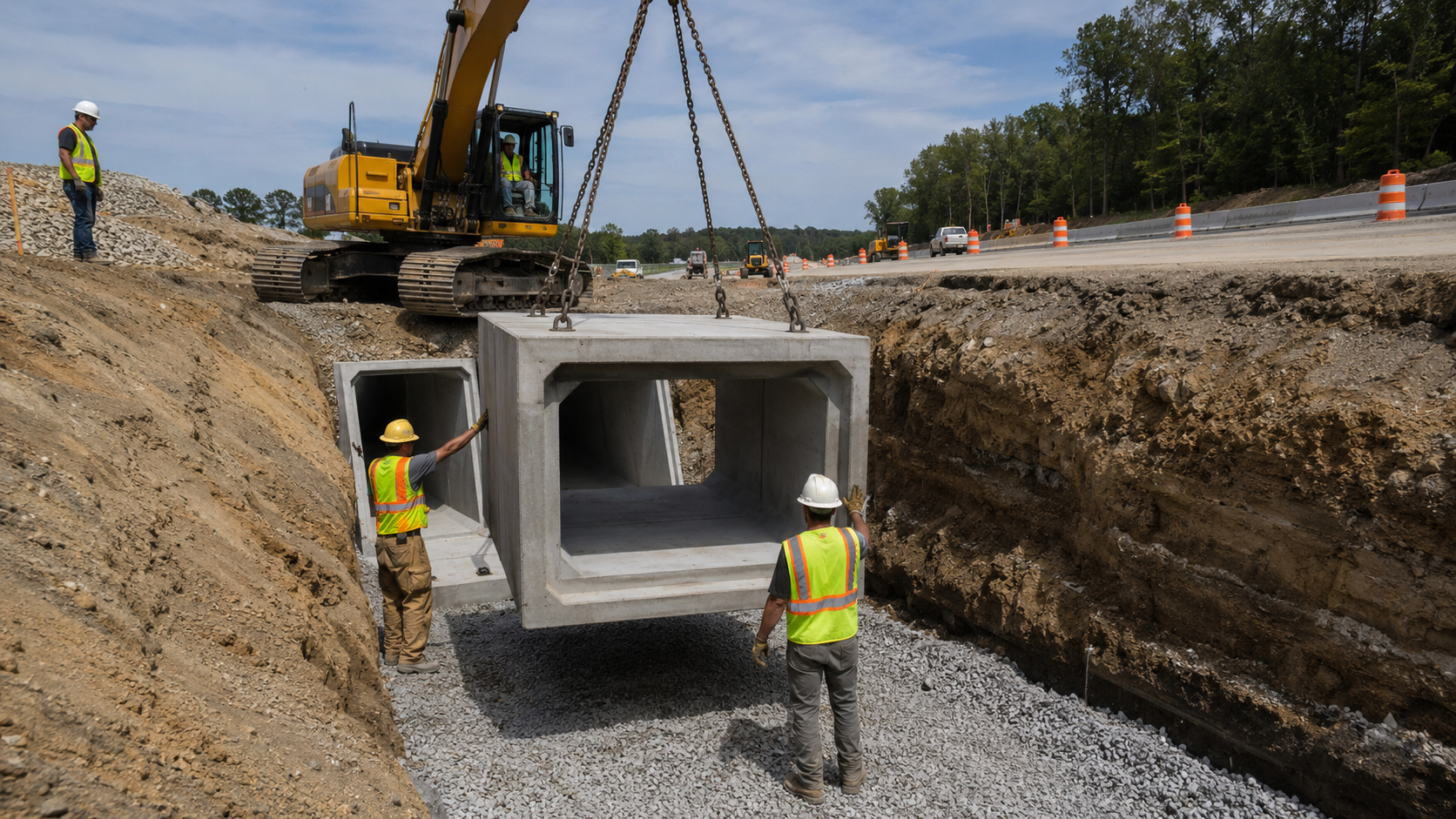
Concrete culverts are drainage structures that allow water to pass beneath roads, railways, driveways, industrial yards, and other built surfaces. They are used to move stormwater, creek flow, irrigation runoff, and site drainage while keeping the surface above open for traffic or operations.
Concrete culverts come in several forms, and the best choice depends on the project’s drainage needs, site conditions, and structural requirements:
- Reinforced concrete pipe: Commonly used for smaller crossings and storm drainage systems.
- Concrete box culverts: Often used when a project needs a larger hydraulic opening, shallow profile, or rectangular shape that fits the road grade or drainage channel.
- Custom precast drainage structures: Used for more specialized project conditions where standard pipe or box culverts may not fit the design requirements.
The structure type matters because concrete culvert costs are shaped by more than the concrete itself. A larger box culvert can require more reinforcement, heavier equipment, more excavation, wider staging areas, and stricter installation sequencing. A pipe culvert may be simpler in some locations, but it still needs proper bedding, alignment, jointing, backfill, and outlet protection.
Why Concrete Culvert Costs Vary So Much
There is no universal price for concrete culvert costs because every project depends on size, location, loading, hydraulic needs, and installation conditions. A small private driveway crossing is not priced the same way as a culvert beneath a public roadway carrying heavy truck traffic. Rural drainage projects also differ from urban replacements, where crews may need to manage traffic, protect utilities, work in tight spaces, and control water during construction.
Another issue is scope. Some estimates only include the supplied culvert. Others include delivery. Owners usually care about installed cost, which may include excavation, bedding, lifting, placement, backfill, compaction, headwalls, wingwalls, erosion control, traffic control, testing, and site restoration. If two quotes do not cover the same scope, the comparison is junk.
What Influences Concrete Culvert Costs?
Several factors can influence concrete culvert costs, and most of them go beyond the culvert itself. Size, structure type, loading demands, site conditions, installation quality, and erosion control all affect the final price. Understanding these cost drivers helps owners, engineers, and contractors build a more realistic budget instead of relying on a rough price-per-foot estimate.
1. Size and Hydraulic Capacity
Size is one of the biggest drivers of concrete culvert costs because larger pipes, taller boxes, wider spans, and multi-cell systems require more material and heavier handling. It is also a hydraulic decision, since the culvert must move expected water flow without causing flooding, roadway overtopping, or erosion. Undersizing a culvert to cut costs can create drainage problems that are far more expensive to fix later.
Here is the blunt version: if the culvert size was chosen because it “looked about right,” the estimate is weak. A culvert is not decoration. It is a hydraulic structure, and the right size should come from drainage analysis and project standards.
2. Culvert Type: Pipe, Box, or Custom Precast
The structure type has a major impact on concrete culvert costs because pipe, box, and custom precast options serve different project needs. Reinforced concrete pipe is often practical for smaller crossings, while box culverts are better for wider openings, shallow cover, or rectangular flow areas. Custom precast solutions may cost more upfront but can reduce field forming, curing time, and traffic disruption on complex projects.
For broader transportation infrastructure, our precast highway and bridge solutions show why controlled fabrication matters on demanding Texas projects. The same principle applies to drainage work: quality, schedule, installation practicality, and long-term durability all belong in the cost conversation.
3. Load Requirements and Design Standards
Load requirements can significantly affect concrete culvert costs because a farm road, highway, industrial access road, and port facility all place different demands on the structure. Heavier loads may require thicker walls, stronger concrete, added reinforcement, and greater cover depth. Choosing a cheaper culvert that cannot handle the required loading is not a savings move; it is a future failure risk.
4. Site Conditions and Excavation
Installation conditions can greatly affect concrete culvert costs because excavation depth, soil stability, groundwater, rock, utilities, and worksite access all change the scope. A shallow installation in stable soil is usually far less expensive than a deep installation near traffic, groundwater, or utility conflicts. Even when the culvert size is the same, difficult site conditions can make the installed cost much higher.
Poor soils may require over-excavation, stabilization, special bedding, geotextile, or additional compaction. Groundwater can require dewatering or bypass pumping. Rock excavation can slow production and increase equipment costs. These are not minor details; they can make or break the budget.
5. Bedding, Backfill, and Compaction
Bedding and backfill are critical to culvert performance because they support the structure once it is installed. If the bedding is uneven, the backfill is poor, or compaction is inconsistent, the culvert may settle, shift, crack, or fail. Concrete culvert costs should include proper installation materials and workmanship because cutting corners below grade can damage the road, driveway, or yard above it.
For public infrastructure, contractors also need to account for testing, inspection, and specification compliance. Those items may not look exciting on a bid sheet, but they protect the owner from expensive problems after the crew leaves.
6. End Treatments and Erosion Control
The culvert barrel is only one part of the full drainage system. Inlets, outlets, headwalls, wingwalls, aprons, riprap, safety end treatments, and erosion control can all affect concrete culvert costs. These features help control water, prevent scour, maintain capacity, and reduce future roadway maintenance problems.
In many cases, accessory work separates a durable drainage installation from a cheap installation that slowly falls apart. Owners should confirm whether these items are included in the estimate or left as future change orders.
Realistic Pricing: Use Texas Bid Data, Not Generic Guesswork
Generic online price ranges for concrete culvert costs are usually too broad to be useful. Some articles throw out national averages without saying whether the number includes material only, delivery, installation, excavation, traffic control, or end treatments.
For Texas projects, a better starting point is actual bid history. The Texas Department of Transportation provides bid item averages and historical bidding information that can help owners and contractors understand what reinforced concrete pipe and concrete box culvert items have recently cost in public work. TxDOT data should not be treated as a final quote for a private project, but it is more grounded than random national averages.
TxDOT statewide data has shown reinforced concrete pipe items priced by linear foot, with larger diameters generally costing more than smaller ones. Concrete box culvert items vary even more by dimensions and whether the work involves a new installation or extension of an existing culvert. That is exactly why pricing should be discussed by item type, size, scope, and site condition rather than by a single generic number.
Material Cost vs. Installed Cost
A common mistake in estimating concrete culvert costs is comparing only the material price instead of the full installed cost. The table below shows the difference:
| Cost Type | What It Means | What It May Include | Why It Matters |
|---|---|---|---|
| Material Cost | The price of the culvert component itself. | Reinforced concrete pipe, box culvert sections, or custom precast drainage components. | This is only one part of the total budget and does not show the full cost of completing the drainage system. |
| Installed Cost | The cost of placing the culvert correctly and leaving behind a functioning drainage system. | Engineering, survey, permits, demolition, excavation, bedding, dewatering, bypass pumping, crane work, traffic control, backfill, compaction, paving, erosion control, testing, and cleanup. | These supporting items can exceed the material cost on difficult sites. |
| Lifecycle Cost | The long-term cost of owning and maintaining the culvert system. | Maintenance, repair risk, traffic disruption, durability, replacement timing, and service life. | A cheaper product upfront may cost more later if it requires more labor, maintenance, or early replacement. |
How Precast Concrete Can Affect Project Value
Precast concrete is not always the cheapest option, but it can offer stronger value when quality control, speed, consistency, and reduced field work matter. Because precast components are made in a controlled environment, production is less affected by weather, site congestion, or schedule pressure. It can also shorten installation time by reducing the need for on-site forming, reinforcing, pouring, and curing.
That matters on transportation projects where delays create real costs. Lane closures, detours, equipment standby, and crew downtime all affect the budget. Our work with precast prestressed bridge girders reflects the same broader infrastructure advantage: controlled fabrication can support faster installation and dependable structural performance when schedules are tight.
When evaluating concrete culvert costs, do not stop at the purchase price. Ask what the selected approach does to construction schedule, quality risk, traffic disruption, and expected service life.
Lifecycle Cost and Long-Term Performance
The cheapest culvert is not always the least expensive culvert. Lifecycle cost includes maintenance, repair risk, inspection needs, traffic disruption, and replacement timing.
Concrete culverts are often selected because they offer strength, durability, fire resistance, and a long service life when properly designed and installed. For roads, industrial sites, and public infrastructure, those advantages matter because drainage failures are disruptive and expensive.
A failed culvert can damage pavement, interrupt traffic, create flooding, erode embankments, and force emergency repairs. Emergency work is almost always more expensive than planned work. That is why owners should evaluate concrete culvert costs through total performance, not just first cost.
How to Build a Better Culvert Budget
A reliable culvert budget depends on more than the price of the concrete structure. Before comparing quotes, the project team needs to define the scope, site conditions, installation needs, and local market factors that can affect the final cost.
Start With the Right Project Questions
A stronger culvert budget starts with asking the right questions early. The project team should confirm the required water flow, expected loading, soil and groundwater conditions, and whether the work involves new construction, replacement, or an extension.
Define the Full Scope
The estimate should also identify whether traffic control, headwalls, wingwalls, aprons, riprap, bedding, backfill, testing, and inspection are included. These details matter because missing scope items can quickly turn into change orders.
Compare Costs Fairly
Material pricing should be separated from installed pricing so suppliers, contractors, and design options can be compared accurately. If one quote includes delivery, lifting, and end treatments while another only includes the culvert barrel, the comparison is not useful.
Use Current Local Cost Data
For Texas infrastructure work, owners and contractors should review current bid data, local labor conditions, and agency specifications. Concrete culvert costs can shift with fuel, cement, steel reinforcement, labor availability, market demand, and project backlog, so an old estimate may no longer reflect today’s pricing.
When to Talk to a Precast Infrastructure Partner
Project teams should involve experienced concrete infrastructure professionals early when the culvert is part of a roadway, bridge, industrial, marine, or heavy civil environment. Early input can help identify fabrication considerations, transportation constraints, constructability issues, and schedule risks before they become expensive problems.
Heldenfels Enterprises has more than a century of Texas concrete experience and a long history in highway and bridge construction. Our current work in precast and prestressed concrete supports transportation, marine, industrial, sports, entertainment, and custom precast projects across the state. That background is relevant when owners and contractors are thinking beyond one drainage crossing and looking at the broader infrastructure package.
The point is not that every culvert question needs a major engineering meeting. The point is that serious infrastructure deserves serious cost thinking. For larger or more demanding projects, concrete culvert costs should be reviewed alongside structure type, project schedule, installation method, and long-term performance requirements.
Conclusion: Price the System, Not Just the Culvert
Concrete culvert costs depend on size, structure type, load requirements, hydraulic capacity, site conditions, installation needs, end treatments, and long-term performance expectations. A small pipe crossing and a large box culvert both move water, but they should not be priced the same way. The best approach is to price the full drainage system using real bid data, confirmed design requirements, installation realities, and lifecycle value instead of first cost alone.
If there is one practical takeaway, it is this: a culvert estimate that ignores field conditions is not a budget; it is a wish. Owners, engineers, and contractors who evaluate concrete culvert costs early and honestly are far more likely to avoid change orders, drainage failures, schedule delays, and expensive repairs later.
Plan Your Next Precast Infrastructure Project With Confidence
For transportation, bridge, marine, industrial, and custom precast projects, Heldenfels can help teams think through structure type, fabrication, schedule, and constructability before costly issues show up in the field.
Contact us today