
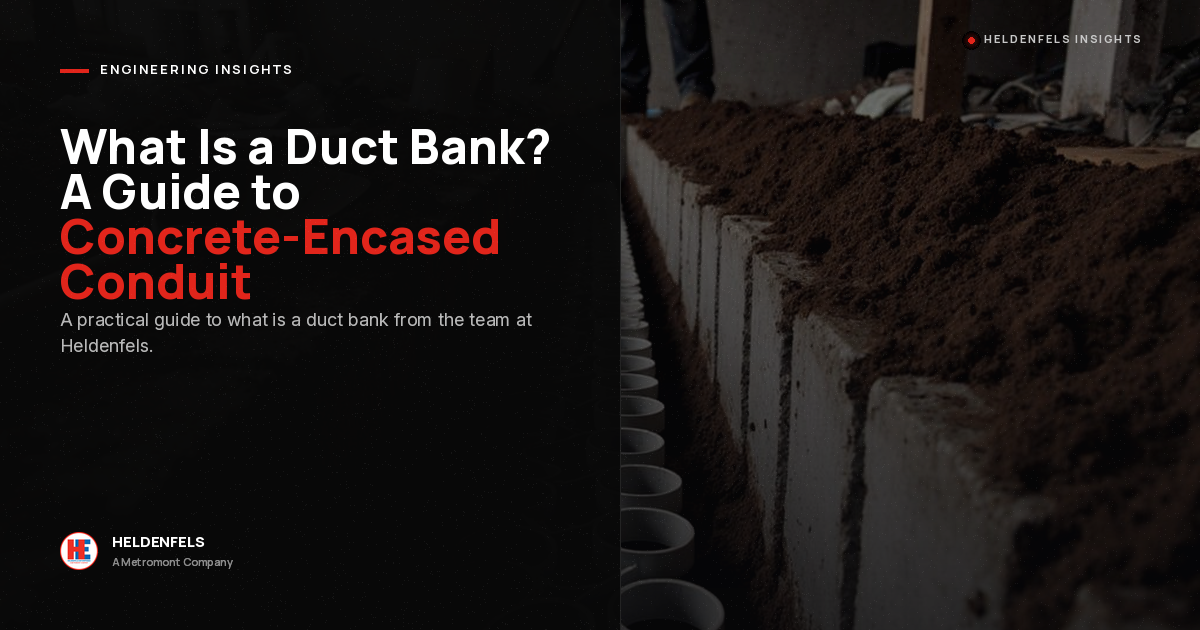
What Is a Duct Bank? The Complete Guide to Proven Concrete-Encased Conduit
So, what is a duct bank, and why do engineers bury power and telecom cable inside a block of concrete? Here is a clear, plain-English guide to concrete-encased conduit, where it is used, and why the encasement matters.
In This Guide
Let us answer the core question directly, because this guide is built to be the plain answer you were searching for. A duct bank is a group of electrical or communication conduits, bundled together in a fixed grid and fully encased in concrete, then buried underground to protect the power and data cable that will later be pulled through it. Picture a permanent, hardened highway for cable: the conduits form the lanes, and the concrete around them shields those lanes from crushing loads, moisture, ground movement, and accidental dig-ins for decades. At Heldenfels Enterprises, we build these systems as precast concrete duct banks, cast in our plant and delivered ready to set in the trench.
What Is a Duct Bank? A Clear Definition
In the simplest terms, a duct bank is an underground array of conduits, usually PVC or fiberglass raceway, held in precise position by plastic spacers and then completely surrounded by concrete. Once that concrete cures, the loose conduits become a single rigid structure. Utility and electrical crews later pull power feeders, control wiring, or fiber-optic and telecom cable through the empty ducts, often months or years after the concrete first went into the ground.
The concrete is the defining feature, and it is what separates a real duct bank from simpler methods. A bundle of loose conduits dropped into a trench is just direct-buried conduit. Encase that same bundle in a monolithic envelope of concrete and you have an engineered system: one rated to carry heavy electrical loads, survive traffic and construction above it, and keep every circuit spaced, aligned, and protected for the life of the facility.
What is a duct bank made of?
A typical duct bank combines three elements. First are the conduits, the empty pathways that the cable is pulled through. Second are intermediate spacers that lock those conduits into a repeating grid so they hold consistent separation. Third is the concrete envelope that binds and shields everything into one block. Reinforcing steel is added when the bank has to span soft soils or carry structural load. In a precast version, all of this is assembled and cast against steel forms in a plant, then shipped to the jobsite as finished, ready-to-install sections.

Conduits held in a fixed grid by spacers inside a form, the moment before concrete locks the geometry in place.
How Concrete Encasement Protects Power and Telecom Cable
The cable inside a duct bank is often the most expensive and least accessible part of an entire power or communications system. Digging it up to repair it can mean shutting down a data hall, a runway, or a live substation. Concrete encasement exists so that almost never has to happen. Here is what the concrete actually does for the circuits inside it:
Mechanical Protection
The concrete distributes crushing loads from soil, traffic, and heavy equipment, so a passing loader or a stack of backfill never deforms a conduit or pinches the cable inside it.
Dig-In Defense
A solid mass of concrete is an unmistakable signal to any future excavator. It stops a backhoe bucket long before it reaches live conductors, and warning tape or red concrete dye adds another layer of caution.
Thermal Stability
Concrete draws heat away from loaded power cable, helping conductors run cooler and hold their rated ampacity even when many circuits are bundled tightly together in one bank.
Alignment and Separation
Fixed spacing keeps power and communication circuits at the distances engineers assumed in their calculations, preventing induced interference and maintaining the geometry the design depends on.
There is also the matter of longevity. Direct-buried cable and loose conduit are exposed to shifting soil, root intrusion, rodent damage, and groundwater. A concrete-encased system isolates the conduits from all of it. That is a large part of why our precast banks are engineered for a service life well past 100 years, matching the infrastructure they support rather than becoming the weak link that has to be dug up and replaced first. Because these systems are also installed to the spacing and cover rules of the National Electrical Code (NFPA 70), the finished bank meets the same standards inspectors hold the rest of the electrical system to. It all starts with quality precast concrete produced under controlled conditions.
Where Duct Banks Are Used
Electrical Substations
High-voltage feeders enter and leave the yard through duct banks, where a single damaged circuit can carry grid-level consequences and outages that ripple far beyond the fence line.
Data Centers
Redundant power and fiber route between utility connections, generator yards, and the server halls, often in dense banks with dozens of conduits and deliberate spare capacity for the next expansion.
Airports and Transit
Duct banks run beneath taxiways and aprons to carry runway lighting, navigation, and communication circuits under the constant weight of aircraft and ground vehicles.
Campuses and Industry
Universities, hospitals, and large manufacturing plants distribute medium-voltage power and controls between buildings without a maze of overhead lines or vulnerable direct-buried cable.
In every one of these settings the logic is identical: the cost of an unplanned outage dwarfs the cost of encasing the pathway in concrete up front. That is why duct banks show up on projects where reliability is not negotiable, and why they are frequently specified as part of larger precast concrete systems that also include vaults, manholes, and structural elements delivered by the same manufacturer.

A finished precast section is craned into the trench, ready to set and join instead of being built by hand on site.
Precast vs. Field-Built Duct Banks
Duct banks are built one of two ways. In the traditional method, crews assemble conduits and spacers by hand in an open trench, tie in any reinforcing steel, build formwork, and pour concrete right there on the site. Every step is exposed to weather, soil conditions, and the pace of field labor. The alternative is to manufacture the duct bank as finished precast sections in a controlled plant, then truck them to the site ready to lower into place.
| Factor | Field-Built (Cast-in-Place) | Precast |
|---|---|---|
| Conduit alignment | Depends on crew and trench conditions | Consistent, cast against steel forms |
| Quality control | Variable, weather dependent | Controlled plant environment |
| Trench open time | Days, through pour and cure | Hours, set and backfill |
| On-site labor | High | Reduced to setting and joining |
| Weather exposure | Significant | Minimal |
| Schedule certainty | Lower | Higher |
Because our sections are cast against precise steel forms indoors, the conduit alignment and concrete cover come out consistent every time. They do not depend on how carefully a crew held the spacers while wet concrete was placed around them in a muddy trench. Sections arrive cured and ready, so the trench stays open for hours instead of days, and on-site labor shrinks to setting, joining, and backfilling. For owners on a tight schedule, that difference is often measured in weeks, and it is a core part of our precast manufacturing capabilities.
A duct bank is one of those systems you want to install once and never think about again. Building it under factory control, rather than in an open trench at the mercy of weather and schedule pressure, is the surest way to get that outcome.
Duct Bank FAQ
What is the difference between a duct bank and a conduit?
A conduit is a single tube that a cable runs through. A duct bank is a group of those conduits arranged in a fixed grid and encased in concrete as one structure. Put simply, the duct bank is the protective concrete system, and the conduits are the individual pathways inside it.
How deep are duct banks buried?
Burial depth depends on voltage, location, and the governing code, but many duct banks are set with roughly two to four feet of cover over the top of the concrete. Crossings under roadways or heavy traffic areas are typically buried deeper for added protection.
Is a duct bank the same as a manhole or vault?
No. The duct bank is the concrete-encased run of conduits between points. Manholes and vaults are the access chambers spaced along the route where crews pull, splice, and service the cable. They work together as one underground distribution system.
How long does a concrete duct bank last?
A properly engineered concrete-encased duct bank is built to last well beyond 100 years. The concrete protects the conduits from the soil movement, moisture, and physical damage that would otherwise shorten the life of buried cable pathways.
The Bottom Line on Duct Banks
So, to close the loop on what a duct bank is: it is a bundle of conduits locked in a fixed grid and encased in concrete, engineered to protect critical underground power and telecom cable for the entire life of a facility. The concrete is not incidental. It is the whole point, providing mechanical protection, dig-in defense, thermal stability, and a century-plus of reliable service.
When that pathway is manufactured as precast sections under plant conditions rather than built by hand in a trench, owners get tighter alignment, better quality control, and a faster, more predictable installation. For infrastructure that cannot afford to fail, that combination is exactly what a duct bank is designed to deliver.
Planning a Project With Underground Power or Data?
Heldenfels Enterprises manufactures precast concrete duct banks built to your project specifications and delivered ready to install. Let us talk through your conduit layout and schedule.
Start the Conversation →