
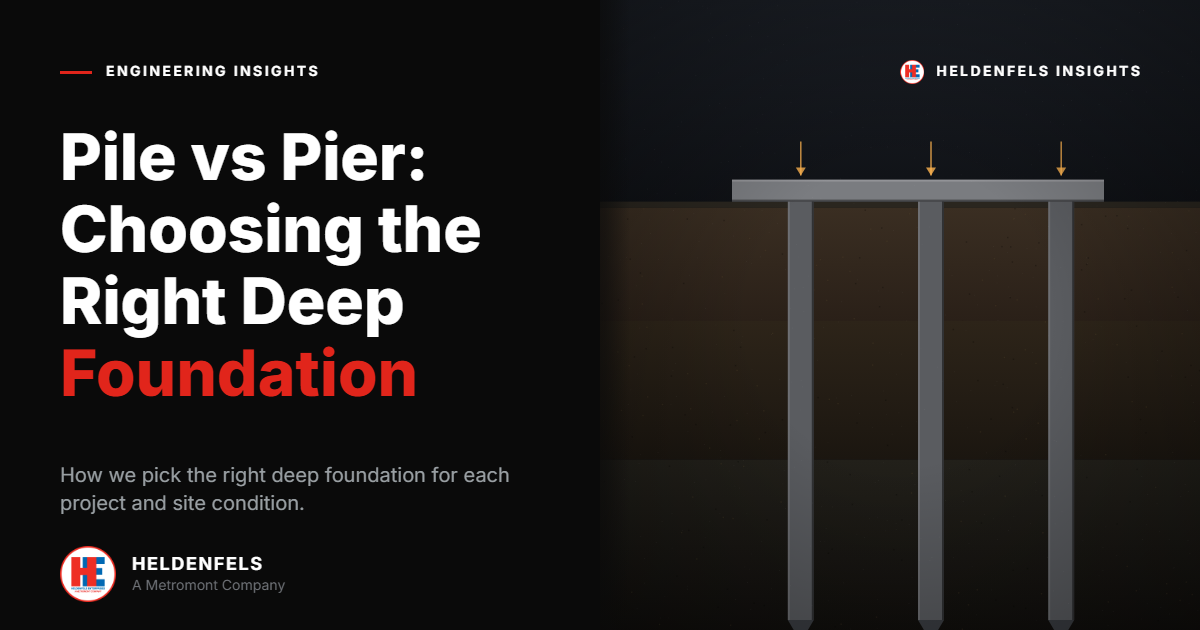
Pile vs Pier Foundation: Choosing the Right Deep Foundation for Infrastructure, Marine, and Industrial Projects
A practical guide to comparing pile vs pier foundations so you can choose the safest, most cost-effective solution for demanding project sites.
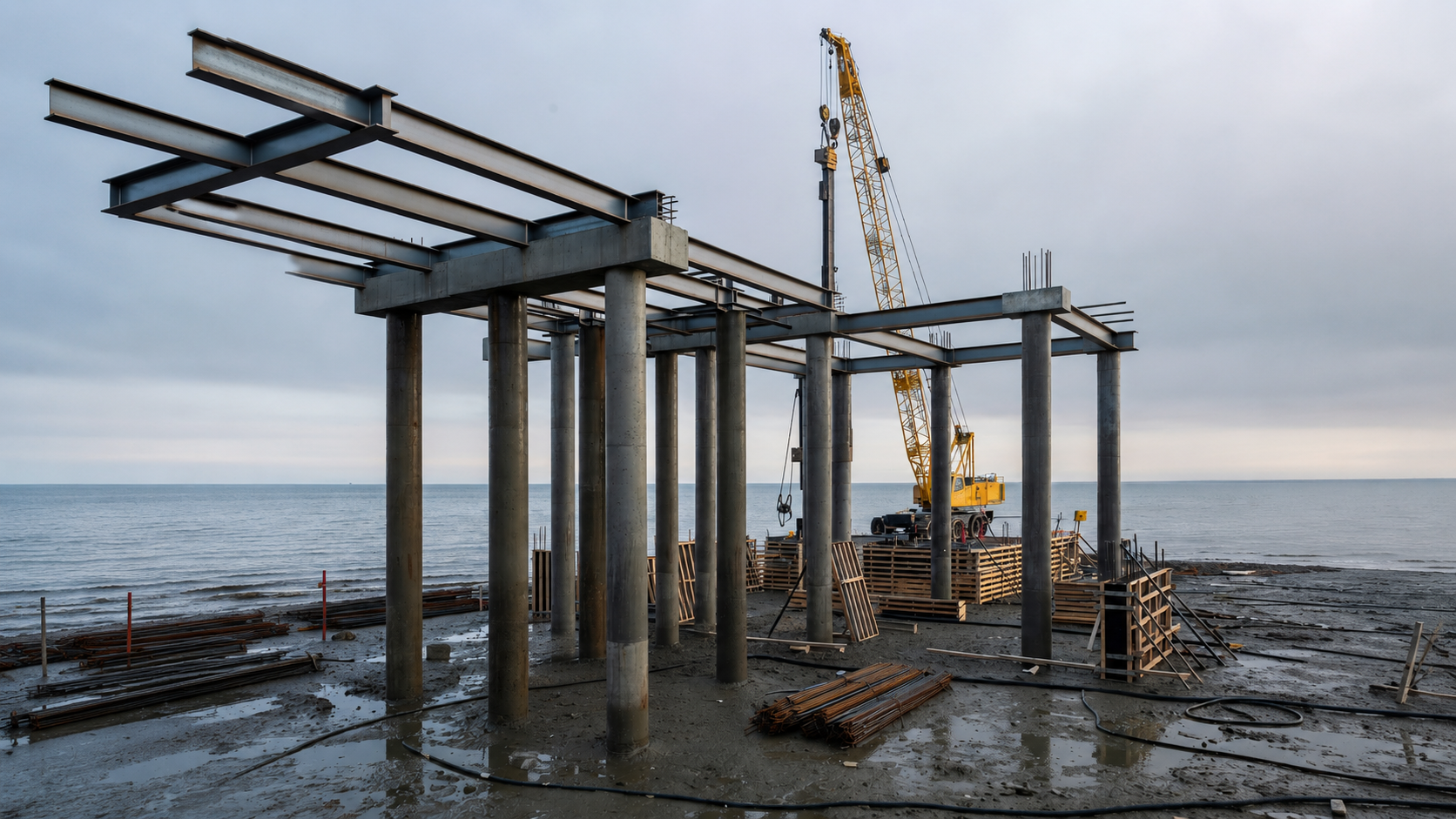
Pile vs pier foundation work underway at a coastal construction site with concrete supports, steel framing, and crane equipment.
Choosing the right foundation system is critical because bridges, marine structures, industrial facilities, ports, docks, and commercial buildings require support that performs under real-world site conditions. These conditions may include weak soils, groundwater, lateral loads, exposure to corrosion, and long-term service demands. That is why the pile vs pier foundation decision should be based on soil data, structural loads, project location, installation constraints, and durability requirements.
For project owners, contractors, and engineers, understanding this comparison helps reduce risk, avoid delays, and select a foundation system that can support the structure for decades.
What is a Pile Foundation?
A pile foundation is a deep foundation system used to transfer structural loads through weak or unstable near-surface soils to deeper, stronger soil or rock layers. Piles may support loads through:
- End bearing: The pile transfers load to a strong soil or rock layer below.
- Side resistance: Load is transferred along the pile surface through friction between the pile and the surrounding soil.
- Combined resistance: Many pile designs use both end bearing and side resistance, depending on site conditions and engineering requirements.
In the pile vs pier foundation discussion, piles are often preferred for projects with poor surface soils, heavy structural loads, high groundwater, scour concerns, or marine exposure.
Precast/prestressed concrete piles are manufactured before installation and driven into place on site. Because they are produced under controlled plant conditions, they offer consistent strength, quality, and durability before reaching the jobsite. Heldenfels provides prestressed concrete piles for deep foundation applications across marine, industrial, infrastructure, and commercial projects.
Common pile foundation applications include:
- Bridge foundations
- Marine structures
- Ports, docks, and wharves
- Industrial facilities
- Commercial buildings
- Retaining structures
- High-capacity deep foundations
For Heldenfels projects, precast/prestressed concrete piles are particularly relevant because they meet the needs of the highway, marine/industrial, and building construction markets.
What is a Pier Foundation?
A pier foundation uses individual vertical supports to transfer structural loads into the ground, but the term “pier” can vary depending on the project type. In residential or light commercial work, it may refer to a shallow or moderately deep support, while in heavy civil construction, it often refers to a drilled pier or shaft formed by drilling, reinforcing, and filling the hole with concrete. This is why the pile vs pier foundation topic can be confusing: a shallow pier, a drilled shaft, and a driven precast pile are not the same system.
Drilled piers may be used when:
- Pile driving vibration must be limited
- Large-diameter cast-in-place support is needed
- Site access or overhead clearance restricts driven pile equipment
- Subsurface conditions favor drilled construction
- Nearby structures require lower vibration installation methods
However, drilled piers depend heavily on field execution. Borehole stability, groundwater control, reinforcement placement, and concrete quality all affect performance. For technical background, the Federal Highway Administration’s resource on drilled shaft construction procedures and design methods explains how construction methods, subsurface investigation, inspection, and load testing influence drilled shaft performance.
Pile vs Pier Foundation: Key Differences
The table below gives a straightforward comparison of the two systems.
| Factor | Pile Foundation | Pier Foundation / Drilled Pier |
|---|---|---|
| Typical installation | Driven, vibrated, jetted, or otherwise installed into the ground | Drilled, reinforced, and cast in place |
| Common materials | Precast concrete, prestressed concrete, steel, or timber | Cast-in-place reinforced concrete |
| Best suited for | Weak soils, marine exposure, bridges, ports, industrial facilities, and high-capacity foundations | Large concentrated loads, limited vibration sites, and drilled-access conditions |
| Load transfer | End bearing, side resistance, or both | End bearing, side resistance, or both |
| Quality control | Strong plant-based quality control before installation | Depends heavily on field drilling and concrete placement |
| Construction speed | Can be efficient once piles are delivered and equipment is mobilized | May require more site-sensitive drilling, inspection, and concrete placement control |
| Vibration concerns | Driven piles may create vibration depending on installation method | Usually lower vibration than driven piles |
| Durability considerations | Precast/prestressed concrete piles are well suited for marine and infrastructure environments | Durability depends on mix design, placement quality, reinforcement protection, and exposure conditions |
| Common Heldenfels relevance | Strong fit for Heldenfels’ precast/prestressed concrete pile applications | Less central to Heldenfels’ manufactured precast/prestressed product focus |
A responsible pile vs pier foundation decision should not be based on shortcuts. The project team should compare soil conditions, load requirements, installation risks, schedule, durability, and long-term value.
When Precast/Prestressed Concrete Piles Make Sense
Precast/prestressed concrete piles are often a strong choice for demanding infrastructure and marine construction. They are produced before installation, which gives the project team better control over material quality, curing, strength, and consistency.
In a pile vs pier foundation evaluation, precast/prestressed concrete piles may be the better fit when the project involves:
- Weak or inconsistent surface soils
- Deep bearing requirements
- Heavy vertical loads
- Lateral loads from water, wind, traffic, or impact
- Marine or coastal exposure
- High groundwater conditions
- Repetitive pile layouts
- Schedule-sensitive installation
- Long-term durability requirements
Prestressing helps concrete piles resist stresses from handling, transport, driving, and service. This makes them especially useful for bridge, marine, industrial, and commercial foundation work where performance and reliability matter. The Federal Highway Administration’s Design and Construction of Driven Pile Foundations provides technical guidance on driven pile foundation design, construction, subsurface exploration, pile selection, and installation monitoring.
For Heldenfels, this is the strongest angle. Our expertise is not generic residential foundation repair. It is precast/prestressed concrete construction for serious infrastructure, marine, industrial, and building projects.
When Drilled Piers May Be a Better Fit
A balanced pile vs pier foundation comparison should also recognize when drilled piers or drilled shafts may be appropriate.
Drilled piers may be a good option when:
- Vibration from driven piles is a concern
- Nearby structures could be affected by pile driving
- The project requires large-diameter foundation elements
- Access conditions make pile driving difficult
- Overhead clearance is limited
- Soil and rock conditions are favorable for drilled construction
That said, drilled piers are not automatically simpler or cheaper. They require careful field control. If the drilled hole collapses, groundwater is not managed properly, reinforcement is misaligned, or concrete placement is poor, performance can suffer.
The real pile vs pier foundation question is not “which one is better?” The better question is: which system fits the site, structure, construction method, and long-term performance requirements?
Soil and Site Conditions That Influence the Decision
Soil conditions are among the most important factors in foundation design, but they should never be reduced to simple rules of thumb. There is no reliable shortcut that says one soil type always requires piles while another always requires piers. A proper pile vs pier foundation review should be based on soil borings, geotechnical data, groundwater levels, depth to competent bearing material, settlement limits, scour potential, lateral loads, uplift requirements, seismic or impact concerns, and site access.
For marine and industrial projects, the evaluation becomes even more demanding because the foundation may be subject to saltwater exposure, tidal action, wave forces, vessel impacts, erosion, corrosion, and heavy equipment loads. These conditions can affect not only foundation capacity but also long-term durability and constructability. That is why the right foundation system should be selected through engineering review, not assumptions.
In many coastal, bridge, and industrial settings, driven precast/prestressed concrete piles are selected because they can reach deeper supporting layers while offering durable performance in wet and aggressive environments. Heldenfels’ marine and industrial capabilities include precast/prestressed concrete piling, deck slabs, caps, sheet piles, docks, piers, wharfs, ramps, erosion protection, and related components for demanding marine environments.
Load Capacity and Structural Performance
Both piles and piers can be engineered to support significant loads, but they achieve that capacity in different ways. In a pile vs pier foundation decision, engineers look beyond vertical load and evaluate axial compression, uplift, lateral loads, bending, settlement, group effects, driving stresses, durability, and environmental exposure. These factors help determine which foundation system can safely support the structure under real project conditions.
For bridges, wharves, docks, ports, and industrial facilities, lateral and environmental demands can be just as important as vertical capacity. A foundation may look adequate in calculations but still create problems if it is difficult to install, vulnerable to site exposure, or poorly matched to soil conditions. That is why load capacity should always be reviewed alongside constructability, durability, and long-term performance.
Cost, Schedule, and Lifecycle Value
The cheapest foundation option is not always the most cost-effective. A foundation system that creates delays, quality problems, maintenance issues, or settlement risk can become expensive fast.
A practical pile vs pier foundation cost review should include:
| Cost Factor | Why It Matters |
|---|---|
| Material cost | Includes concrete, steel, reinforcement, prestressing, and fabrication |
| Equipment and mobilization | Foundation equipment can significantly affect total installed cost |
| Installation speed | Faster installation may reduce schedule risk |
| Inspection requirements | Some systems require more field testing and observation |
| Site access | Limited access can influence equipment selection |
| Weather sensitivity | Wet or unstable sites may affect drilled construction more heavily |
| Durability | Longer service life can reduce maintenance and replacement costs |
| Repair difficulty | Deep foundation problems are expensive to fix after construction |
For infrastructure and marine work, lifecycle value often matters more than the lowest initial bid. The foundation is not the place to gamble.
How to Choose Between Piles and Piers
The best foundation system should be selected based on engineering data, not assumptions or the lowest upfront cost. Before making a pile vs pier foundation decision, project teams should review the geotechnical report, confirm whether near-surface soils can support the structure, and determine whether settlement, deeper bearing layers, lateral loads, uplift, scour, or impact forces are concerns. They should also evaluate whether pile driving is practical for the site, whether vibration or noise restrictions apply, and whether drilled construction would reduce or increase overall risk.
From there, the team can compare quality control, schedule impact, durability, and lifecycle value. This creates a stronger decision-making process than simply choosing the option with the lowest installed price.
Final Takeaway: Choosing the Right Foundation Starts with Engineering Data
The pile vs pier foundation decision should be based on soil conditions, structural loads, site access, exposure risks, and long-term performance needs, not assumptions. For heavy civil, marine, industrial, bridge, and commercial projects, precast/prestressed concrete piles are often a strong choice when deep foundation capacity, controlled manufacturing, efficient installation, and durability are priorities. Drilled piers or drilled shafts may still be appropriate under certain conditions, so the final decision should be based on geotechnical data, structural requirements, and a constructability review.
For teams evaluating pile vs pier foundation options in Texas infrastructure, marine, industrial, or commercial construction, Heldenfels provides the precast/prestressed concrete experience and product capability needed to support strong, durable, and high-performing foundation systems.
Need Help Choosing Between Pile vs Pier Foundations?
Foundation decisions are too expensive to guess on. Heldenfels can support your team with durable precast/prestressed concrete pile solutions for marine, industrial, infrastructure, and commercial projects where deep foundation performance matters.
Talk to Our Team