
Precast Concrete Swimming Pools: A Proven, Expert Pros and Cons Guide
An honest, engineering-grounded look at where factory-built pool shells and panels outperform the alternatives, and where they do not.

Homeowners and commercial pool buyers keep asking the same question: are precast concrete swimming pools actually a better option than the gunite, fiberglass, or vinyl-liner choices that dominate the residential market? The honest answer is that they win decisively on some criteria and lose on others, and the right call depends on your site, your budget, and how long you intend to own the pool. This guide lays out both sides without the sales pitch, drawing on the same structural precast principles we apply every day at Heldenfels Enterprises across Texas bridge, stadium, and commercial work.
What Precast Concrete Swimming Pools Actually Are
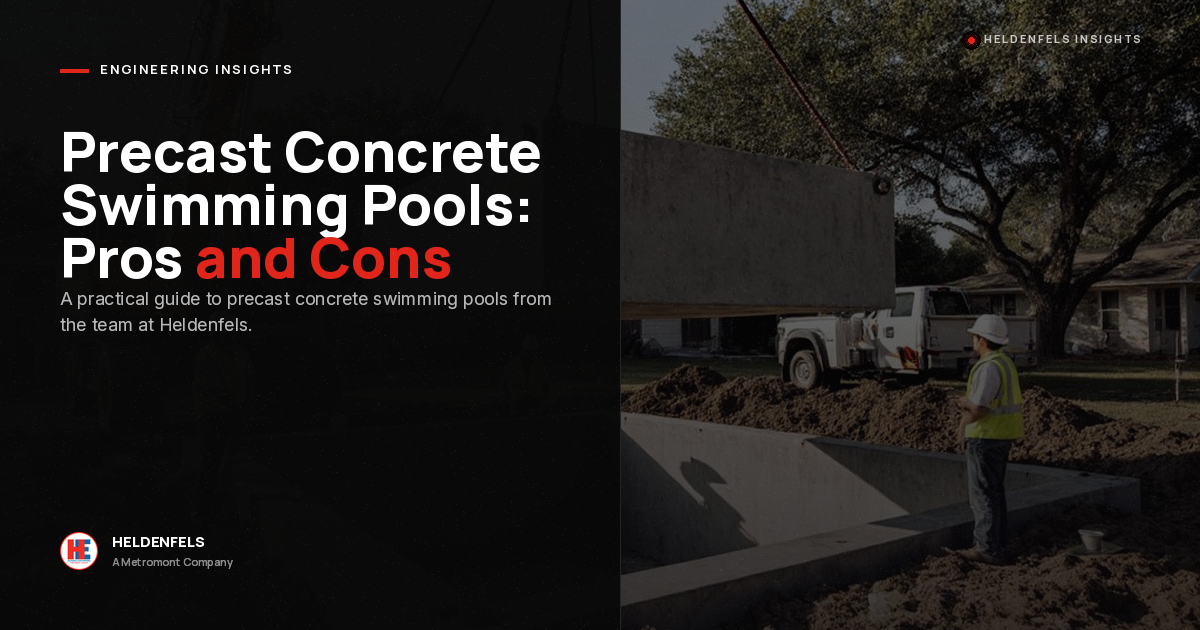
The category covers two related construction methods that are often lumped together. The first is a monolithic precast pool shell: a single, factory-cast reinforced concrete vessel, typically up to about 16 by 40 feet, that arrives on a flatbed and is lowered into the excavation in one piece by a heavy-duty crane. The second method uses precast structural panels for the walls, with a poured or precast floor slab and field-installed waterproofing. Both approaches rely on the same idea: cast the structural concrete in a controlled plant environment, then assemble on site.
That distinguishes precast pools from the dominant gunite or shotcrete method, where wet concrete is sprayed against a curved rebar cage in the ground and hand-troweled to shape. It also separates them from fiberglass shells, which are not concrete at all, and from vinyl-liner pools, which use a thin plastic membrane over a steel or polymer wall. Pool builders who want concrete strength with plant-controlled quality have been turning to precast wall panels for pool construction as a hybrid path that combines the durability of structural concrete with the schedule advantages of off-site fabrication.
The Pros of Precast Concrete Swimming Pools
The case for precast is strongest where time, quality control, and long-term durability matter most. Five advantages stand out.
Installation Speed Measured in Days, Not Months
A traditional gunite pool typically takes six to twelve weeks from dig to swim-ready, much of it spent waiting on multiple inspection cycles, curing, plaster, and weather. A precast shell, by contrast, can be set in a single morning and brought online within two to three weeks once plumbing and decking are complete. For commercial pool projects on a tight ribbon-cutting deadline, that schedule compression often justifies the higher unit cost by itself.
Factory Quality Control
Concrete cast indoors at a controlled temperature and humidity, with calibrated mix designs and vibration, reaches design strength with fewer defects than concrete sprayed against a dirt wall in 95-degree heat. Plant casting produces tighter dimensional tolerances, uniform cover over reinforcement, and a denser, less permeable surface. Less permeability means less long-term water absorption, fewer freeze-thaw cycles working on absorbed moisture, and longer life between resurfacings.
A 75-Year Structural Design Life
Properly engineered structural precast concrete is designed for service lives that routinely exceed 75 to 100 years, which is why agencies specify it for bridges, marine terminals, and infrastructure. A precast pool shell inherits the same engineering tradition. Plaster and tile finishes still need refresh cycles every 10 to 20 years, but the structural vessel itself outlasts every gunite pool on the block.
A Cold-Climate Advantage
In freeze-prone regions, the dense, low-permeability concrete of a precast shell handles seasonal freeze-thaw cycles better than the more porous shotcrete finishes. The factory-cured product enters service with less internal moisture for ice crystals to expand against. That matters less in San Antonio than in Pittsburgh, but it is a real engineering benefit for northern installs.
Engineering Predictability
Because the shell or panels are designed and stamped before fabrication, structural performance is predictable from day one. Reinforcement is placed exactly where the engineer specified, not where a field crew was able to wire it in around the rebar chairs at 4 p.m. on a Friday. For pools that will eventually carry diving boards, slides, or significant equipment loads, that predictability is reassuring.
The Cons of Precast Concrete Swimming Pools
The downsides are real, and they explain why precast has not displaced gunite for most U.S. residential work. Four limitations dominate the conversation.
Higher Upfront Cost Than Vinyl or Fiberglass
A vinyl-liner pool can be installed for $35,000 to $65,000, and a fiberglass shell typically runs $45,000 to $85,000 installed. A precast pool, with delivery, crane work, and finish, generally starts around $80,000 and climbs from there for larger sizes or premium finishes. The price tracks closer to a custom gunite pool than to the budget alternatives, which means the buyer is paying for longevity rather than first-cost savings.
Size and Shape Limits
A monolithic shell has to fit on a flatbed and pass under bridges and power lines on the way to the site. That caps practical shell sizes at roughly 16 by 40 feet, eliminates many custom freeform geometries, and rules out vanishing-edge or beach-entry features that gunite handles easily. Panel systems extend the size envelope, but the shape vocabulary is still narrower than what a hand-shaped shotcrete crew can produce.
Site Access Requirements
Setting a 40,000-pound shell requires a large hydraulic crane with clear swing access, no overhead utility conflicts, and ground bearing capacity for the outriggers. Backyards with narrow side-yard easements, mature tree canopy, or sloped approaches often disqualify themselves. Pool builders routinely walk away from precast on otherwise-good lots simply because the truck and crane cannot reach the dig.
A Sparse Regional Supplier Network
Fiberglass shells ship economically from a few national plants, and gunite is available anywhere a shotcrete crew can drive. Precast pool shells, by contrast, are produced by a relatively small number of regional plants, which means freight costs balloon fast for sites more than a couple hundred miles from the factory. If no precast pool supplier serves your zip code, the math rarely works no matter how appealing the technology.

Cost Reality: What You Actually Pay
Quoted prices vary wildly because three line items dominate the total: shell or panel cost, freight to site, and crane time. A 14-by-28-foot rectangular shell delivered within 100 miles of the plant might land at $60,000 for the structural piece alone. Add $8,000 to $15,000 for freight on longer hauls, $4,000 to $12,000 for a crane day, plus excavation, plumbing, electrical, decking, fencing, and finish work, and the all-in number lands between $85,000 and $140,000 for most residential installs. Commercial municipal pools push higher, but they also benefit from the schedule savings more dramatically.
The right way to compare is total cost of ownership over 25 to 30 years. A vinyl liner needs replacement every 7 to 10 years at $4,000 to $6,000 each cycle. A gunite pool needs replastering every 10 to 15 years at $5,000 to $10,000. A properly built precast pool typically needs only finish refreshes on the same plaster cycle, with the structure itself remaining sound. Over three decades the cost lines often cross.
Quick budget snapshot. For a 14-by-28-foot pool installed in 2026 dollars: vinyl-liner around $50,000 with $30,000 in liner replacements over 30 years; fiberglass around $70,000 with limited mid-life work; gunite around $90,000 with $20,000 in replaster cycles; precast around $110,000 with finish refreshes only. The precast premium narrows considerably when life-cycle cost is the metric.
Site Conditions That Favor Precast Concrete Swimming Pools
Some sites are tailor-made for the technology. Open lots with truck and crane access, predictable soil conditions, and either commercial schedule pressure or owner intent to stay 20-plus years are the classic match. So are projects where pump rooms, filtration vaults, and chiller skids need specialized equipment foundations alongside the pool, since coordinating the precast vessel with precast equipment pads simplifies layout and shortens the construction sequence.
Cold-climate installs above the 36th parallel are another natural fit, as are HOA, hotel, and apartment-complex pools where every closed-down week represents lost revenue. The schedule certainty of a single-day shell drop is hard to argue against in those contexts.
When to Pick a Different Method Instead
Conversely, the case for gunite or fiberglass strengthens when the project is a one-of-a-kind freeform shape, the site lacks crane access, the buyer plans to sell within five to seven years, or the nearest precast pool supplier is hundreds of miles away. A custom curved infinity pool wrapping a hillside is still a gunite job. A budget backyard install on a flat lot with a 4-foot side-yard gate is still a vinyl-liner or fiberglass job. Precast wins the middle ground where buyers want the durability of concrete without the calendar pain of cast-in-place.
| Pool Type | Installed Cost (14×28) | Build Time | Service Life |
|---|---|---|---|
| Vinyl-liner | $45,000 to $65,000 | 3 to 5 weeks | Liner: 7 to 10 years |
| Fiberglass shell | $55,000 to $85,000 | 2 to 4 weeks | 25 to 35 years |
| Gunite (shotcrete) | $70,000 to $120,000 | 6 to 12 weeks | 50+ years (replaster every 10 to 15) |
| Precast concrete | $85,000 to $140,000 | 2 to 3 weeks | 75+ years (finish only) |
How Heldenfels Fits Into the Precast Pool Conversation
We are not a residential pool packager, and our truck does not arrive with a chlorinator and a robotic vacuum in the back. What we do every day is engineer and fabricate structural precast and prestressed concrete elements: bridge girders, stadium risers, marine piles, retaining walls, equipment pads, and architectural panels. Pool builders working on commercial or large residential projects sometimes engage us for the structural wall panels, equipment vaults, and surrounding hardscape that turn a basic shell into a finished aquatic facility.
If you want to understand the underlying material science, our complete guide to precast concrete covers why factory casting produces a stronger, more predictable product than site-cast concrete. For a closer look at the production sequence itself, the how precast concrete is made walkthrough traces the process from form setup through curing and shipping. Both posts apply to pool work just as much as to the bridge and stadium projects that fill our yard. For the industry-wide engineering perspective, the Precast/Prestressed Concrete Institute publishes the consensus standards that govern all serious precast structural work in North America.
The Bottom Line
Precast concrete swimming pools are an excellent choice for buyers who value schedule certainty, factory quality, and 75-plus year durability, and who own a site that can accept a truck and crane. They are usually the wrong choice for tight urban lots, freeform custom geometries, or budget-driven installs. The technology has matured into a credible alternative to gunite for the right project, but it is not a universal replacement, and any sales pitch that treats it as one should be viewed with skepticism. Buy precast for the reasons the engineering supports, not because a brochure called it superior.
Planning a Project With Structural Precast?
Heldenfels Enterprises has engineered and fabricated structural precast and prestressed concrete across Texas since 1909. If your aquatic facility, equipment platform, or commercial site needs precast wall panels, foundations, or custom structural elements, our team can help you scope it correctly from the first sketch.
Start the Conversation