
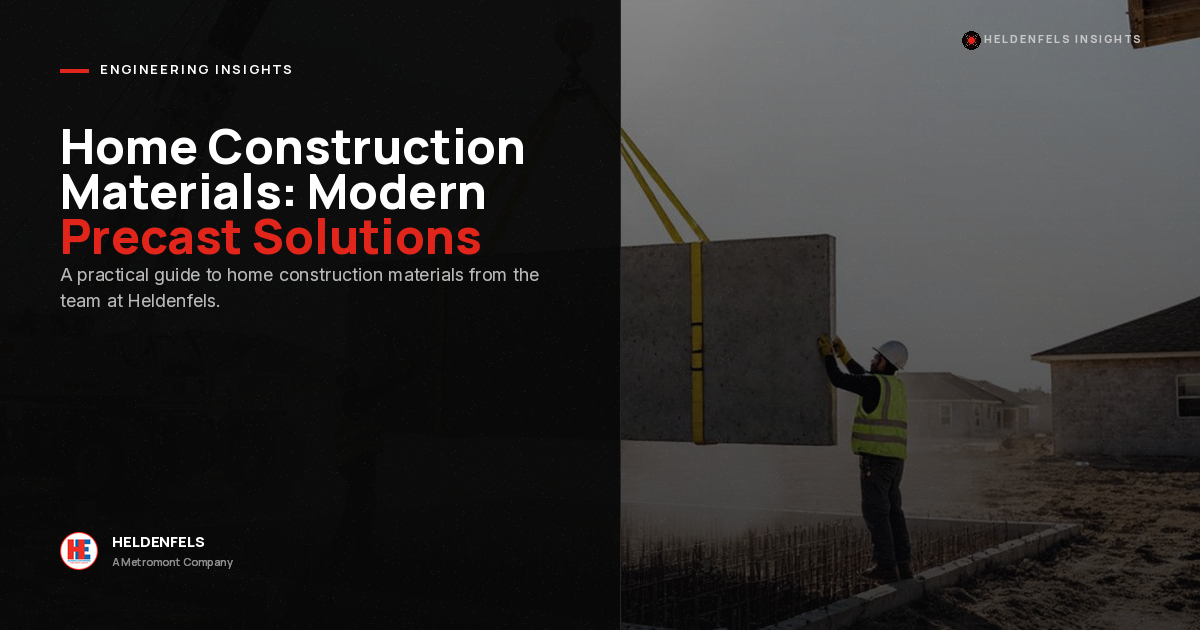
Home Construction Materials: A Complete, Proven Guide to Smart Precast Solutions
Choosing the right home construction materials is one of the most consequential decisions a homeowner or builder makes, and it quietly shapes every year the house stands afterward. The foundation you pour, the walls you raise, and the structure that carries the load all determine how well the home holds up against heat, moisture, wind, fire, and time. Yet most residential projects still default to the same wood-and-block routine that has been standard for generations.
There is a category of building material that has been proving itself on bridges, stadiums, and industrial structures for more than a century, and it is finally earning attention in residential design: precast, prestressed concrete. Cast under controlled factory conditions and delivered ready to set, precast components bring a level of strength, consistency, and speed that field-built systems struggle to match.
At Heldenfels Enterprises, we have engineered precast and prestressed concrete from our San Marcos, Texas plant since 1909. This guide walks through where precast fits among modern building options, what makes it different, and how to decide whether it belongs in your next build.
- Precast concrete is cast in a controlled plant, not in the field, which yields higher strength, tighter tolerances, and far fewer defects than site-poured work
- Prestressing lets slim concrete members carry heavy loads over long spans, making precast practical for foundations, walls, and structural columns
- Compared with wood and block, precast resists fire, rot, insects, and moisture, and it can last 50 to 100 years with minimal maintenance
- Because pieces arrive finished, precast compresses the build schedule and reduces on-site labor, weather delays, and waste
- Heldenfels has engineered precast and prestressed concrete in Texas since 1909, from wall panels to structural columns
What Sets Precast Apart From Traditional Home Construction Materials
The difference between precast and conventional building products comes down to where and how the concrete is made. On a typical site, concrete is poured into wooden forms, cured in the open air, and finished by whatever crew is available on a given day. Temperature, humidity, mix variability, and human timing all leave their mark on the result.
Precast flips that equation. Components are cast on reusable steel beds inside a plant, where the mix, the temperature, the curing, and the reinforcement are controlled to engineered standards. The first panel off the bed looks and performs like the hundredth. That repeatability is the quiet advantage that field-built systems can rarely promise.
Most precast structural pieces are also prestressed. High-strength steel strands are tensioned before the concrete is cast, so the finished member carries load in compression, where concrete is strongest. The payoff is a slimmer, stronger element that can span farther and resist cracking better than an ordinary poured section. Plant-cast members routinely reach compressive strengths of 6,000 to 8,000 psi and beyond, well above typical residential concrete.
Quality control is the third pillar. Reputable manufacturers work under third-party certification through the Precast/Prestressed Concrete Institute, which sets audited standards for testing, tolerances, and documentation. Every piece is traceable, so what gets specified on paper is what shows up on the truck.

Precast Solutions for the Parts of a Home That Matter Most
Precast is not an all-or-nothing choice. Builders can specify it for the specific parts of a house where strength, speed, and durability pay off the most, and blend it with conventional methods elsewhere. Three areas tend to see the biggest benefit.
Foundations and Structural Columns
The foundation is where material quality is least forgiving, because everything above it depends on what sits below. Precast foundation elements and structural columns for home foundations arrive already cured to full strength, so there is no waiting on a field pour to reach load capacity before framing can begin. On sloped lots, expansive soils, or elevated coastal designs, engineered precast columns give a predictable, load-rated base that poured piers can struggle to match consistently.
Walls and Enclosure
Wall systems are where precast reshapes the schedule most dramatically. A single precast wall panel for residential construction can replace days of framing, sheathing, and finishing with a component that is craned into place in minutes. The panels arrive with consistent thickness, built-in reinforcement, and a dense surface that shrugs off wind-driven rain. For homeowners in storm-exposed regions, that solid mass is a meaningful upgrade over stick framing.
Because these panels are engineered as a system rather than assembled piece by piece, the enclosure goes up fast and stays true. Fewer joints, fewer gaps, and fewer opportunities for the small field errors that compound into callbacks later.
Durability, Fire Resistance, and Lifecycle Value
When people compare home construction materials on price alone, they usually compare the wrong number. The sticker cost of framing lumber or block is only the first payment. The real cost shows up over decades in maintenance, repairs, insurance, and eventual replacement. This is where precast concrete separates itself.
Concrete does not rot, warp, feed termites, or fuel a fire. Those four failure modes account for an enormous share of the money homeowners pour into aging houses. A precast enclosure sidesteps all of them at once, which is why concrete consistently ranks among the most durable construction materials available for residential work.
- Fire resistance: Concrete is noncombustible and does not contribute fuel to a fire, an increasingly important trait in wildfire-exposed regions.
- Storm resilience: Dense, reinforced panels resist wind loads and flying debris far better than conventional framing.
- Moisture and pests: There is nothing in cured concrete for mold, rot, or insects to consume.
- Thermal mass: The material’s mass moderates indoor temperature swings, which can ease heating and cooling demand.
- Longevity: Engineered precast is designed to perform for 50 to 100 years, spreading its cost across generations rather than decades.
There is an environmental dimension as well. Factory production means tighter material use and less jobsite waste, and modern mixes and reuse practices continue to improve the picture. If sustainability factors into your decision, it is worth understanding how precast concrete is sustainable across its full life.
How Precast Compares to Wood, Block, and Cast-in-Place
Every material has a place, and precast will not be the right answer for every element of every home. It helps to see honestly where it wins and where the traditional options still make sense.
- Versus dimensional lumber: Wood is cheap, familiar, and easy to modify on site, but it burns, rots, and moves with moisture. Precast trades that flexibility for strength and permanence.
- Versus concrete masonry block: Block shares many of concrete’s benefits but is laid unit by unit in the field, which is slow and only as good as the mason. Precast delivers the same mass as engineered, plant-controlled panels in a fraction of the time.
- Versus cast-in-place concrete: Site-poured concrete can achieve similar strength, but it inherits weather delays, formwork costs, and pour-to-pour variability. Precast moves that work into the plant and delivers a finished, tested product to the site.
The pattern across all three comparisons is the same. Precast asks for a little more planning up front and rewards it with speed, consistency, and a structure that demands less from you for the rest of its life.
Is Precast Right for Your Home Construction Materials Plan?
Precast earns its place when durability, schedule, and long-term value matter more than the lowest possible up-front bid. If you are building in a fire-prone or storm-exposed area, working on a tight timeline, or simply want a home engineered to outlast the mortgage, precast concrete belongs on your short list of home construction materials.
The best way to find out is to bring the question to a manufacturer that actually engineers and casts the product rather than resells it. That is exactly what we do. We can look at your design, tell you honestly where precast helps and where it does not, and lay out the real numbers so you can decide with clear eyes.
Build It Stronger. Build It To Last.
From landmark Texas bridges and stadiums to precast wall panels and structural columns, Heldenfels has engineered and installed precast and prestressed concrete since 1909. PCI-certified. In-house engineering. Plant-cast in San Marcos.
Tell us about your project, and we will tell you honestly whether precast is the smart call for your build.
Contact Us About Your ProjectPCI-certified. Texas-built. Since 1909.