
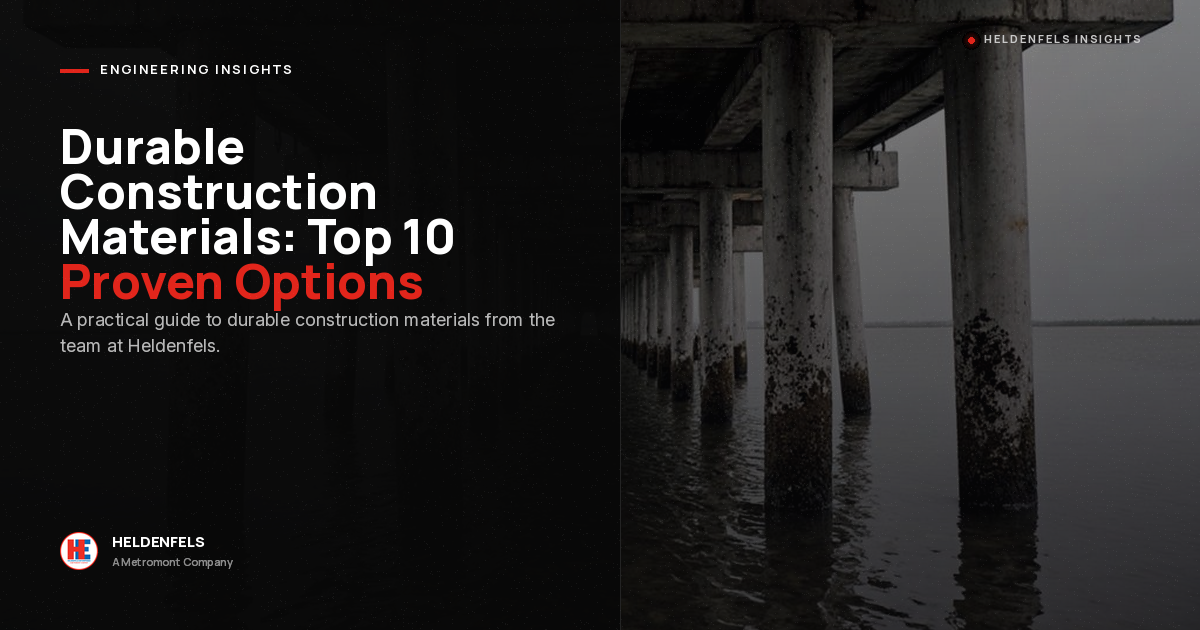
Durable Construction Materials: Guide for the Top 10 Proven Options
A practical, engineer’s ranking of the materials that actually go the distance, and why precast concrete keeps earning the top spot on projects built to outlast their owners.
When people ask which building materials last the longest, they are usually weighing a much bigger question: how do you spend a construction budget once and not pay for it again every fifteen years? Choosing the right durable construction materials is the difference between a structure that needs constant patching and one that quietly does its job for generations. Some materials resist fire but rot in moisture. Others shrug off water but corrode in salt air. The strongest choices hold up against all of it at the same time.
Below is our ranked breakdown of the ten most durable options used in real projects today, from natural stone to engineered composites, with an honest look at where each one wins and where it falls short. We build precast and prestressed concrete for bridges, stadiums, and marine structures across Texas, so we will not pretend every material is equal. But we will tell you exactly why the rankings land where they do.
In This Guide
What Makes a Material Truly Durable
Durability is not a single property. A material earns its reputation by performing across several stress tests at once, and the best durable construction materials score well on every one of them rather than excelling at just a single trait.
When our engineers evaluate a material for a long-service structure, we look at five things: compressive and tensile strength under load, resistance to water and chemical intrusion, fire performance, dimensional stability across temperature swings, and maintenance demand over a 50 to 100 year horizon. A material that aces strength but needs repainting every decade has a hidden lifetime cost that rarely shows up in the original bid.
The Top 10 Durable Construction Materials, Ranked
Precast & Prestressed Concrete
Cast and cured in a controlled plant rather than in the weather, precast concrete reaches consistent strength, tight tolerances, and dense, low-permeability surfaces that resist water and chloride intrusion. Prestressing adds internal tension that lets a beam or pile carry heavier loads with less cracking over time. Bridge girders and marine piles cast decades ago are still in active service, which is why it anchors the top of any honest durability list.
Natural Stone (Granite & Basalt)
Granite and basalt have proven themselves over literal millennia. Their compressive strength is enormous and they barely weather. The catch is cost, weight, and weak tensile behavior, which limits stone to cladding, paving, and compression-only elements rather than spanning structural members.
Structural Steel
Steel offers an unmatched strength-to-weight ratio and is the backbone of high-rise framing. Left unprotected, though, it corrodes, loses capacity in fire without insulation, and carries an ongoing coating and inspection burden in humid or coastal settings.
Reinforced Cast-in-Place Concrete
Concrete poured on site shares much of precast’s durability DNA, but field curing in heat, rain, and wind makes quality harder to control. The result is generally strong and fire-resistant, just less consistent than a plant-cast equivalent.
Fired Clay Brick
Brick is a heritage material for good reason. It resists fire, weather, and decay with almost no upkeep. Its limitation is structural: modern brick is mostly a veneer over a stronger frame rather than a load-bearing system on its own.
Fiber Cement
A blend of cement, sand, and cellulose fiber, fiber cement siding and panels resist rot, insects, and fire far better than wood. It is a durable cladding choice, though it handles enclosure duty rather than carrying real structural load.
Aluminum
Aluminum forms a self-protecting oxide layer that resists corrosion without paint, making it excellent for facades, curtain walls, and roofing. It is soft and low in stiffness compared to steel, so it suits envelope work more than primary structure.
Engineered Mass Timber (CLT)
Cross-laminated timber has revived wood as a serious structural material, with good strength and a strong sustainability story. It still demands disciplined moisture control and fire detailing, and its long-term durability record is measured in decades rather than centuries.
Fiber-Reinforced Polymer (FRP)
FRP composites are corrosion-proof and remarkably light, which makes them valuable for repairs and aggressive chemical environments. Cost and a relatively short field history keep them in specialty roles rather than mainstream structural use.
Treated Hardwood
Properly treated dense hardwoods can last generations in the right conditions, and they remain a renewable, attractive option. But of every material here, wood is the most vulnerable to moisture, insects, and fire, which is why it closes out the list.

Plant-cast components reach consistent strength and dense, low-permeability surfaces that field pours struggle to match.
Side-by-Side Durability Comparison
Rankings are useful, but a quick scan across the key properties shows why the order falls the way it does. Notice how few materials score high on every column at once.
| Material | Typical Service Life | Moisture Resistance | Fire Performance | Maintenance |
|---|---|---|---|---|
| Precast Concrete | 100+ years | Excellent | Excellent | Very Low |
| Natural Stone | 100+ years | Excellent | Excellent | Low |
| Structural Steel | 50–100 years | Needs coating | Needs protection | Moderate |
| Cast-in-Place Concrete | 75–100 years | Very Good | Excellent | Low |
| Fired Clay Brick | 100+ years | Very Good | Excellent | Low |
| Mass Timber (CLT) | 50–80 years | Needs control | Needs detailing | Moderate |
| Treated Hardwood | 30–60 years | Fair | Poor | High |
Why Precast Concrete Leads the Durable Construction Materials List
The top spot is not brand loyalty talking. Precast concrete combines the things that usually force a trade-off in other materials. It is fire-resistant like stone, strong like steel, and resistant to water and rot in a way wood and unprotected metal never are, all in a single component that arrives ready to install.
The controlled-plant advantage is the part most people overlook. When concrete is batched, cast, and cured indoors to a fixed mix design, the finished surface is denser and far less permeable than a pour that set up in summer heat or a cold snap. Lower permeability means water, chlorides, and freeze-thaw cycles have a much harder time reaching the reinforcement inside. That single factor drives most of the long-term durability difference between a structure that lasts 40 years and one that lasts well past 100.
Prestressing compounds the advantage. By tensioning high-strength strand before the load ever arrives, we keep the concrete in compression where it is strongest and limit the cracking that lets moisture in. That is exactly why coastal and marine projects rely on prestressed concrete piles for long-lasting foundations that stand in saltwater for decades, and why exterior enclosures use precast wall panels that withstand harsh weather conditions without the constant upkeep other claddings demand. The same logic carries through highway work, where precast girders are still carrying traffic generations after they were cast.
The cheapest material at bid time is rarely the cheapest over a building’s life. Durability is a budgeting decision disguised as a material spec, and the option that almost never needs you to come back is usually the one that wins.

Prestressed girders carry heavier loads with less cracking, the reason so many remain in service decades after installation.
Choosing the Right Material for Your Project
The best material depends on what the structure has to survive. Use this quick logic to narrow the field before you ever request a quote.
Match the material to the threat
For anything exposed to water, salt, or freeze-thaw, like piers, parking structures, and foundations, prioritize low permeability. Plant-cast concrete leads here. For pure aesthetic cladding with a long life, stone and brick are hard to beat. For tall, light framing on a tight site, steel often makes sense despite its maintenance burden.
Count the lifetime cost, not the bid price
A material that needs recoating, sealing, or replacement on a cycle carries a cost that compounds quietly for decades. Fire resistance and sustainability matter too, and concrete performs strongly on both, a point we cover in our look at sustainable precast options. Run the numbers over the full service life and the durable choice usually becomes the economical one.
Lean on industry standards
Independent benchmarks keep material claims honest. Bodies like the Precast/Prestressed Concrete Institute publish testing and certification frameworks that let you verify a manufacturer’s quality rather than take it on faith. Specifying a certified plant is one of the simplest ways to protect long-term durability.
The Bottom Line on Durable Construction Materials
Every material on this list has a place, and the right answer always depends on the loads, the environment, and the budget horizon. Stone and brick will outlast us all in the right role, steel makes the impossible spans possible, and mass timber is rewriting what wood can do.
But when a structure has to carry heavy loads, stand up to water and fire, and do it for a century with minimal upkeep, precast and prestressed concrete keeps earning the top of the list. It is the material that turns a one-time decision into a structure your grandchildren will still be using.
Building Something Meant to Last?
For more than a century, Heldenfels Enterprises has engineered precast and prestressed concrete for bridges, stadiums, and marine structures across Texas. Let’s talk about the right materials for your project.
Start the Conversation →