
Precast Concrete Block Retaining Walls: Definitive Expert Guide to Proven Systems
Master the complete design, manufacturing, and installation process for precast concrete block retaining wall systems
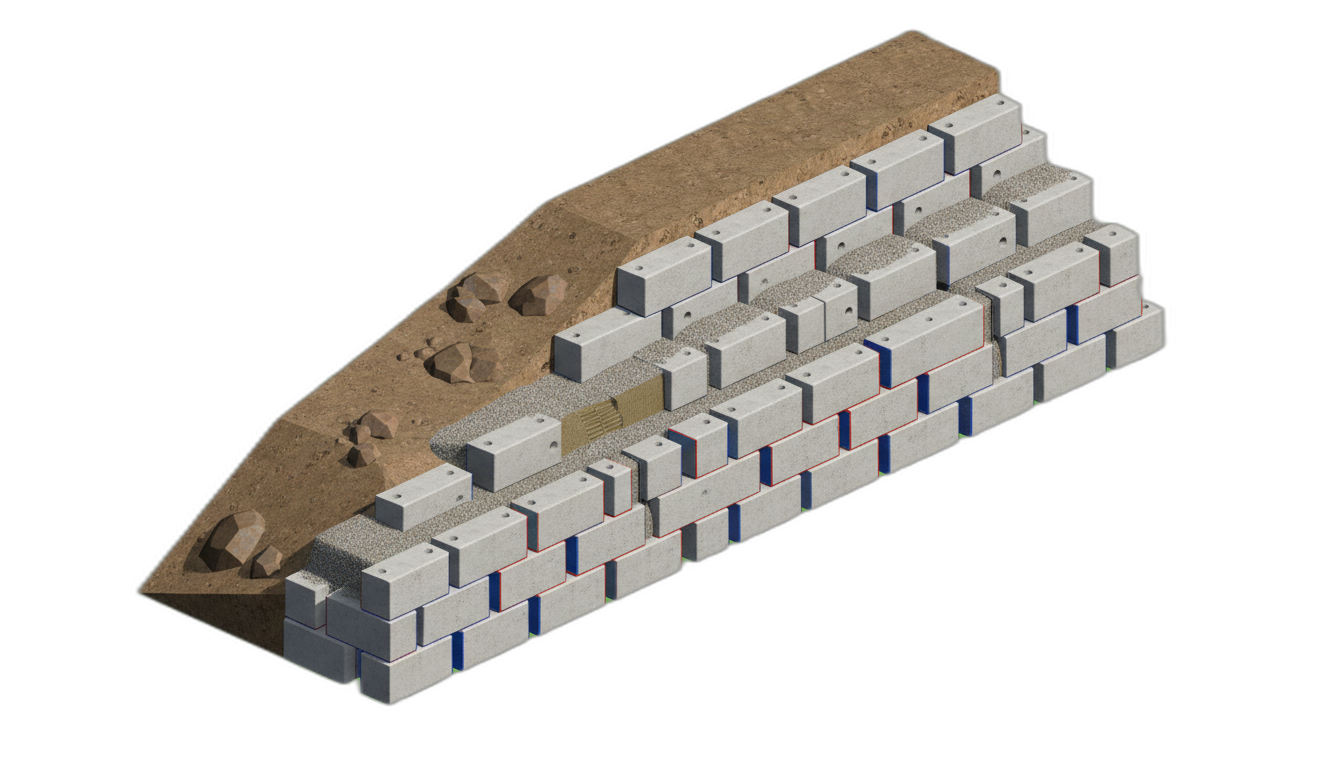
Precast concrete block retaining walls deliver structural performance and rapid installation for commercial and infrastructure projects
What Are Precast Concrete Block Retaining Walls?
Precast concrete block retaining walls are engineered earth retention systems constructed from factory-manufactured concrete components that are transported to the project site and assembled into gravity or mechanically stabilized wall structures. Unlike cast-in-place retaining walls that require extensive on-site formwork, reinforcement placement, concrete pouring, and curing time, precast concrete block retaining walls arrive ready for immediate installation — dramatically reducing construction timelines and site disruption.
At Heldenfels Enterprises, we manufacture precast retaining wall components in our controlled production facilities, ensuring consistent quality, precise dimensions, and structural performance that meets the most demanding engineering specifications. Our precast wall panels and retaining wall systems serve highway departments, commercial developers, and industrial clients throughout Texas and beyond.
Types of Precast Concrete Block Retaining Walls
Several distinct precast concrete block retaining wall systems are available, each designed for specific site conditions, loading requirements, and aesthetic preferences. Understanding the differences between these systems is essential for selecting the right solution for your project.
Gravity Retaining Walls
Gravity retaining walls rely on the mass and weight of the precast concrete blocks themselves to resist lateral earth pressures. These walls are typically used for moderate height applications up to 10-12 feet. The large, interlocking precast blocks are stacked without mortar, with the wall's self-weight and geometric batter providing stability.
Gravity walls are the simplest precast concrete block retaining wall configuration to design and install, making them ideal for projects where rapid construction and cost efficiency are priorities. No soil reinforcement is required, simplifying the backfill process.
Mechanically Stabilized Earth (MSE) Walls
MSE walls combine precast concrete facing panels with horizontal soil reinforcement layers (geogrids or steel strips) extending back into the retained earth. This system creates a reinforced soil mass that acts as a gravity structure, enabling wall heights exceeding 40 feet. The precast panels serve as the facing element while the reinforced soil provides structural stability.
MSE precast concrete block retaining walls are the preferred system for highway and transportation applications, offering excellent seismic performance, tolerance for settlement, and cost-effectiveness at heights where traditional gravity walls become impractical.
Cantilever Retaining Walls
Precast cantilever retaining walls feature an L-shaped or inverted T-shaped cross section, with the base slab extending under the retained soil. The weight of soil on the base slab, combined with the structural capacity of the stem, provides resistance against overturning and sliding. These walls are effective for heights up to 20-25 feet.
Factory production of cantilever sections ensures consistent concrete quality, precise reinforcement placement, and optimal structural performance — advantages difficult to achieve with cast-in-place cantilever construction on congested job sites.
Modular Block Systems
Modular precast concrete block retaining walls use standardized interlocking blocks that stack without mortar. Connection between courses is typically achieved through shear keys, pins, or geometric interlocking features cast into the blocks. These systems are highly versatile, allowing curved alignments and stepped configurations.
Modular systems excel in projects requiring speed and design flexibility. Standard block sizes allow rapid installation while accommodating complex wall geometries that would require custom formwork in cast-in-place construction.
Design Considerations for Precast Concrete Block Retaining Walls
Successful precast concrete block retaining walls require careful engineering analysis that accounts for site-specific conditions, loading requirements, and long-term performance expectations. The design process integrates geotechnical investigation, structural analysis, and constructability planning to produce retaining wall systems that perform reliably for their entire design life.
Geotechnical Investigation
Every retaining wall project begins with a thorough understanding of subsurface conditions. Soil borings, laboratory testing, and geotechnical analysis establish the bearing capacity, lateral earth pressure coefficients, groundwater conditions, and settlement characteristics that govern retaining wall design. According to the Federal Highway Administration, geotechnical investigation is the single most important factor in retaining wall performance — inadequate site characterization is the leading cause of retaining wall failures nationwide.
Lateral Earth Pressure Analysis
Precast concrete block retaining walls must resist active earth pressure from the retained soil, surcharge loads from traffic or structures above the wall, and hydrostatic pressure from groundwater. Engineers calculate these forces using established methods (Rankine, Coulomb, or finite element analysis) to determine the required wall section, reinforcement, and foundation dimensions. The design must also verify stability against sliding, overturning, and bearing capacity failure.
Always account for drainage behind precast concrete block retaining walls. Hydrostatic pressure from trapped groundwater can double the lateral forces on a retaining wall. Proper drainage aggregate, filter fabric, and weep holes are essential components of every retaining wall design.
Seismic Design Requirements
In seismically active regions, precast concrete block retaining walls must resist additional lateral forces generated by earthquake ground motion. The Mononobe-Okabe method or numerical analysis techniques are used to calculate seismic earth pressures. MSE walls with flexible reinforcement connections between panels perform particularly well under seismic loading, as the system can accommodate differential movement without structural distress.
Manufacturing Process for Precast Retaining Wall Components
The manufacturing process for precast concrete block retaining walls directly impacts structural performance, dimensional accuracy, and installation efficiency. Factory-controlled production delivers consistent quality that field-cast construction cannot match.
Mold Preparation and Setup
Steel molds are cleaned, treated with release agent, and configured for the specific wall panel dimensions required. Connection hardware, lifting inserts, and alignment features are precisely positioned within the mold before reinforcement placement begins.
Reinforcement Placement
Welded wire fabric or individual reinforcing bars are positioned within the mold according to engineering drawings. Cover spacers ensure proper concrete cover over all reinforcement. For prestressed components, tendons are stressed to specified forces before concrete placement.
Concrete Batching and Casting
High-performance concrete is batched using computer-controlled systems that ensure precise mix proportions. Concrete is placed into forms and consolidated using internal vibration to eliminate air voids and achieve full reinforcement encapsulation. Mix designs typically achieve 5,000-8,000 psi compressive strength.
Controlled Curing and Stripping
Components cure under controlled temperature and humidity conditions — often using steam curing to accelerate strength gain. Panels are stripped from molds once they reach specified release strength, then moved to storage yards for continued curing until reaching design strength.
Quality Inspection and Delivery
Every component undergoes dimensional inspection, surface quality evaluation, and documentation review before release for shipment. Precast concrete block retaining wall panels are transported to the project site on flatbed trailers, arriving ready for immediate installation.
Precast vs. Cast-in-Place Retaining Walls: Complete Comparison
Project teams evaluating precast concrete block retaining walls against traditional cast-in-place alternatives should consider the full spectrum of cost, schedule, quality, and performance factors that influence total project value.
| Factor | Precast Block Walls | Cast-in-Place Walls |
|---|---|---|
| Installation Speed | 75% faster — panels set same day | Weeks for form, pour, cure, strip |
| Quality Consistency | Factory-controlled, PCI certified | Variable — weather and crew dependent |
| Weather Sensitivity | Minimal — manufactured indoors | High — rain, cold, heat affect quality |
| Site Labor Required | Crane crew + small setting crew | Large crew for forming, rebar, pour |
| Site Footprint | Minimal staging area needed | Extensive material storage and work area |
| Design Life | 100+ years with proper drainage | 75-100 years typical |
| Aesthetic Options | Multiple textures, colors, patterns | Form liner textures, limited options |
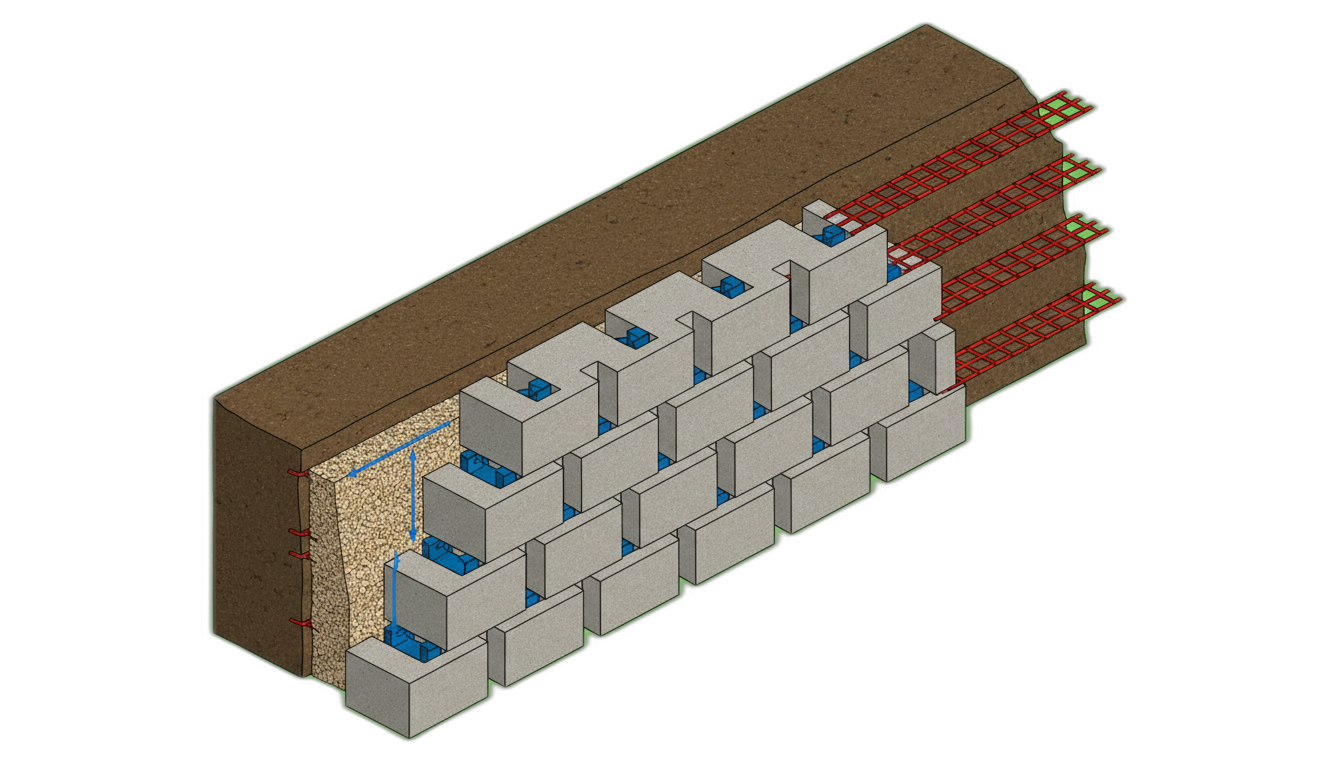
Factory manufacturing ensures every retaining wall component meets exacting quality and dimensional standards
Installation Best Practices for Precast Concrete Block Retaining Walls
Proper installation is essential to ensure precast concrete block retaining walls perform as designed throughout their service life. While installation is significantly faster and simpler than cast-in-place construction, following established best practices protects the long-term performance of the wall system.
Foundation Preparation
The foundation must be excavated to the specified depth and compacted to achieve required bearing capacity. A leveling pad of compacted crushed stone provides a uniform bearing surface for the first course of blocks or panels. Foundation elevation and alignment must be verified before any components are placed — corrections at this stage are simple, but errors compound rapidly as wall height increases.
Component Setting and Alignment
Precast components are lifted into position using cranes and guided by experienced setting crews. Each component is checked for plumb, level, and alignment before proceeding to the next unit. Connection hardware between panels is installed and tightened according to engineering specifications. For MSE walls, geogrid reinforcement layers are placed and backfilled in lifts as the wall rises.
Drainage System Installation
Drainage is critical to retaining wall longevity. A drainage aggregate zone behind the wall face, combined with perforated drain pipe at the wall base and filter fabric to prevent soil migration, ensures groundwater drains freely rather than building hydrostatic pressure against the wall. Our precast foundation solutions incorporate drainage provisions that protect both the wall structure and adjacent infrastructure.
The difference between a retaining wall that lasts 30 years and one that lasts 100 years comes down to three things: proper drainage, quality materials, and engineered design. Precast concrete block retaining walls deliver all three when manufactured and installed correctly.
Heldenfels Enterprises Retaining Wall DivisionCommon Applications for Precast Concrete Block Retaining Walls
Precast concrete block retaining walls serve diverse applications across transportation, commercial, industrial, and residential construction. Their speed of installation, structural capacity, and aesthetic versatility make them the preferred earth retention solution for time-sensitive and quality-critical projects.
- Highway and Transportation: Bridge abutments, roadway widening, interchange ramps, and noise barriers along major corridors
- Commercial Development: Site grading, parking structure perimeters, building pad creation, and loading dock walls
- Industrial Facilities: Containment walls, material storage bays, rail siding grade changes, and equipment pad support
- Waterfront and Marine: Bulkheads, flood protection walls, and channel lining applications where water resistance is critical
- Residential and Municipal: Subdivision grading, park terracing, stormwater management, and slope stabilization
Our engineering and manufacturing teams have delivered precast retaining wall systems for highway projects, commercial developments, and industrial facilities across the region. We handle everything from design assistance through manufacturing, delivery, and installation support — ensuring every wall performs as intended for its full design life.
Conclusion: Precast Concrete Block Retaining Walls Deliver Superior Performance
Precast concrete block retaining walls combine the structural reliability of engineered concrete with the speed and quality advantages of factory manufacturing. Whether your project requires gravity walls for moderate heights or MSE systems for major transportation infrastructure, precast retaining wall components deliver faster installation, more consistent quality, and longer service life than cast-in-place alternatives.
At Heldenfels Enterprises, we manufacture precast retaining wall panels, blocks, and specialty components that meet the most demanding structural and aesthetic requirements. Our controlled production environment ensures every component arrives on-site dimensionally accurate, structurally sound, and ready for immediate installation. Contact our team today to discuss how precast concrete block retaining walls can accelerate your next earth retention project while delivering the quality and durability your clients expect.