
Eco Friendly Construction Materials: Essential Sustainable Precast Concrete Options
See how sustainable precast options support environmental friendly construction materials through efficient mixes, durable components, EPDs, and planning.
Project teams evaluating environmental friendly construction materials need more than broad claims about what is “green.” They need to know which precast options can reduce waste, support efficient material use, improve envelope performance, extend service life, or serve lower-impact infrastructure goals.
Precast concrete is not automatically sustainable. Cement production carries embodied carbon, transport matters, and project-specific design decisions can change the environmental outcome. The strongest approach is to select precast systems and specifications that fit the actual sustainability goals of the project, then verify those choices with product data, engineering requirements, and lifecycle considerations.
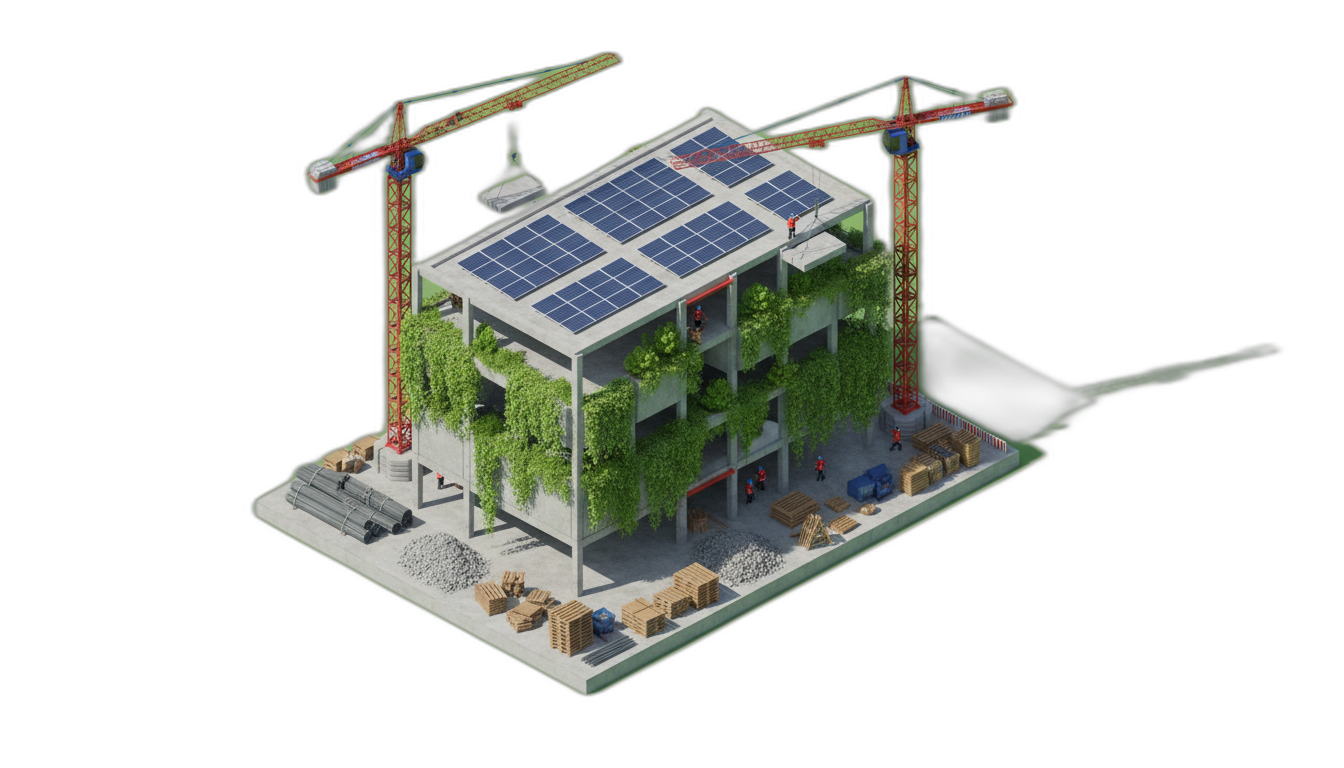
Precast concrete manufacturing delivers environmental friendly construction materials through controlled processes and reduced waste.
Which Sustainable Precast Concrete Options Support Environmental Friendly Construction Materials Goals?
The most useful sustainable precast options are not a single product category. They include lower-impact concrete mix strategies, prestressed structural components that use material efficiently, insulated wall panels, precast foundations for renewable-energy infrastructure, and durable project-specific elements designed to reduce replacement and field work.
For teams comparing environmental friendly construction materials, that means the decision should focus on what the component is expected to do. A bridge girder, wall panel, equipment foundation, battery-energy-storage foundation, or marine pile has a different environmental profile, service environment, transport requirement, and maintenance burden.
Precast can support a more efficient project when it is engineered around those conditions instead of selected only because it is manufactured off site. For a deeper explanation of waste reduction, durability, water use, recyclability, and other lifecycle benefits, see Heldenfels’ guide to how precast concrete is sustainable.
Lower-Impact Concrete Mix Designs
One of the first sustainability decisions is the concrete mix itself. Portland cement is a major contributor to concrete’s embodied carbon, so reducing cement intensity where engineering requirements allow can matter more than attaching a generic “eco-friendly” label to the finished component.
Potential approaches include using supplementary cementitious materials, optimizing cementitious content, selecting aggregates strategically, and designing mixes around required strength, durability, curing, and exposure conditions. The exact mix depends on structural performance, specifications, availability, and the environment in which the precast component will operate.
Project teams should avoid assuming that a high replacement percentage is automatically better. A mix still has to reach its required strength, durability, finish, production cycle, and long-term performance. Sustainable precast design is a balancing exercise between environmental impact and technical performance.
Where embodied-carbon reporting is important, Environmental Product Declarations can help. The Precast/Prestressed Concrete Institute’s Environmental Product Declarations include regionalized industry-average EPDs for architectural, insulated, and structural precast concrete. These declarations provide standardized, third-party-verified environmental information and give specifiers a more defensible basis for evaluating products than unsupported percentage claims.
What Makes a Precast Option More Sustainable?
A sustainable precast option should improve one or more measurable parts of the project without creating a larger problem elsewhere. That may mean lowering embodied carbon in the mix, reducing the quantity of material needed, combining several building functions in one component, limiting jobsite waste, shortening disruptive field work, improving durability, or supporting efficient end-of-life recovery.
These factors should be considered together. For example, an insulated wall panel may reduce the need for separate structural, insulation, and facade layers, but its overall value still depends on panel design, insulation performance, transportation, connections, and the building energy model. A prestressed member may reduce the number of supports or allow a more efficient section, but hauling distance and erection equipment still matter.
This whole-project approach is especially important when environmental friendly construction materials are part of a formal sustainability target. Instead of asking whether precast is “green,” project teams should define the metric they need to improve, then select and document the precast option that best supports that objective.
Prestressed Structural Components for Material-Efficient Design
Prestressing can be a useful option when a project needs long spans, high load capacity, or efficient structural sections. By introducing compressive forces into the concrete, prestressing allows structural members to resist service loads differently from conventionally reinforced concrete and can make slimmer or longer-spanning elements practical in the right application.
That does not mean every prestressed member automatically has a lower environmental impact. The sustainability case depends on the whole design, including concrete volume, reinforcement, prestressing steel, span, number of supports, transportation, erection, maintenance, and expected service life.
For environmental friendly construction materials planning, the practical question is whether the structural system can meet the project requirements with efficient use of material and fewer secondary elements. Bridge girders, slab beams, piles, wall panels, raker beams, and other prestressed components can be evaluated this way.
Early coordination between the engineer, contractor, and precast producer is important because member size, weight, hauling limits, crane access, connection details, and erection sequence all affect the final solution. A structurally efficient element that requires impractical logistics can lose some of its project-level advantage.
Insulated Precast Wall Panels for Building Envelope Performance
Insulated precast wall panels are one of the clearest examples of a precast option that combines structural and building-envelope functions. Heldenfels’ prestressed concrete wall panels can be produced as load-bearing or non-load-bearing units and are available in insulated and non-insulated configurations.
For projects focused on environmental friendly construction materials, insulated panels can be relevant because they can combine concrete wythes, insulation, structure, and exterior finish within a factory-produced system. This can reduce the number of separate wall assemblies and field-installed layers required, depending on the project design.
The environmental value should still be evaluated project by project. Important questions include:
- What insulation level does the energy model require?
- How are panel joints and connections detailed?
- Will the system reduce thermal bridging?
- Can the wall assembly eliminate separate cladding or backup systems?
- What maintenance will the exterior finish require?
- How far will the panels travel and what lifting equipment will be needed?
Concrete’s thermal mass can help moderate temperature swings, but thermal mass alone does not guarantee lower building energy use. Climate, insulation, air sealing, glazing, controls, occupancy, and HVAC design all influence performance. The more credible sustainability case is therefore based on the complete wall assembly and modeled building performance, not a universal energy-savings percentage.
Precast Foundations for Renewable-Energy and BESS Projects
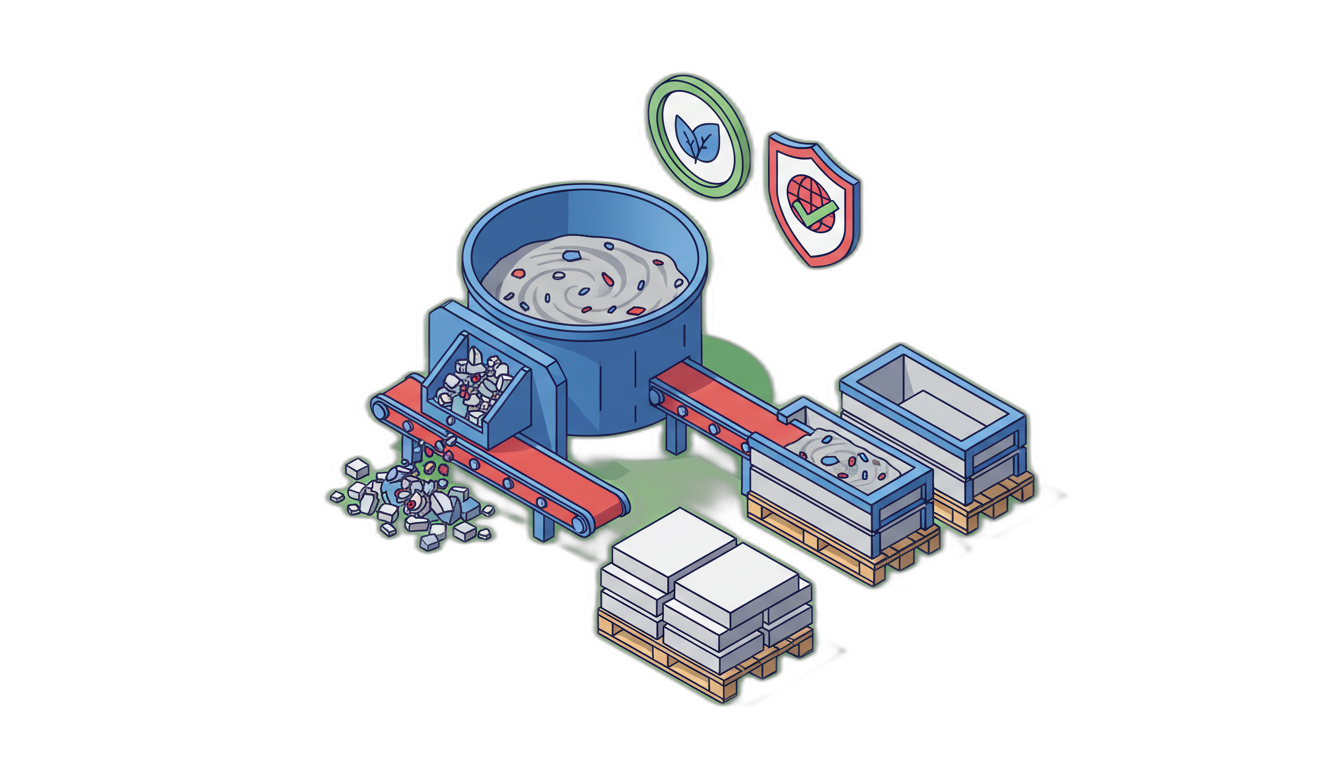
Precast concrete foundations support renewable energy infrastructure with minimal environmental impact.
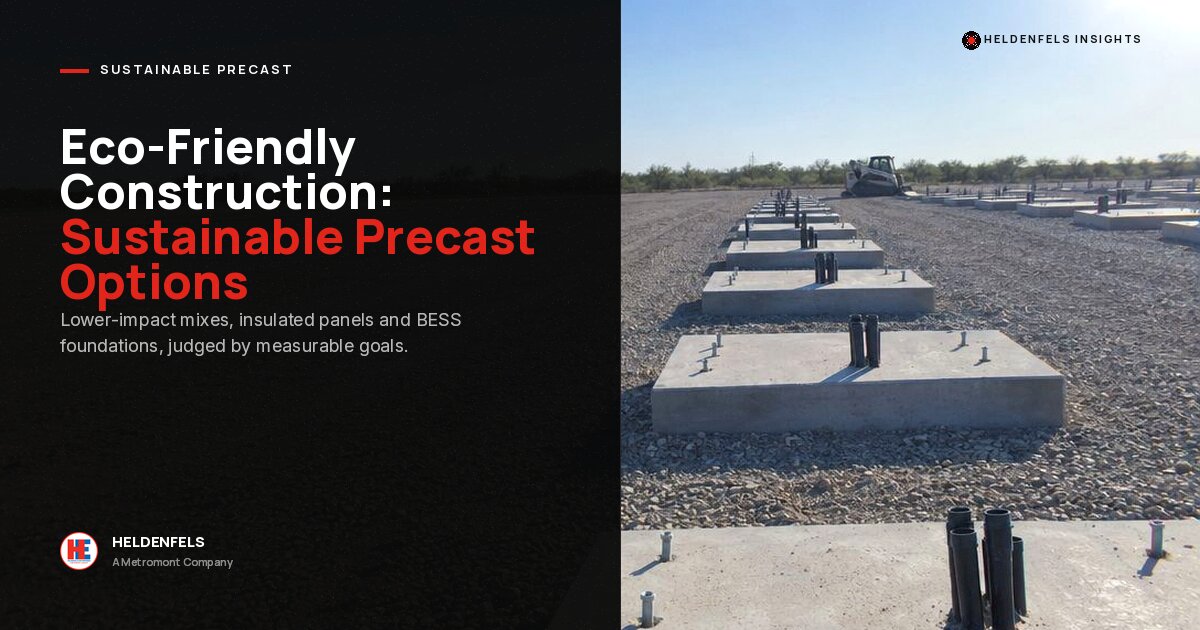
Sustainable precast concrete options also include foundations for renewable-energy and energy-storage infrastructure. Heldenfels manufactures precast foundations for Battery Energy Storage Systems , including adjustable foundation solutions intended for different battery and inverter configurations.
This application is relevant to environmental friendly construction materials because the precast element supports infrastructure that is itself part of modern energy systems while also allowing foundation production to move into a controlled plant environment. Repeated foundation geometry can be especially suitable for reusable forms and planned production.
The sustainability value comes from project execution rather than from assuming that every precast foundation is inherently low impact. Teams should consider the number of units, mix design, reinforcement, transport distance, site access, installation equipment, grading requirements, and whether the precast system reduces field forming, curing, rework, or repeated concrete deliveries.
For large BESS sites, repetition can create opportunities to standardize forms, optimize reinforcement, coordinate embeds, and sequence delivery efficiently. Those factors can reduce avoidable material use and field activity while keeping installation predictable.
Precast foundations can also be useful where the site schedule or operating environment makes lengthy field-cast work difficult. However, the best solution still depends on geotechnical requirements, equipment loads, anchorage, drainage, local codes, and the project engineer’s design.
Durable Precast Options for Infrastructure and Industrial Projects
A sustainable material decision should account for how long the component is expected to remain in service and what it will require over that period. This is especially important in highway, marine, industrial, and heavy civil work, where replacement can involve traffic closures, specialized equipment, demolition, and significant additional material.
Heldenfels manufactures precast and prestressed components for highway and bridge, marine, industrial, sports, entertainment, and custom applications. In these settings, durability is not a marketing extra. It is part of the environmental calculation.
For example, a precast element exposed to chlorides, moisture, heavy loads, abrasion, or industrial conditions should be designed around that exposure. Concrete mix, cover, reinforcement, prestressing, drainage, connections, detailing, and quality control all influence how well the component performs.
This is where environmental friendly construction materials decisions need to move beyond initial material quantities. A component that uses slightly more material upfront but avoids premature repair or replacement may produce a better lifecycle outcome than a lighter option that performs poorly in the actual environment.
Project teams should also consider whether the component can be manufactured with repeatable forms, whether integrated embeds can reduce field drilling or modification, and whether off-site production can shorten disruptive work at the project location.
How Should Environmental Friendly Construction Materials Be Evaluated for a Precast Project?
The strongest way to evaluate sustainable precast options is to compare measurable project requirements rather than rely on broad environmental claims.
Ask for Environmental Product Information
If embodied carbon or green-building documentation matters, ask what environmental information is available for the product category. PCI’s current regionalized EPDs cover architectural, insulated, and structural precast concrete and can help teams understand industry-average impacts.
An EPD is not a blanket sustainability certificate and should not be treated as one. It is a standardized disclosure of environmental impacts based on defined rules and system boundaries. PCI also cautions that EPD comparisons need compatible functional units, reference service life, lifecycle scope, and product category rules to be meaningful.
Check Whether the Design Uses Material Efficiently
A sustainable precast option should be engineered for its actual loads and geometry. Oversizing adds unnecessary material. Undersizing creates performance risk. Repetition, prestressing, optimized section shapes, coordinated openings, cast-in embeds, and efficient reinforcement can all affect material use.
This is one reason early precast input can be valuable. Decisions made before drawings are locked can affect panel dimensions, member repetition, connection strategy, transportation, and erection planning.
Review Manufacturing and Waste Strategy
Controlled production can create opportunities to reuse forms, improve batching accuracy, plan pours, and reduce field-generated waste. However, the project team should still ask how offcuts, rejected units, wash water, returned concrete, reinforcement scrap, and demolition material are handled.
The U.S. Environmental Protection Agency’s guidance on construction and demolition materials identifies concrete as a major C&D material and notes that concrete and masonry can be recycled into applications such as fill, subbase, and other aggregate uses. That makes end-of-life planning relevant, but recyclability should not be confused with automatic closed-loop reuse.
Include Transportation and Installation
Heavy precast components must be hauled and lifted. Transportation distance, truck configuration, route restrictions, crane size, staging space, and erection sequence can materially affect project impacts.
A sustainable option on paper can become inefficient if it requires excessive hauling, multiple re-handling steps, or poorly planned site logistics. Delivery planning should therefore be part of the sustainability review, not an afterthought.
Design for Service Life, Maintenance, and Future Adaptability
Long service life is valuable only when the component is properly designed for its environment. Project teams should consider durability requirements, inspection access, connection detailing, repairability, and the consequences of future replacement.
Where practical, modularity and disassembly can also be considered. Not every structural precast element will be suitable for direct reuse, but designing with clear connections and recoverable materials can improve end-of-life options.
Selecting Sustainable Precast Concrete Options for the Project
There is no universal precast product that should be labeled the most sustainable choice for every project. The right option depends on structural demands, service environment, required lifespan, energy goals, material availability, transportation, installation, and the environmental metrics the owner is trying to improve.
For teams searching for environmental friendly construction materials, sustainable precast concrete options are strongest when they are selected deliberately: an optimized mix where lower cement intensity is feasible, prestressed members where structural efficiency matters, insulated wall panels where envelope integration is useful, or repeatable precast foundations where off-site production can simplify a large installation program.
The article on how precast concrete is sustainable explains the broader environmental benefits. This page serves a different purpose: helping project teams identify which precast options and specification decisions deserve attention when sustainability is part of procurement and design.
Discuss Sustainable Precast Options for Your Project
Heldenfels Enterprises works across highway, marine, industrial, sports, entertainment, and custom precast applications in Texas. If sustainability targets are part of your project requirements, talk with our team about the component type, performance criteria, production approach, logistics, and documentation needed for your precast scope.
Contact Our Team