
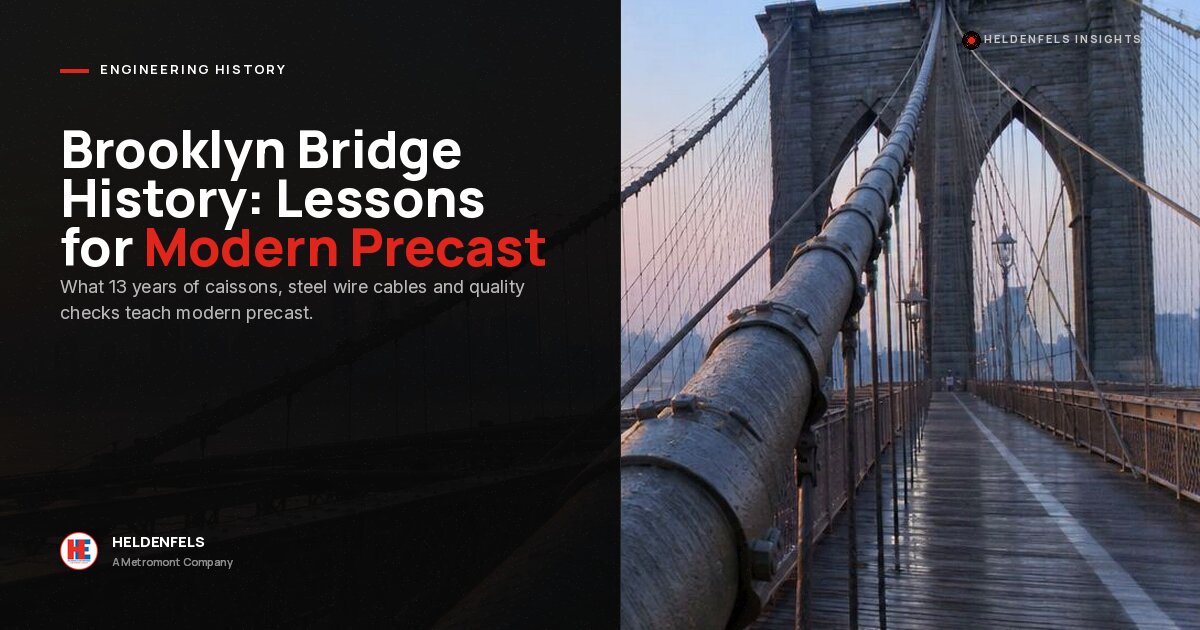
Brooklyn Bridge History: Proven Lessons for Modern Precast Construction
How the Brooklyn Bridge’s 19th-century construction and engineering breakthroughs offer useful lessons for today’s precast concrete industry
The Brooklyn Bridge’s formal construction began on January 3, 1870, following design approval and preliminary work in 1869. The bridge officially opened on May 24, 1883 — a monumental undertaking lasting more than 13 years that pushed the boundaries of what engineers believed possible.
Designed by John Augustus Roebling and completed under the direction of his son Washington Roebling, the project also depended heavily on Emily Warren Roebling, who relayed Washington’s instructions, communicated with engineers and contractors, and took on important project responsibilities after her husband became ill. This iconic suspension bridge spanning the East River between Manhattan and Brooklyn revolutionized how we think about large-scale construction projects.
At Heldenfels Enterprises, we study landmark infrastructure projects like the Brooklyn Bridge because they reveal timeless principles about quality, durability, and innovation — principles that directly inform our approach to modern bridge construction techniques. The challenges overcome during the Brooklyn Bridge’s construction parallel many obstacles we address today through precast concrete technology.
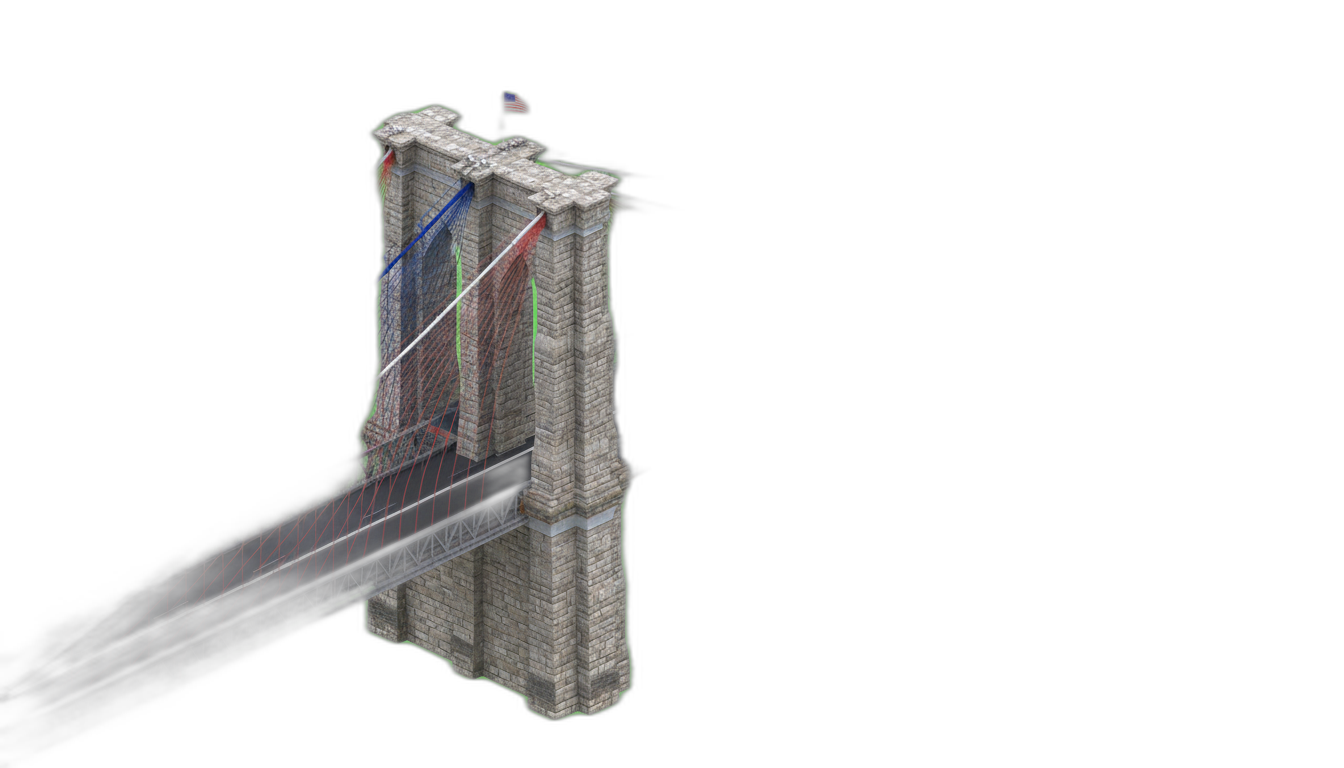
The Brooklyn Bridge’s pioneering construction methods offer useful lessons for modern precast concrete engineering
Historic Construction Challenges That Shaped Modern Innovation
Understanding the Brooklyn Bridge’s construction in context requires examining the extraordinary engineering challenges that workers and engineers confronted during those 13 years of construction. The project demanded solutions that had never been attempted at such a scale, and the lessons learned continue to resonate throughout the construction industry.
Pioneering Foundation Work
One of the Brooklyn Bridge’s most dangerous construction methods involved pneumatic caissons — massive wooden boxes sunk to the riverbed where workers excavated under compressed air. These caissons reached depths of 44 feet on the Brooklyn side and 78 feet on the Manhattan side. Workers suffered from “caisson disease” (decompression sickness), a condition not yet understood at the time.
The American Society of Civil Engineers recognizes the Brooklyn Bridge as a National Historic Civil Engineering Landmark and documents the enormous difficulties faced during its construction. The caisson phase was one of the project’s most hazardous and technically demanding stages.
Today, precast concrete foundations can reduce certain on-site risks by shifting fabrication into controlled plant conditions and reducing some field construction activities. Prefabrication can also shorten on-site installation time and limit worker exposure to hazardous work-zone conditions, depending on the project.
Material Innovation Under Pressure
The Brooklyn Bridge’s construction demanded exceptional material performance. John Roebling specified steel wire cables — a bold choice when most bridges still relied on iron. The bridge’s four main cables, each containing 5,434 individual wires, represented a leap of faith in material science that ultimately proved transformative for the industry.
| Construction Approach | How It Worked |
|---|---|
| Brooklyn Bridge Era Methods |
Construction relied on hand-mixed concrete, manually placed stone masonry, and site-assembled steel cables. Much of the erection and assembly occurred on-site under variable weather conditions, while key materials and components, including steel wire, shaped stone, and ironwork, were produced off-site. Quality depended heavily on individual craftsmanship and constant supervision. More than 600 workers were involved in the bridge’s construction, with limited mechanization available.
Foundation work required laborers to work in pressurized environments underwater — a dangerous, slow, and unpredictable process that caused numerous injuries and delays throughout the construction timeline. |
| Today’s Precast Concrete Advantages |
Modern precast manufacturing takes place in controlled plant environments where mix designs, reinforcement placement, dimensions, and curing are managed to specified quality standards and tolerances. Components arrive on-site ready for installation, which can reduce field labor requirements and weather-related delays.
Advanced precast bridge girders used in today’s construction incorporate prestressing technology that allows longer spans with shallower sections — capabilities that would have astonished the Roebling engineers. |
Brooklyn Bridge Construction Date Timeline: Key Milestones
The full scope of the Brooklyn Bridge construction timeline reveals how each phase built upon previous innovations. While modern precast projects use very different technologies, both historical and current infrastructure work depend on careful sequencing and coordination across multiple construction phases.
| Year | Milestone | Modern Precast Parallel |
|---|---|---|
| 1869 | Design approval and initial surveying | BIM modeling and digital design coordination |
| 1870 | Caisson construction begins on Brooklyn side | Precast foundation manufacturing in controlled plant |
| 1871 | Manhattan caisson work commences | Parallel production lines accelerate component delivery |
| 1875–1876 | Brooklyn tower completed in 1875 and Manhattan tower completed in 1876 | Precast column and beam erection in weeks, not years |
| 1877 | Cable spinning begins across the East River | Prestressed tendon technology in precast girders |
| 1883 | Bridge opens to public after more than 13 years | Prefabricated bridge elements can reduce on-site construction time |
Historical Perspective: The Brooklyn Bridge took more than 13 years to complete — a duration that seemed reasonable for the era’s technology and knowledge. Today, prefabricated bridge elements and precast systems can reduce on-site construction time for suitable projects, although schedules vary with span type, foundations, site access, traffic requirements, and overall project complexity.
How Historic Bridge Engineering Offers Lessons for Precast Innovation
The Brooklyn Bridge’s construction and engineering history illustrate principles including material innovation, quality oversight, and coordinated fabrication that remain relevant to modern infrastructure work. These parallels help show how today’s precast practices address many of the same broad construction priorities using different technologies, standards, and engineering methods.
Quality Control: From Craftsmanship to Science
During the Brooklyn Bridge’s construction, quality assurance relied on visual inspection and the experience of master builders. When a contractor attempted to substitute inferior wire for the bridge’s cables, Washington Roebling caught the deception and compensated by adding extra wires — a testament to vigilant quality oversight. Modern precast production facilities maintain PCI Plant Certification, utilizing automated testing equipment, statistical process control, and digital quality management systems that trace every component from mix design to final installation.
Prefabrication: The Brooklyn Bridge’s Hidden Innovation
While not typically recognized as a prefabrication project, the Brooklyn Bridge actually employed significant off-site manufacturing. The steel wire was produced in dedicated mills, the stone for the towers was quarried and shaped before delivery, and the iron components were fabricated in specialized shops. This distributed manufacturing approach — producing components off-site in controlled conditions — provides a useful historical parallel to the philosophy that drives modern precast concrete construction.
Heldenfels Enterprises Engineering Team: The principle of producing components off-site and assembling them on-site can be seen in large historic projects like the Brooklyn Bridge and is now central to sophisticated precast concrete manufacturing processes.
Structural Safety Margins and Durability
John Roebling designed the Brooklyn Bridge with an unusually high safety margin, with its main cables designed around a factor of safety of approximately six. Rather than representing the same form of structural redundancy used in modern design, this reflected the conservative engineering approach applied to a groundbreaking 19th-century structure. At Heldenfels, long-term precast performance is supported through contemporary structural analysis, prestressing where appropriate, high-performance materials, quality control, and current design requirements.
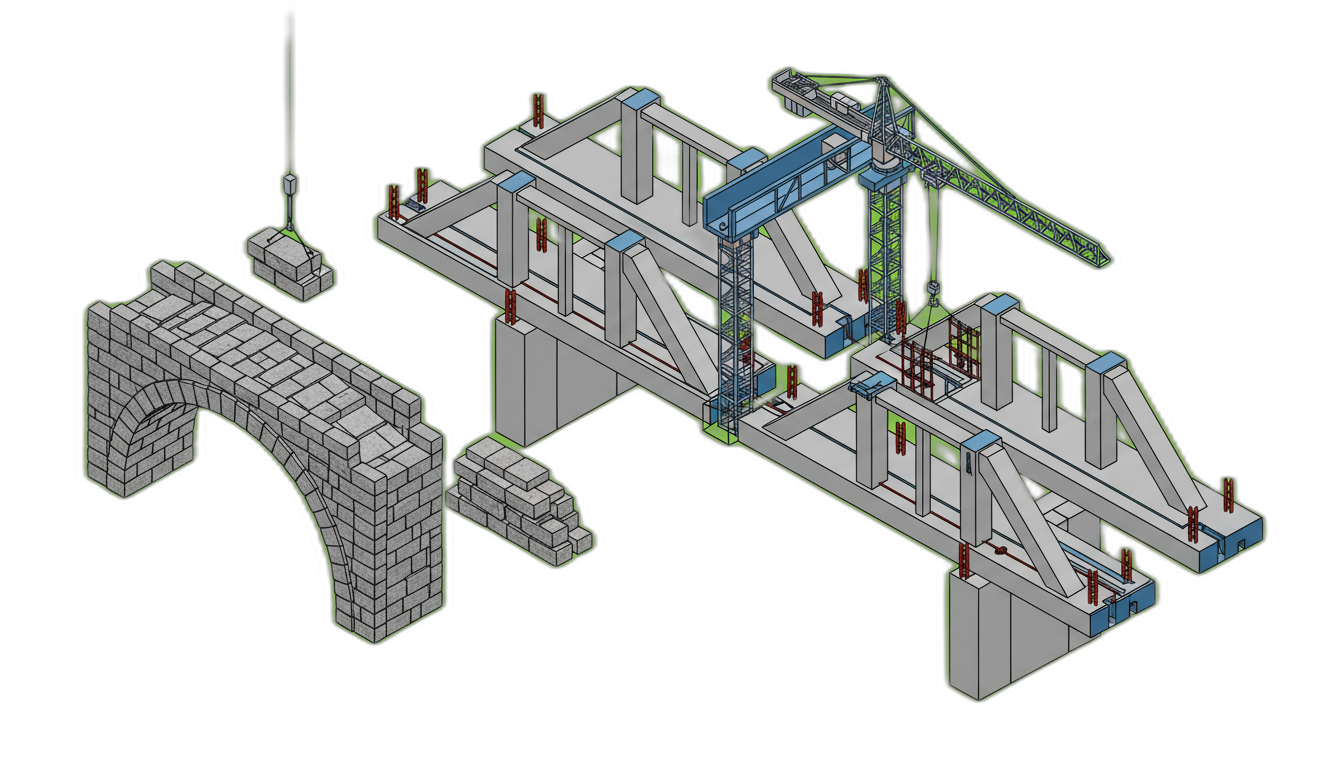
Modern precast bridge girder manufacturing applies lessons from historic engineering to achieve superior quality and efficiency
Modern Precast Applications and Lessons From the Brooklyn Bridge Era
The Brooklyn Bridge’s construction highlights challenges that modern infrastructure projects still face, including schedule coordination, material performance, worker safety, and quality control. Today’s precast applications address these priorities using technologies and engineering standards developed long after the bridge was built.
Accelerated Bridge Construction (ABC)
The Federal Highway Administration describes Accelerated Bridge Construction as the use of planning, design, materials, and construction methods that can reduce on-site construction time. Modern ABC projects may use prefabricated bridge elements and systems manufactured while other project activities proceed, helping reduce traffic disruption, weather exposure, and worker exposure to work-zone hazards depending on project conditions.
Seismic-Resistant Bridge Design
The Brooklyn Bridge’s engineers understood that structures must withstand forces beyond their primary design loads. Today’s precast bridge components can incorporate advanced seismic detailing — ductile connections, energy-dissipating joints, and isolation bearings — that allow structures to absorb earthquake forces without catastrophic failure. These technologies come from modern seismic research, code development, and detailing practices rather than directly from Brooklyn Bridge-era construction, but they reflect the same broad goal of structural resilience.
Heldenfels Advantage: Our precast bridge girders, deck panels, and substructure components are manufactured under strict quality controls that reflect the same attention to excellence that distinguished the Brooklyn Bridge from its contemporaries — with the schedule advantages that prefabrication can provide on suitable projects.
High-Performance Concrete Mixes
The Brooklyn Bridge’s masonry and foundation work used Rosendale natural cement rather than modern Portland-cement concrete. Modern precast and prestressed concrete uses engineered mix designs and controlled production to achieve specified strength and durability requirements. For bridge applications that require it, high-performance prestressed concrete can reach specified compressive strengths of 10,000 psi or higher. Self-consolidating concrete, ultra-high-performance concrete (UHPC), and modern admixture technology provide performance options that were unavailable during the Brooklyn Bridge’s 19th-century construction.
Connecting Past and Present: Why History Matters for Construction
Studying the Brooklyn Bridge’s construction history and its engineering legacy provides more than historical perspective — it offers practical insights that improve how we approach complex infrastructure projects today. The bridge remains a powerful reminder that construction excellence requires bold vision, meticulous execution, and relentless quality commitment.
At Heldenfels Enterprises, we honor this engineering tradition by continuously investing in manufacturing technology, workforce development, and quality assurance systems. Our precast concrete products serve highway bridges, commercial buildings, parking structures, and specialty applications across Texas and beyond, carrying forward the legacy of innovation that landmark projects like the Brooklyn Bridge established.
Building on a Legacy of Engineering Excellence
The Brooklyn Bridge’s 1870–1883 formal construction period represents far more than a historical footnote. It remains a landmark in suspension-bridge engineering and offers useful parallels for modern infrastructure work, particularly in material innovation, quality oversight, coordinated fabrication, and long-term structural performance. Modern precast concrete developed through later advances in concrete technology, prestressing, manufacturing, codes, and quality systems, but the bridge’s history still provides valuable lessons about solving difficult construction problems.
At Heldenfels Enterprises, we combine this proven engineering heritage with cutting-edge technology to deliver precast concrete solutions that meet the demands of 21st-century infrastructure. Whether you need bridge girders, structural components, or specialty precast elements, our team brings decades of manufacturing expertise to every project.
Build on Proven Engineering Expertise
Partner with Heldenfels for precast concrete solutions engineered for strength, quality, and efficient project delivery. Contact our team to discuss your bridge, structural, or specialty precast requirements.
Contact us today