
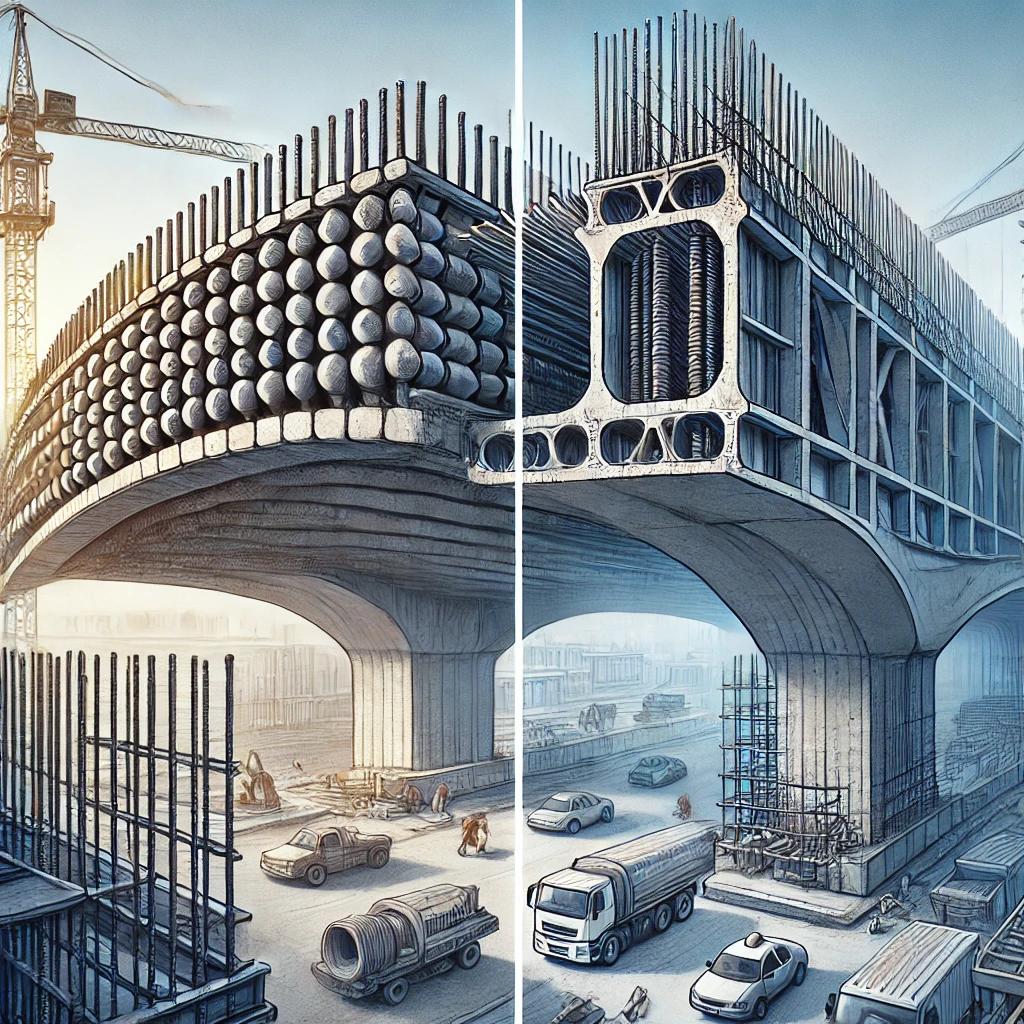
Precast Prestressed Beams vs Reinforced Concrete Beams: What’s the Difference?
Understand when reinforced concrete works best, when prestressed beams offer an advantage, and how to choose the right system for your project.
Choosing between precast prestressed vs reinforced concrete beams affects how a structure performs, how quickly it can be built, and how much field complexity the project team has to manage. For bridges, parking structures, marine work, and industrial projects, the beam decision can influence the construction schedule, erection plan, maintenance outlook, and total installed cost.
The basic difference is that reinforced concrete beams use steel rebar to resist tensile forces after loads are applied, while precast prestressed beams use tensioned steel strands to place the concrete into compression before the beam goes into service.
This article compares plant-produced precast prestressed concrete beams with conventional non-prestressed reinforced concrete beams, which are often cast in place, so the focus stays on what actually matters: span, load demand, schedule, site conditions, hauling route, crane access, exposure environment, and long-term performance.
What Are Reinforced Concrete Beams?
Reinforced concrete beams, often called RC beams, are concrete members strengthened with steel reinforcing bars. Concrete performs well under compression but poorly under tension, so rebar is added to carry the tensile forces that develop when the beam bends under load. This combination allows concrete and steel to work together, which is why reinforced concrete is widely used in buildings, bridges, foundations, retaining walls, and other civil structures.
Many reinforced concrete beams are cast in place, with crews building formwork, installing rebar, pouring concrete, consolidating the mix, and allowing the beam to cure in its final position. This gives designers and contractors flexibility for custom dimensions, unusual geometry, and integrated cast-in-place connections, but it also makes the work dependent on field conditions such as weather, labor availability, inspection timing, concrete delivery, formwork quality, and curing. Reinforced concrete is still a proven structural system, but for longer spans, faster installation, tighter crack control, or repeatable production, it may not always be the most efficient option.
What Are Precast Prestressed Beams?
Precast prestressed beams are concrete beams manufactured in a controlled plant environment using high-strength steel strands or tendons. In many plant-produced beams, the strands are tensioned before the concrete is placed, a process called pretensioning. After the concrete reaches the required strength, the strands are released, transferring compressive force into the beam as they try to return to their original length.
That built-in compression is the main advantage of prestressing. It does not make concrete naturally strong in tension; it helps offset tensile stresses that develop after the beam is installed and loaded. This is why precast prestressed beams are useful in bridge and infrastructure work, especially when a project needs repeatable members, efficient spans, and faster site installation than cast-in-place reinforced concrete can typically provide.
For example, transportation projects often use prestressed bridge members because they need consistent quality, predictable performance, and practical erection methods. Heldenfels’ work with precast prestressed bridge girders is a direct example of where this system fits: highway overpasses, river crossings, railroad bridges, and urban interchanges.
Precast Prestressed vs Reinforced Concrete Beams: The Core Difference
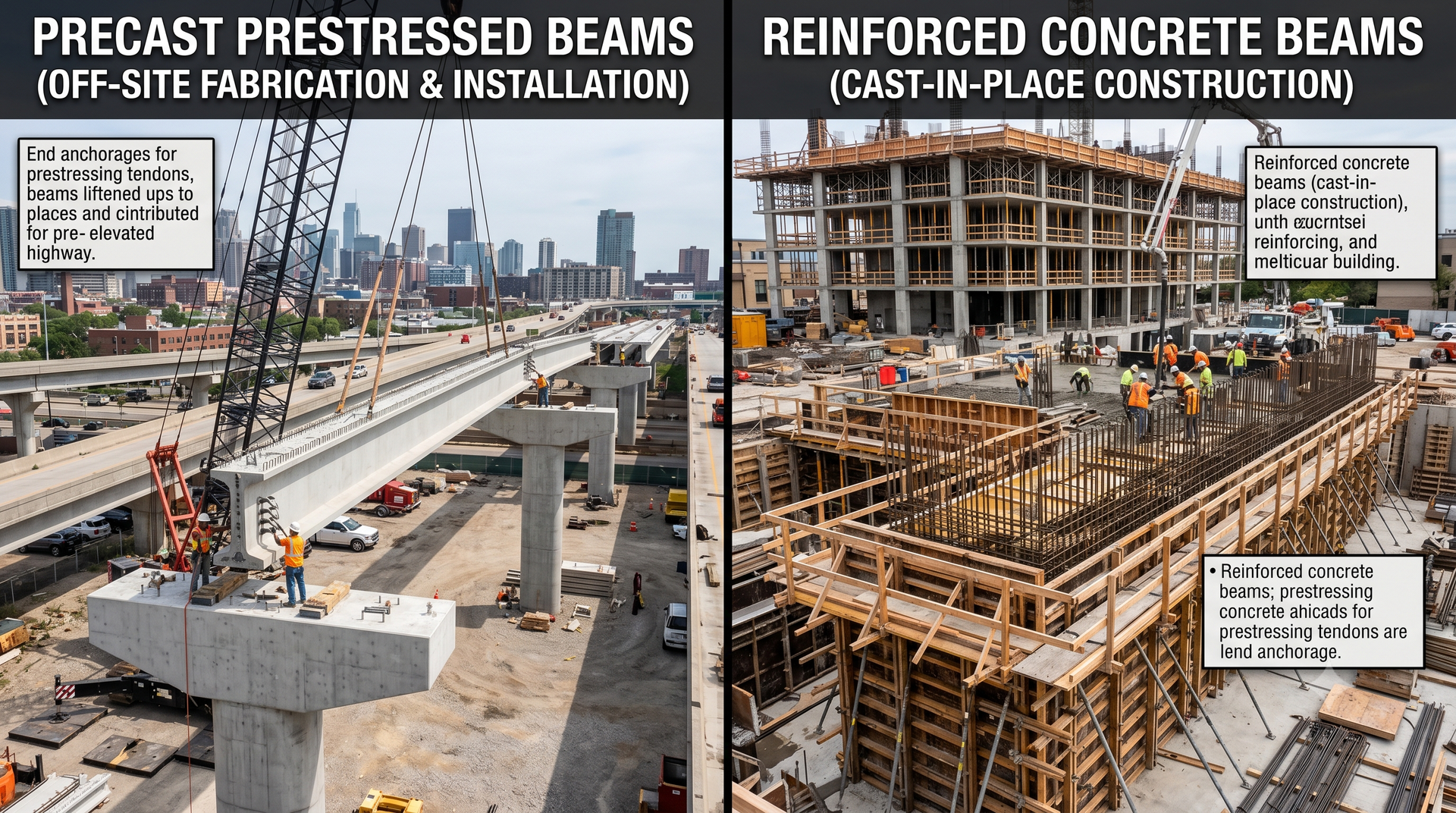
The difference between precast prestressed beams and reinforced concrete beams is not just about strength. The real comparison is how each system handles tension, controls cracking, supports span demands, and affects construction risk.
| Project Factor | Reinforced Concrete Beams | Precast Prestressed Beams |
|---|---|---|
| How they handle tension | Develop tensile stress as the beam bends, with rebar resisting those forces. | Start with built-in compression, so applied loads must counteract that compression before significant tension develops. |
| Crack control | Cracking is managed through proper reinforcement design, detailing, concrete quality, and construction practices. | Prestressing helps reduce service-load cracking when the beam is properly designed, fabricated, transported, installed, and protected. |
| Span efficiency | May require deeper sections, more reinforcement, or additional supports for longer spans or heavier loads. | Can often carry heavy loads over longer spans more efficiently. |
| Deflection control | Deflection is controlled through member depth, reinforcement, concrete strength, and support spacing. | Prestressing can improve serviceability by helping limit downward deflection under load. |
| Construction speed | Often requires field forming, shoring, rebar placement, concrete placement, curing, and cleanup. | Arrives ready for erection, reducing field work and helping shorten construction timelines. |
| Quality control | Depends heavily on jobsite conditions, field workmanship, weather, and curing environment. | Plant production allows tighter control over concrete placement, curing, strand position, dimensions, and inspection. |
| Project risk | Can be flexible, but may add field coordination, weather, and schedule risks. | Can reduce field complexity when transportation, lifting, and erection are planned properly. |
How Reinforced Concrete Beams Are Built
A conventional cast-in-place reinforced concrete beam is usually built at the project site. The sequence includes formwork, rebar placement, inspections, concrete placement, consolidation, finishing, curing, and form removal. In some structures, temporary shoring is also required until the concrete reaches enough strength.
This process works well when the beam needs to be integrated directly with slabs, columns, walls, or other cast-in-place elements. It also works when the project has irregular geometry that would make precast fabrication, hauling, or erection inefficient.
The drawback is that much of the work must happen in sequence. If formwork falls behind, the pour falls behind. If weather interrupts concrete placement, the schedule shifts. If inspections or curing take longer than planned, other trades may be stuck waiting.
On simple projects, field sequencing may be manageable. On congested jobsites or active roadways, it can become expensive fast.
How Precast Prestressed Beams Are Built
Precast prestressed beams move much of the beam construction process away from the jobsite and into a plant. In a pretensioned process, high-strength steel strands are stretched along a casting bed. Concrete is placed around the strands and cured under controlled conditions. Once the concrete reaches the specified release strength, the strands are released and compression transfers into the beam.
The finished beams are then transported to the project site and lifted into place. This requires planning. Haul routes, crane access, pick points, bearing preparation, site staging, and erection sequence all matter.
But when the plan is strong, the payoff can be substantial. While crews build substructures, foundations, caps, or other site elements, the beams can be fabricated off-site. Once the site is ready, erection can move quickly.
For bridge work, this is one reason precast prestressed systems are so common. The Federal Highway Administration maintains concrete bridge resources that include prestressed and post-tensioned bridge topics, reflecting how established these systems are in U.S. infrastructure practice.
When Reinforced Concrete Beams Make Sense
Reinforced concrete beams are the right choice in many projects. Saying prestressed beams are always better would be nonsense.
RC beams may make sense when:
- Spans are short or moderate
- Loads are manageable without prestressing
- The project requires custom shapes
- Cast-in-place construction integrates better with the surrounding structure
- Site access makes large precast delivery difficult
- Crane access is limited
- The schedule can accommodate forming, pouring, curing, and stripping
- The design does not require the span efficiency of prestressed members
Reinforced concrete is practical and economical for many buildings, foundations, retaining structures, and smaller structural elements. Its main drawback is that more work happens on site, which increases exposure to weather delays, labor constraints, inspections, and field coordination issues. When comparing precast prestressed vs reinforced concrete beams, do not rely only on upfront material cost because field labor, delays, traffic control, and temporary works can change the real project cost.
When Precast Prestressed Beams Make Sense
Precast prestressed beams are often strongest when the project values speed, repeatability, controlled production, and span performance.
They may be a better fit when:
- Longer spans are required
- Heavy live loads must be supported
- Field construction time needs to be reduced
- Traffic disruption must be minimized
- Beam quality and consistency are priorities
- The project involves bridge, roadway, marine, parking, or industrial infrastructure
- Standardized beam shapes can be used efficiently
- Transportation and erection logistics can be planned early
This is where precast/prestressed work becomes less about the beam alone and more about the project delivery strategy. A beam that can be fabricated off-site while other work continues may help compress the schedule. A beam that arrives ready to set may reduce field congestion. A beam with better crack control may help long-term durability.
For certain bridge, roadway, parking, pedestrian, marine, and industrial applications, precast prestressed box beams are one product type that can fit this kind of need. The value is not just that they are precast. The value is that they combine structural efficiency with a practical installation approach.
In our opinion, this is where many project teams weaken their decision-making. They look at the beam as a line item instead of looking at the installed system. That is too narrow. The smarter comparison includes fabrication, hauling, crane time, labor, traffic control, weather exposure, maintenance risk, and the cost of schedule disruption.
Performance Comparison
The best beam type depends on the project’s engineering requirements, but several performance differences are worth understanding.
Load Capacity
Both reinforced concrete and prestressed concrete beams can carry heavy loads when properly designed, but prestressed beams are often more efficient for longer spans. Prestressing helps counteract tensile stresses, which can reduce the need for deeper members or closer support spacing. Reinforced concrete beams can also handle substantial loads, but they may require more depth, more reinforcement, additional supports, or stricter deflection control depending on the project.
Crack Control
Crack control is a major advantage of prestressed concrete because the beam starts in compression, reducing tensile stresses under service loads. This is especially important in exposed infrastructure, where cracks can let water, chlorides, and other harmful materials reach embedded steel. Prestressing is not a cure-all, but when combined with proper cover, concrete quality, drainage, detailing, and maintenance, it can support better long-term durability.
Deflection and Camber
Prestressed beams can be designed with camber, an upward curvature created by the prestressing force. Camber helps offset downward deflection from dead loads and service loads. However, it must be planned early because it affects deck elevations, haunch buildup, bearing conditions, and erection planning.
Construction Schedule
Precast prestressed beams can reduce field time because they are fabricated off-site while other work continues. Once delivered, they can be erected quickly if the site is ready and the lift plan is solid. Cast-in-place reinforced concrete beams require more on-site sequencing, which can become a problem when work windows are short or access is limited.
This is especially relevant in highway and bridge construction, where closures, staging, and traffic control can dominate the project plan. Heldenfels’ Highway & Bridges work sits in that exact environment, where durable precast and prestressed components can help support efficient project execution.
Cost Considerations
The cheapest beam on paper is not always the lowest-cost option once the full project is considered. Reinforced concrete beams may cost less upfront, but field labor, formwork, shoring, curing time, delays, and weather risk can add up. Precast prestressed beams require more planning for fabrication, transportation, and erection, but they can reduce field labor, shorten schedules, improve quality control, and limit disruption.
A serious cost comparison should include:
- Beam fabrication
- Rebar or strand requirements
- Formwork and shoring
- Transportation
- Crane and erection costs
- Field labor
- Traffic control
- Weather risk
- Inspection and testing
- Long-term maintenance expectations
A weak estimate only compares concrete volume and steel quantity. That is not enough. The better comparison looks at total installed value.
Common Misconceptions
“Precast means prestressed.”
Not always. Precast means the concrete member is manufactured before it is transported to the site. It may be prestressed, conventionally reinforced, or both.
“Reinforced concrete is outdated.”
No. Reinforced concrete remains one of the most important structural systems in construction. The issue is not whether RC beams are old-fashioned. The issue is whether they fit the project’s span, load, schedule, and site conditions.
“Prestressed beams do not crack.”
Too absolute. Prestressing improves crack control, but cracking can still occur depending on design, loading, handling, installation, exposure, and service conditions.
“Prestressed beams are always more expensive.”
Not necessarily. They may cost more to fabricate or transport, but the total installed cost can be competitive when schedule, field labor, traffic control, and lifecycle performance are included.
Which Beam Type Should You Choose?
Choose reinforced concrete beams when the project needs flexibility, shorter spans, custom cast-in-place integration, or a conventional construction sequence. Choose precast prestressed beams when the project needs efficient spans, better crack control, faster installation, controlled fabrication, and less field construction time.
For bridge and infrastructure work, precast prestressed beams often have an advantage because they combine structural efficiency with jobsite speed. For highly customized building or site-specific work, reinforced concrete may still be the practical choice, especially when large precast transportation or lifting logistics do not make sense.
Final Takeaway: Match the Beam to the Build
Precast prestressed vs reinforced concrete beams is not just a strength comparison. Reinforced concrete beams use rebar to resist tensile forces as loads are applied, while precast prestressed beams use tensioned steel strands to add compression before service. The right choice depends on span, loading, schedule, site access, transportation, crane planning, exposure conditions, and maintenance expectations.
The right beam system should fit the way the project will actually be built. Before choosing between reinforced concrete and precast prestressed beams, confirm the span and load requirements, site constraints, transportation limits, and installation plan so the beam choice strengthens the project instead of complicating it.
Optimize Your Infrastructure Build
Get in touch with our team at Heldenfels to review your project blueprints, plan out transportation logistics, and discover how our high-performance precast structural solutions keep your job moving efficiently.
Contact us today