
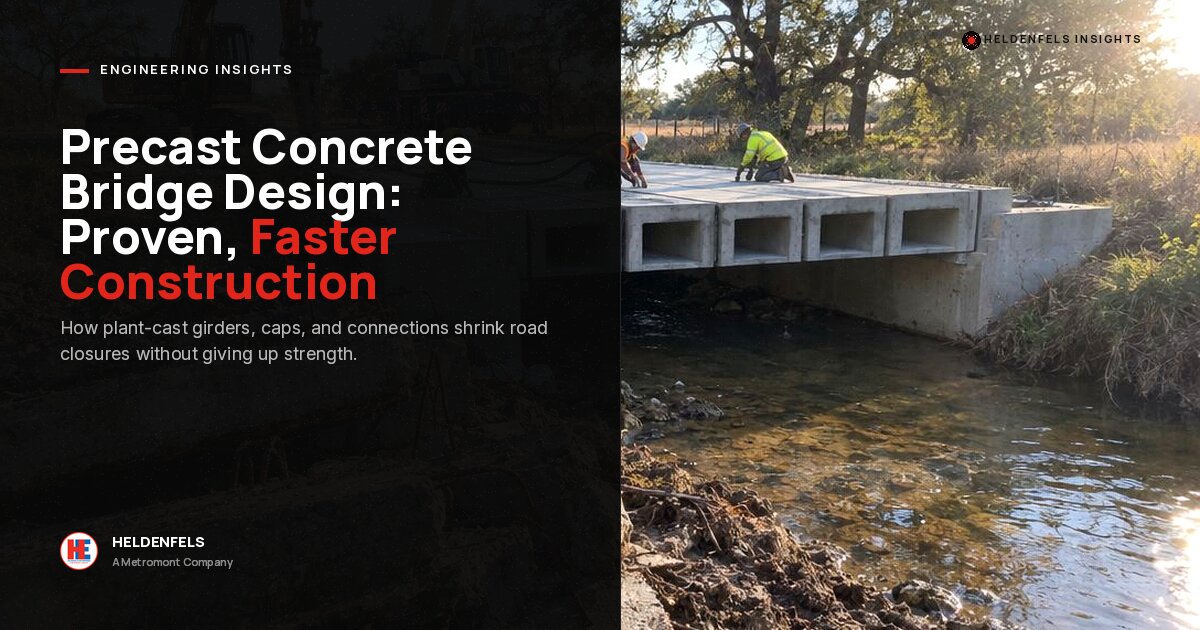
Precast Concrete Bridge Design: An Expert Guide to Proven, Faster Construction
Picture a two-lane county road crossing a creek. The road closes at 8 p.m. on a Friday. By Sunday afternoon the old bridge is broken up on the bank, and a new deck of box beams already sits on new caps while the crew grouts the joints between them. Traffic is back by 4 a.m. Monday, 56 hours after the barricades went up. That is what precast concrete bridge design makes possible: almost all of the slow, weather-sensitive work happens in a plant weeks before anyone closes a lane.
Speed is only half of it. The pieces arriving on that truck were also cast, cured, and inspected under conditions a field pour cannot match. The design choices below are what make a precast bridge both fast and durable.
- Precast design moves the critical path off the jobsite. Girders, caps, and panels are cast while foundations and site work happen in parallel.
- Owners should track two clocks: total time on site, and the much more expensive time that traffic is actually restricted.
- Plant-cast, prestressed members offer tighter tolerances, controlled curing, and dense, durable concrete.
- Connections between pieces are where precast bridges succeed or fail, so they need to be detailed early, not at shop-drawing stage.
- Bringing the precaster in during design keeps pieces within crane, haul, and casting-bed limits.
The Two Clocks Every Bridge Owner Should Watch
Bridge schedules usually get judged on one number: how long the contractor is on site. That number matters, but it hides a second clock the public cares about more. Call it traffic impact time: every hour that lanes are closed, narrowed, detoured, or slowed because of the work.
On a conventional cast-in-place job, the two clocks run together for months. Forming a cap, tying steel, placing concrete, waiting for it to reach strength, stripping forms, and then repeating the process for the deck all happen over live traffic or behind a detour. Each step waits on the weather and on the step before it.
A precast design pulls those clocks apart. The site clock might still run several weeks for foundations, approach work, and finishing. But the traffic clock can shrink to a few nights or a single weekend, because the pieces that need curing time arrive already cured. The Federal Highway Administration’s program on accelerated bridge construction exists largely because of this gap.
Why the second clock matters: Delay, detour mileage, and crash risk in a work zone are real costs paid by drivers and businesses, yet they rarely show up in a bid tab. When those road user costs are counted, a precast option that looks slightly more expensive on paper often turns out to be the cheaper bridge.
What Precast Concrete Bridge Design Changes
The rule is simple: if it can be built in a controlled plant, build it there. That pulls design work earlier and changes what the engineer is optimizing for. Instead of a structure formed in place, the team designs a kit of pieces that can be cast, shipped, lifted, and joined.
The Superstructure
Most of the span is carried by precast prestressed bridge girders, chosen by span length and depth budget. I-girders and Texas U-beams handle medium and long spans under a cast-in-place deck. Box beams and slab beams placed side by side suit shorter spans where the road profile cannot rise, and they can serve as the riding surface or the form for a thin topping. Precast deck panels can then replace much of the field formwork, so crews are not hanging plywood over traffic or water.
The Substructure
Substructure work has traditionally been the slowest part of a bridge, and it is where precast now saves the most time. Texas has long used precast bent caps on highway bridges. Columns are built first with reinforcing bars left projecting from the top. The precast cap, cast with matching ducts, is lowered over those bars, leveled on shims, and the ducts are filled with grout. A cap that would have taken weeks of forming and curing over traffic is set in hours. We cover the details in our guide to concrete bridge cap systems.

Abutments, wingwalls, and even footings can be precast too. Every element moved into the plant is one less critical-path activity waiting on weather, inspections, and cure times in the field.
Where the Structural Performance Comes From
A common worry is that faster must mean weaker. In a well-designed precast concrete bridge, the opposite tends to be true, because the conditions that drive quality are easier to control in a plant than on a riverbank in August.
- Controlled curing. Members cure in a managed environment instead of in summer heat, wind, or a cold snap. That protects strength and reduces early cracking.
- Prestressing. High-strength strands tensioned before the concrete is placed keep the concrete largely in compression under service loads. That limits cracking and helps keep water and chlorides away from the steel.
- High-strength, low-permeability concrete. Plant mixes are tested batch by batch and placed with consistent consolidation, giving dense concrete that resists deicing salts, sulfates, and coastal exposure.
- Tight tolerances. Steel forms and repeatable casting beds produce pieces that match the drawings closely, which is what makes fast field assembly possible in the first place.
- Inspection before shipping. Strength, dimensions, strand placement, and finish are checked at the plant, so problems are caught where they are cheap to fix rather than after erection.
That combination is why precast, prestressed girders are commonly designed for service lives measured in generations, not decades. Speed comes from moving the work. Durability comes from where the work was moved to.
Connections: Where the Design Is Won or Lost
A precast bridge is only as good as the joints between its pieces. The members themselves are rarely the problem, so experienced designers spend a large share of their effort on the places where those members meet.
Common Connection Types
- Grouted ducts and couplers tie columns to caps and caps to footings, carrying force through bars that are embedded in grout after the piece is set.
- Grouted shear keys lock adjacent box beams or slab beams together so the deck shares load across its width instead of acting as separate planks.
- Closure pours join deck panels or girder ends with a narrow strip of field concrete. High-performance mixes such as ultra-high-performance concrete let those strips stay short and still develop full bar strength.
Tolerances and Geometry
Substructure tolerances matter most, since everything above inherits their errors. If a column’s projecting bars are out of position, the cap will not drop. If bearing seats are off, girders will not sit evenly. Good designs build in adjustment (oversized ducts, shim stacks, leveling bolts, and grout beds) so small field variations do not stop the job.
Girder camber needs the same planning. Prestressed members bow upward, and that bow keeps changing while they wait in storage. Designers account for it with a variable haunch so the finished deck still meets profile. When deck panels are set side by side without a topping, joints can leave small steps in the riding surface, and some owners specify diamond grinding afterward to smooth it.
Design Decisions That Keep a Precast Bridge Fast
None of these schedule gains are automatic. They come from a few decisions made early, usually before the plans are final.
- Use standard sections where you can. State-standard girder and beam shapes already have forms, details, and production history behind them. Custom shapes add cost and lead time.
- Size pieces to crane and haul limits. Weight, length, and route all matter. A piece that is too heavy for the crane pad or too long for the route has to be redesigned late, and that wipes out the time savings.
- Detail connections during design. Duct sizes, bar locations, grout specifications, and placement sequences belong in the plans, not in a field change.
- Plan for repetition. Repeating the same cap, the same girder length, and the same panel lets the plant reuse forms and keep casting beds busy.
- Talk to the precaster early. A manufacturer can flag bed lengths, strand patterns, and lifting limits before they become problems.

On our own highway bridge construction projects, the smoothest jobs have been the ones where finished pieces sat in the yard well before the closure date. When the road finally closes, all that is left is to set, connect, and open.
When Cast-in-Place Still Makes Sense
Precast is not the answer to every crossing. Highly curved or irregular structures, one-off spans with unusual geometry, and sites with no practical route for long loads can favor field-cast concrete. Very remote sites far from a plant may not justify the haul. Many projects end up as hybrids: precast girders and caps with a cast-in-place deck, for example.
The right choice comes from comparing total cost (traffic impact, schedule risk, and long-term maintenance), not just unit prices. For more on how state agencies weigh those factors, see our article on why precast works so well on DOT bridge projects.
Planning a Precast Concrete Bridge in Texas?
With Texas roots dating to 1909 and prestressed concrete production going back to 1955, Heldenfels Enterprises manufactures and installs precast, prestressed concrete for bridge and infrastructure projects across Texas from our plants in San Marcos and Corpus Christi. Our team can help you choose girder and cap types, plan piece sizes and connections, and line up production so finished members are ready before your closure window opens.
Contact Us About Your Project