
Concrete Bridge Cap Systems: Design, Installation, and Project Planning Factors
Concrete bridge cap systems help transfer loads from bridge girders and decks into columns, piles, or other foundation elements while supporting faster, safer, and more controlled bridge and marine construction.
Concrete bridge cap systems help transfer loads from bridge girders and decks into columns, piles, or other foundation elements. For contractors, engineers, and project owners, the real value is not just strength; it is whether the cap system can reduce field complexity, improve installation control, and support long-term bridge or marine performance.
In bridge and waterfront construction, small delays can turn into expensive problems. A cap that requires difficult elevated formwork, long curing windows, or major field adjustments can slow down the whole project. That is why many teams now look at precast concrete bridge cap systems as a practical alternative to traditional cast-in-place caps, especially when schedule, access, safety, and quality control matter.
Why Concrete Bridge Cap Systems Matter
A bridge cap is one of the main load-transfer points in a bridge or marine structure, connecting the superstructure above to the substructure below. When concrete bridge cap systems are designed and installed properly, they help distribute loads from girders, decks, traffic, equipment, wave action, and environmental forces into the supporting columns or piles.
The challenge is that bridge caps are often built in difficult locations, such as over active roads, waterways, rail lines, industrial sites, or marine terminals. Precast concrete caps help simplify the process by moving production off-site into a controlled plant environment, then delivering the finished component for lifting and installation when the site is ready.
The Federal Highway Administration describes Accelerated Bridge Construction as an approach that uses planning, design, materials, and construction methods to reduce on-site bridge construction time. FHWA’s Accelerated Bridge Construction guidance is a useful reference here because precast bridge elements, including caps, fit directly into that broader goal.
For a Texas manufacturer like Heldenfels Enterprises, concrete bridge cap systems are not theoretical. Heldenfels manufactures precast concrete caps for bridge and marine structure projects across Texas, including caps with formed beam seats, embedded anchor bolts, drainage provisions, and crane-ready lifting hardware.
Understanding Precast Concrete Caps
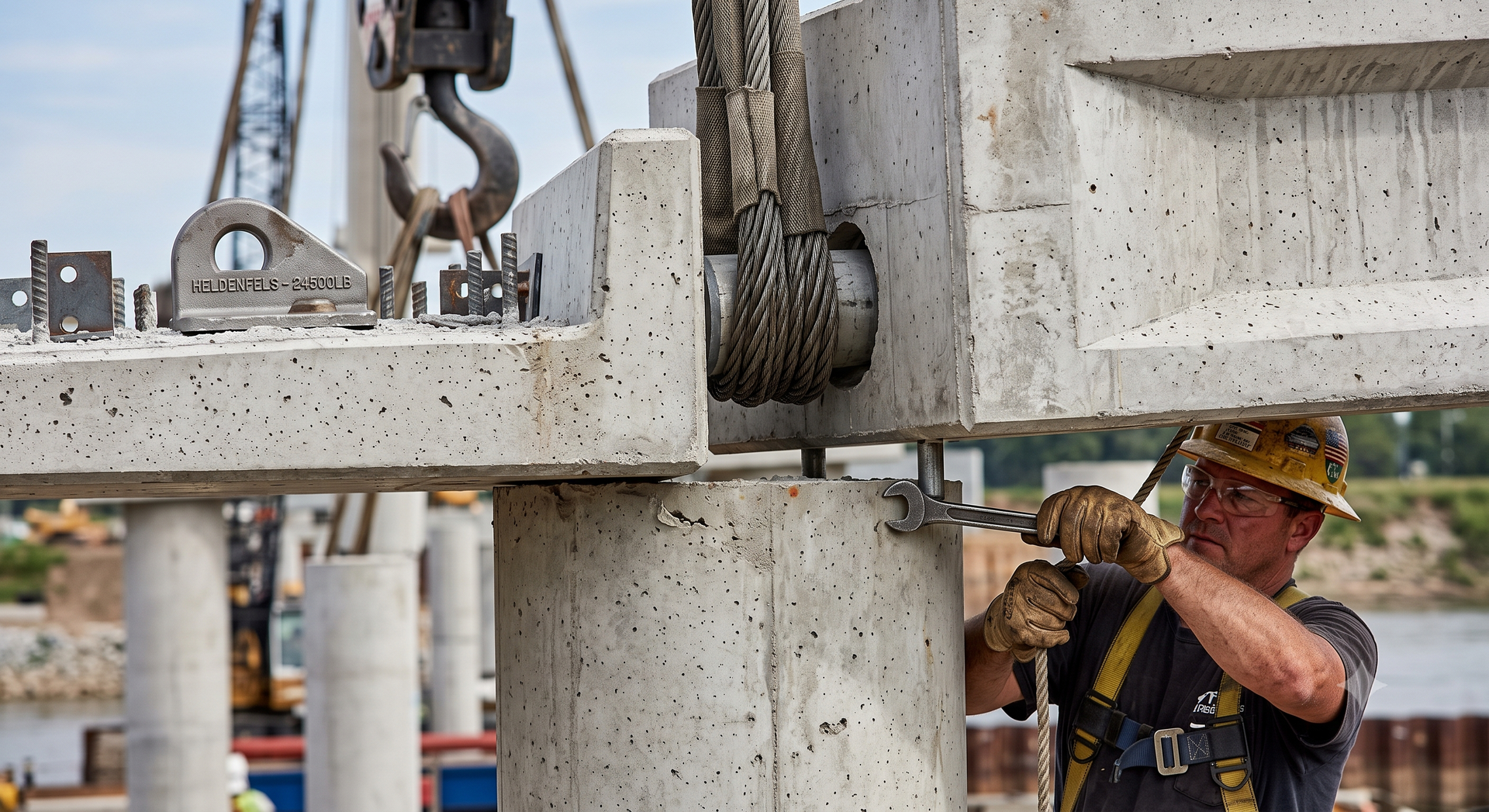
A precast concrete cap is a structural member placed on top of bridge columns, piles, or bents to transfer loads from the superstructure into the supporting substructure. Depending on the project, it may be called a pier cap, bent cap, abutment cap, pile cap, or precast cap. While the function sounds simple, the design must account for girder spacing, beam seat elevations, reinforcement layout, skewed alignments, connection details, crane access, and environmental exposure.
Concrete bridge cap systems need to be coordinated carefully because they affect several parts of the project at once. The cap must match the girder layout, align with column or pile locations, meet load requirements, accommodate connection hardware, and support the intended installation sequence.
Our precast concrete caps are built to project specifications, with size, thickness, and height options determined by the design. Their product information also notes that caps are crane-ready with lifting hardware, which matters because field installation is only efficient if lifting and placement are planned from the start.
Core Principles of Precast Construction
Precast construction moves much of the cap production from the jobsite to a manufacturing facility. Instead of forming, reinforcing, pouring, and curing the cap in the field, it is produced under controlled conditions before delivery. This allows better control over reinforcement placement, concrete quality, curing, dimensional accuracy, and inspection while site crews prepare foundations, columns, piles, access routes, crane pads, and traffic control plans.
Precast does not magically fix a poorly planned project. It rewards good planning. The teams that benefit most from precast concrete bridge cap systems are usually the ones that coordinate design details, transportation limits, lifting points, connection requirements, and field tolerances early.
The Transformative Advantages of Precast Concrete Caps
Precast concrete caps offer more than a faster way to build bridge and marine structures. When planned correctly, they can improve installation efficiency, structural consistency, jobsite safety, environmental durability, and overall project control.
Enhanced Construction Efficiency and Speed
One of the strongest reasons to use precast caps is the ability to reduce field work. Cast-in-place caps often require elevated formwork, temporary supports, rebar installation, concrete placement, finishing, curing, and stripping, which can slow the project down when work is happening over traffic, water, or restricted access zones.
Precast caps arrive as finished structural components that can be lifted into place once the supporting columns or piles are ready. Because the cap can be manufactured off-site while the jobsite is being prepared, project teams can reduce high-risk field labor, avoid some formwork delays, and keep the construction sequence moving more efficiently.
Superior Durability and Structural Performance
Concrete bridge cap systems have to support serious loads from girders, decks, traffic, vibration, and surrounding environmental forces. Precast caps are manufactured with controlled concrete mixes, reinforcement layouts, and curing conditions, which can help improve consistency compared with field-built caps affected by weather, access issues, labor limits, or site congestion.
For bridge projects, durability is not only about compressive strength. It also depends on dimensional accuracy, proper concrete cover, connection performance, corrosion resistance, drainage planning, and details such as formed beam seats, embedded anchor bolts, and drainage provisions that help the cap fit correctly with girders, piles, and other structural components.
Improved Safety and Quality Control
Safety is one of the practical advantages of precast concrete bridge cap systems because more of the work is moved into a controlled plant environment. Cast-in-place caps often require crews to work at height, around formwork, over water, near traffic, or in other difficult site conditions.
A precast cap still requires safe lifting, rigging, traffic control, and installation planning because it is a heavy structural component. However, it can reduce the amount of field formwork, concrete placement, finishing, and curing needed on-site, while allowing forms, reinforcement, concrete quality, and dimensional tolerances to be checked before the cap leaves the plant.
Resilience Against Environmental Forces
Bridge and marine structures face different exposure conditions depending on where they are built. A highway overpass may deal with heavy traffic, vibration, runoff, and deicing chemicals, while a coastal or marine structure may face saltwater, tidal movement, wave forces, and a more corrosive environment.
Concrete bridge cap systems must be designed around these conditions, especially when durability depends on concrete mix design, reinforcement protection, cover depth, drainage, and connection detailing. For marine projects, precast caps are usually part of a larger structural system that may also include piling, deck slabs, sheet piles, docks, piers, wharfs, ramps, erosion protection, and other precast or prestressed components.
Economic and Environmental Benefits
The economic case for precast concrete caps is not only about the price of the component itself. It is about how the system can reduce field labor, limit formwork, shorten closure windows, improve schedule predictability, and lower the risk of weather-related delays.
For owners, fewer delays can matter just as much as material cost, especially when bridge work affects traffic, port operations, industrial access, or freight movement. Precast caps may also help reduce jobsite waste, improve material control, and limit temporary on-site work when the project is planned properly.
For more background on how precast manufacturing can reduce jobsite waste, we also discuss related material planning concerns in its blog on construction materials surplus.
Precast Concrete Caps in Bridge Infrastructure
Precast concrete caps play a central role in bridge infrastructure because they connect the superstructure to the supporting columns, piles, or bents below. Their design affects load transfer, girder alignment, installation planning, and long-term bridge performance, especially on projects with complex spans, tight access, or agency requirements.
Reinforcing Bridge Substructures
In bridge infrastructure, caps connect key parts of the structural system. They may sit on columns, piles, or bents and provide the bearing area for girders. Their performance affects load transfer, girder alignment, and the stability of the bridge superstructure.
Concrete bridge cap systems are commonly used in highway bridges, overpasses, interchanges, river crossings, and other transportation structures. On these projects, caps must often coordinate with prestressed girders, deck systems, piling, columns, bearings, and connection hardware.
Addressing Complex Geometries and Span Requirements
Not every bridge uses a simple, straight layout. Some projects involve skewed crossings, variable girder spacing, limited column locations, curved alignments, or site constraints that affect the cap design. Precast concrete bridge cap systems can be customized to match those conditions, but the design team has to coordinate the details early.
- What type of girder will the cap support?
- How many girders will bear on the cap?
- What are the column or pile spacing requirements?
- Are beam seats required?
- Are embedded anchor bolts needed?
- What drainage provisions should be included?
- How much reinforcement congestion is expected?
- What crane capacity and site access are available?
- Are there transportation limits based on cap length, width, height, or weight?
- Does the owner require specific agency standards or approvals?
These are not small details. They affect whether the cap can be manufactured, transported, lifted, aligned, and connected efficiently.
Regulatory and Engineering Support
Precast bridge elements are not experimental. They are part of a broader movement toward prefabricated and accelerated bridge construction. FHWA recognizes accelerated bridge construction as a way to reduce onsite construction time, especially where traffic disruption, safety, and schedule impacts are major concerns.
In Texas, TxDOT also provides guidance for precast and prefabricated substructure alternatives, including bent caps and abutments. That does not mean every bridge should use a precast cap, but it does show that these systems are part of accepted bridge planning and design discussions.
The best approach is not “precast everything.” That is lazy thinking. The better question is: which components create the most schedule, safety, and quality benefit when they are prefabricated?
Precast Concrete Caps in Marine Infrastructure
Precast concrete caps are especially valuable in marine infrastructure because the work often happens in harsh, high-risk, and hard-to-access environments. When designed for coastal exposure and coordinated with the larger structural system, concrete bridge cap systems can help improve installation efficiency, durability, and long-term performance for piers, wharfs, terminals, and waterfront structures.
Overcoming Harsh Marine Environments
Marine work is where concrete bridge cap systems face some of their toughest conditions, including saltwater exposure, wave action, tidal movement, vessel impact risk, and limited site access. Cast-in-place work can be challenging in these environments, especially when crews need to work around active terminals, docks, piers, or industrial operations.
Precast caps can reduce the amount of formwork and concrete placement required over water because they are manufactured off-site, inspected before delivery, and installed when the site is ready.
Our Marine service page notes that the company provides total precast structures for marine applications, including precast concrete caps, prestressed concrete piling, prestressed deck slabs, sheet piles, docks, piers, break walls, ship berths, wharfs, ramps, erosion protection, and pipe racks.
Applications in Marine Construction
In marine construction, precast caps may be used in:
- Piers
- Wharfs
- Ship berths
- Marine terminals
- Industrial waterfront structures
- Pipe rack supports
- Dock systems
- Coastal infrastructure
- Waterfront bridges
- Heavy-duty access platforms
The cap helps connect vertical supports such as piles to the deck or superstructure above. In these settings, durability and connection detailing are critical. A cap exposed to saltwater or aggressive coastal conditions needs proper concrete cover, reinforcement protection, and drainage planning.
Long-Term Performance in Coastal Conditions
Marine owners usually care about lifecycle cost, not just first cost. A cheaper component that creates more maintenance later is not a bargain. Precast concrete bridge cap systems can support long-term performance when they are designed for the exposure conditions and manufactured with the right quality controls.
That includes considering chloride exposure, cracking risk, reinforcement protection, surface durability, connection performance, and inspection access. These factors should be reviewed early because they affect the cap design, not just maintenance after installation.
Technological Advancements in Precast Caps
Precast cap production has become more precise because design, connection planning, and inspection can now be coordinated before the component reaches the site. For concrete bridge cap systems, these improvements help reduce fit-up issues, support stronger structural connections, and give contractors more confidence during installation.
Digital Design and Modeling
Modern precast cap planning often uses digital design coordination to catch conflicts before production begins. This is important for caps with beam seats, embedded hardware, lifting inserts, reinforcement cages, and connection zones. For concrete bridge cap systems, even a small mismatch in beam seat elevation, anchor bolt location, or girder spacing can create field problems, so early coordination helps reduce that risk.
Improved Connection Details
Connection design is critical because precast caps must properly connect to columns, piles, girders, bearings, and other structural elements. Some projects may also require moment connections or other continuity details to support the intended structural performance. Heldenfels’ precast caps can be designed with full moment connection capability, helping maintain structural continuity while still supporting efficient precast production and installation.
Better Production and Inspection Control
Precast manufacturing allows teams to check dimensions, reinforcement placement, embedded items, lifting hardware, surface finish, and concrete quality before the cap reaches the site. This helps reduce uncertainty for contractors working over traffic, water, or restricted access areas. For difficult field conditions, that added control is one reason concrete bridge cap systems are often considered during project planning.
Challenges and Considerations in Implementation
Precast caps can improve construction efficiency, but they still require careful planning before they reach the site. Transportation, lifting, tolerances, access, and project suitability all need to be reviewed early so concrete bridge cap systems solve problems instead of creating new ones.
Transportation and Lifting Limits
Precast caps can be large and heavy, so transportation, staging, lifting, and placement must be planned early. Access roads, bridge clearances, turning space, crane capacity, pick points, and jobsite staging areas all affect whether the cap can be installed safely.
A precast cap may look efficient on paper, but it can create problems if the engineer, manufacturer, contractor, erector, and owner do not coordinate before production.
Tolerance and Fit-Up Coordination
Concrete bridge cap systems must align with other structural elements. Beam seats, anchor bolts, bearings, columns, piles, and girders all need to work together. If tolerances are ignored, field crews may face delays, rework, or connection problems.
Good precast planning should include:
- Clear shop drawings
- Confirmed field dimensions
- Defined tolerances
- Coordinated embed locations
- Verified lifting points
- Proper bearing details
- Review of reinforcement congestion
- Early input from the precast manufacturer
Project Suitability
Precast caps are not automatically the best answer for every project. For small, simple projects with easy access and minimal schedule pressure, cast-in-place may still make sense. But for complex bridge or marine projects, precast becomes more attractive when the job involves difficult access, tight closures, repetitive elements, high traffic impacts, or aggressive environmental exposure.
This is where honest evaluation matters. Selling precast as perfect for everything would be nonsense. The better approach is to identify where it actually solves a project problem.
Project Planning Factors for Concrete Bridge Cap Systems
| Planning Factor | Why It Matters |
|---|---|
| Girder layout | Determines bearing locations, beam seats, cap geometry, and load-transfer requirements. |
| Column or pile spacing | Affects cap length, reinforcement layout, lifting strategy, and connection detailing. |
| Embedded hardware | Anchor bolts, inserts, and connection hardware must be coordinated before production. |
| Transportation limits | Cap size and weight must fit route restrictions, turning space, and delivery access. |
| Crane access | Pick points, crane pads, reach, and capacity determine whether installation is practical. |
| Environmental exposure | Marine, coastal, highway, and industrial conditions affect durability requirements. |
| Inspection requirements | Quality checks should confirm dimensions, reinforcement, embeds, lifting hardware, and concrete performance. |
The Future of Concrete Bridge Cap Systems
The future of concrete bridge cap systems will depend on smarter planning, better coordination, and stronger lifecycle performance. As bridge and marine projects become more complex, precast caps will continue to be valuable when they reduce field work, support faster construction, and fit into a complete structural system.
More Use in Accelerated Bridge Construction
As agencies and owners look for ways to reduce traffic disruption and construction risk, concrete bridge cap systems will likely remain important in accelerated bridge construction. Moving cap production off-site can reduce field activity during critical project stages. The goal is not to replace engineering judgment, but to use precast where it provides a clear schedule, safety, or quality advantage.
Better Integration with Complete Precast Systems
Precast caps work best when they are coordinated with other precast and prestressed components. For bridge and marine projects, this may include piles, girders, slab beams, box beams, deck slabs, sheet piles, and platform components. A cap is not a standalone product; it is part of the larger load path, construction sequence, and long-term maintenance plan.
Stronger Focus on Lifecycle Value
Owners are becoming more focused on durability, maintenance, and long-term performance. That makes lifecycle value more important than simple upfront pricing. Concrete bridge cap systems can support that goal when they reduce field variability, improve quality control, and are designed for the actual exposure conditions of the structure.
Better Cap Planning Means Better Bridge Performance
Concrete bridge cap systems are critical in bridge and marine construction because they transfer loads from the superstructure into the substructure. Poor planning can cause installation delays, field conflicts, and long-term maintenance issues, while proper design and manufacturing can improve schedule control, safety, quality, and durability.
Precast concrete caps are especially useful where access is limited, elevated formwork is difficult, traffic disruption must be reduced, or marine exposure makes field installation more challenging.
For Texas bridge, highway, and marine projects, Heldenfels Enterprises brings decades of experience in precast and prestressed concrete systems, including precast caps, prestressed piling, and bridge girders. If your project requires a cap system that must fit real site conditions, support heavy structural loads, and arrive ready for efficient installation, early coordination with a precast manufacturer is the smart move.
Frequently Asked Questions
What are concrete bridge cap systems?
Concrete bridge cap systems are structural components that sit on top of bridge columns, piles, or bents and transfer loads from the girders and deck into the substructure. They help distribute forces and provide a stable support point for the bridge superstructure.
What is the difference between a pier cap, bent cap, and abutment cap?
A pier cap usually sits on a pier or column support, a bent cap connects multiple columns or piles within a bent, and an abutment cap is used at the end support of a bridge. The terms can vary depending on the project, but all refer to cap elements that help transfer structural loads.
Why use precast concrete caps instead of cast-in-place caps?
Precast concrete caps can reduce field formwork, curing time, and elevated labor. They are manufactured off-site in controlled conditions and delivered ready for installation, which can improve quality control and reduce schedule risk.
Are precast concrete bridge cap systems suitable for marine projects?
Yes. Precast caps are often used in marine structures such as piers, wharfs, docks, terminals, and waterfront infrastructure. They must be designed for the specific exposure conditions, especially where saltwater, wave action, and corrosion risk are present.
What should be reviewed before specifying a precast bridge cap?
Project teams should review girder layout, design loads, column or pile spacing, beam seat requirements, embedded hardware, connection details, transportation limits, lifting plans, site access, environmental exposure, and owner or agency requirements.
How long does it take to manufacture precast concrete caps?
Timelines vary by project size, design complexity, production schedule, and delivery requirements. Heldenfels notes that, on average, prestressed concrete caps take about 6 to 8 weeks before they are ready to leave the facility, but each project timeline should be confirmed when the order is placed.
Plan Your Precast Concrete Cap System With Confidence
Need a precast concrete cap system for a Texas bridge, highway, marine, or industrial project? Coordinate early with Heldenfels to review design requirements, lifting plans, production details, and installation needs.
Contact us today