

High-Rise Precast Floors: Hollow-Core Slabs vs. Composite Metal Decking
An in-depth analysis of how span lengths, structural loads, and installation timelines dictate the right floor choice for modern vertical construction.
High-rise floor systems affect more than the structure. They influence schedule, crane planning, fire performance, acoustics, floor depth, long-term maintenance, and how quickly the next trade can start work.
Two common options are hollow-core precast concrete slabs and sheet metal decking topped with concrete. Both can work, but they do not solve the same problem. The right choice depends on span, loading, lateral design, diaphragm requirements, local material availability, and the contractor’s erection plan.
This guide compares both systems in practical terms so owners, engineers, architects, and contractors can evaluate high-rise precast floors without relying on vague claims like “precast is always faster” or “metal deck is always cheaper.”
High-Rise Precast Floors: What Hollow-Core Concrete Slabs Actually Do
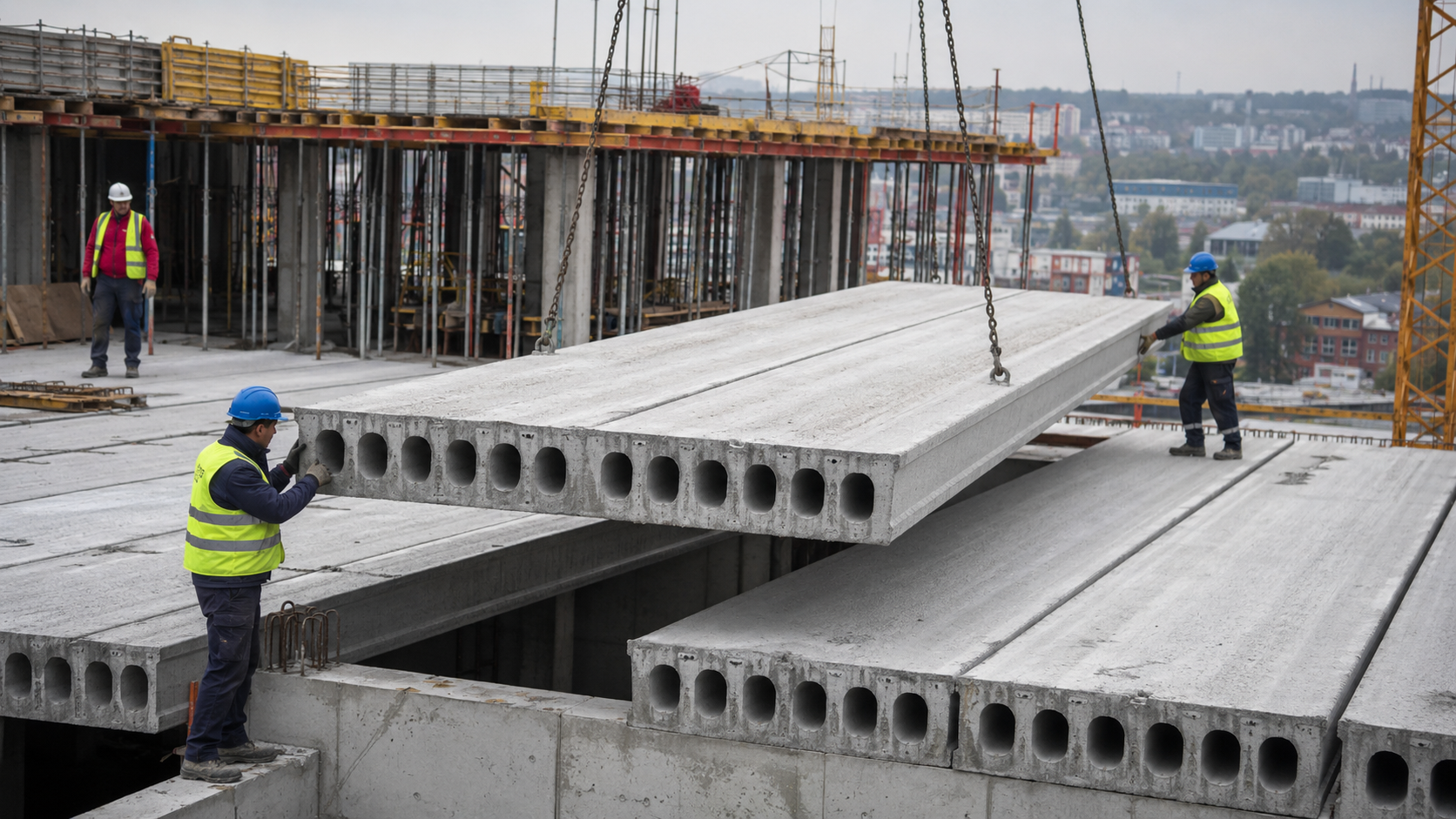
Hollow-core concrete slabs are precast, prestressed concrete members manufactured in a plant, cured under controlled conditions, and delivered to the jobsite for erection. Each slab has long, continuous voids that reduce weight while maintaining structural efficiency. This lighter design can reduce loads on columns, foundations, and supporting walls, while prestressing allows the slabs to span farther than conventional reinforced concrete slabs of similar depth.
Common Applications for Hollow-Core Systems
Hollow-core systems are frequently utilized across a wide variety of commercial and residential structural formats, including:
- Apartments and multifamily buildings
- Hotels and dormitories
- Mixed-use developments
- Schools and hospitals
- Parking structures
- Select office or commercial projects
They can also be used in taller buildings when the overall structural system is properly engineered for the project’s requirements, including:
- Structural loads
- Connections and bearing conditions
- Diaphragm action
- Fire rating
- Building movement
- Sound performance
- Openings, embeds, and penetrations
- Camber, tolerances, and erection access
This is where the details matter. High-rise precast floors are not a plug-and-play product. A floor system that works well for one building may be a poor fit for another if the lateral system, core layout, MEP routing, or connection detailing does not support it.
A common mistake is treating hollow-core concrete slabs as if they alone determine the building’s performance. They do not. The slab is only one part of a larger structural system, so coordination must happen early to avoid costly changes during fabrication or erection.
Where Hollow-Core Slabs Can Be a Strong Fit
Hollow-core concrete slabs are a strong fit when a building has repeated layouts and predictable spans. Residential towers, hotels, student housing, senior living facilities, and similar projects often repeat floor plates, corridors, units, or rooms, which makes plant-made precast components easier to standardize and install floor by floor.
They are also useful when a project needs fewer temporary supports and less wet work on-site. Because each member arrives already cast and cured, hollow-core slabs can reduce formwork, shoring, and curing delays compared with some cast-in-place approaches.
The schedule advantage comes from moving more work into the plant before the material reaches the jobsite, not from magic speed. To get the full benefit, openings, embeds, bearing details, and MEP coordination need to be settled early because precast rewards disciplined planning and punishes late changes.
What Hollow-Core Slabs Do Not Automatically Solve
Hollow-core concrete slabs are sometimes described as “naturally insulating” or “highly energy efficient,” but that wording is too broad. Concrete provides thermal mass, not insulation in the same way foam, mineral wool, or insulated wall panels do.
Thermal mass can help moderate temperature swings when it works with a properly designed building envelope and HVAC strategy. However, a floor system should not be presented as an energy-efficiency solution unless the full assembly is considered.
The same caution applies to sound control and fire resistance. Hollow-core concrete slabs can support strong acoustic and fire performance, but the final results depend on toppings, ceilings, penetrations, finishes, concrete cover, connection details, and project-specific code requirements.
Sheet Metal Decking Covered with Concrete
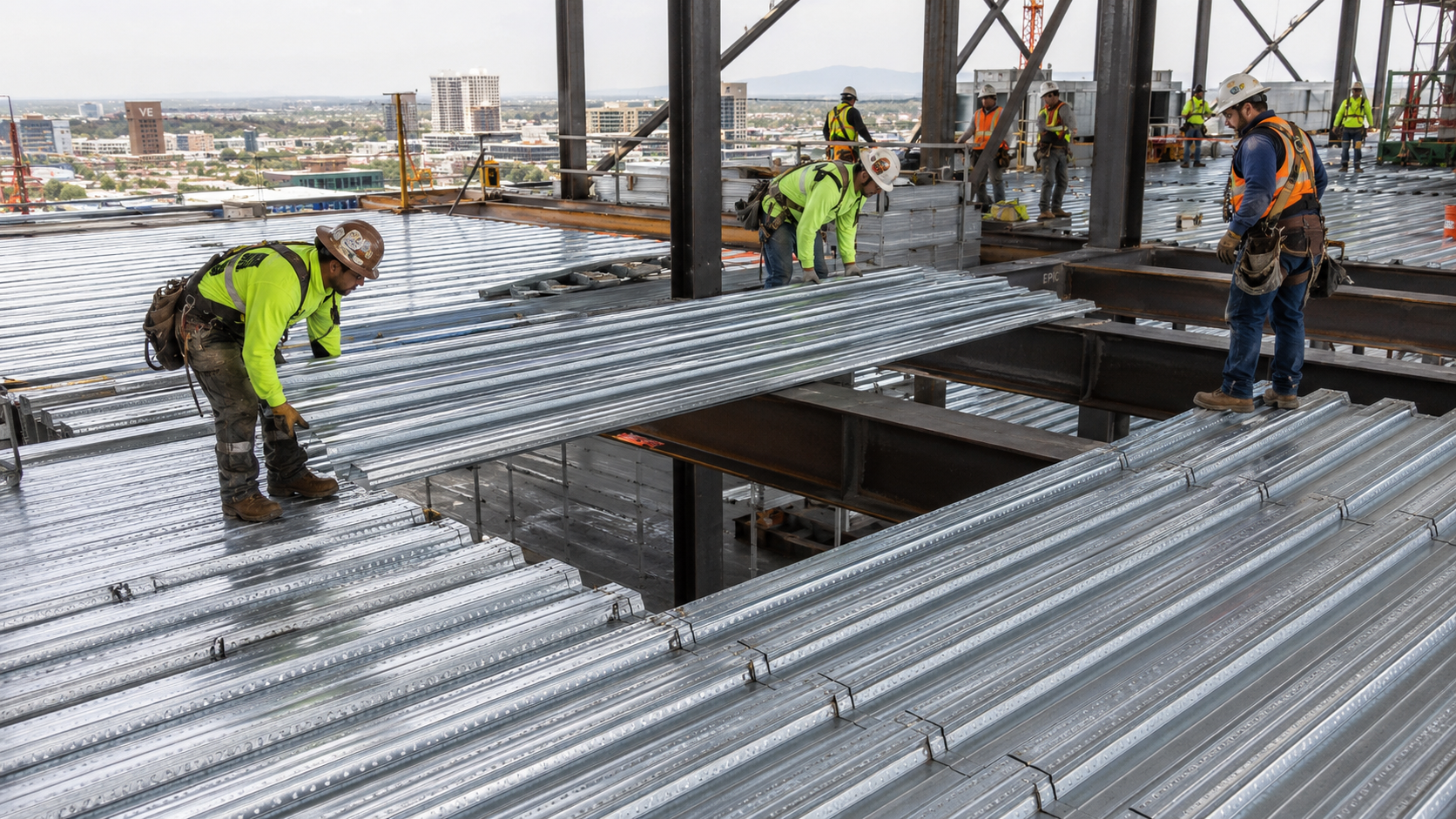
Sheet metal decking, more accurately called steel floor deck or composite metal deck, is another common floor system used in high-rise construction. Corrugated steel deck is placed over beams, fastened into position, and topped with concrete. In a composite slab, the steel deck serves as stay-in-place formwork and contributes tensile reinforcement for positive bending after the concrete cures.
Common Applications for Steel Deck Systems
- Steel-framed office buildings
- Commercial towers
- Mixed-use developments
- Industrial structures
- Buildings with irregular layouts
- Projects with frequent floor penetrations or complex geometry
Metal decking is popular because it is flexible, familiar to many contractors, and highly compatible with steel framing. It can also be cut and adjusted more easily in the field than precast units, which makes it useful when the layout does not repeat cleanly or when openings need to be coordinated around building systems.
It can also support a fast construction sequence. Deck panels create both a working platform and a concrete form, allowing crews to install reinforcement, coordinate sleeves and openings, and pour the slab after the deck is placed and fastened.
That is why it is misleading to say high-rise precast floors are always faster than metal deck. Precast may be faster when the design is repetitive and coordination is tight, while metal deck may be faster when the structure is steel-framed, floor plates vary, or field adjustment is unavoidable.
Comparing Concrete and Metal Decking in High-Rise Buildings
A better comparison is not “which material is better?” The better question is “which system fits the building?”
| Factor | Hollow-Core / High-Rise Precast Floors | Composite Metal Deck Systems |
|---|---|---|
| Weight | Hollow-core slabs reduce concrete volume through internal voids, which can lower overall floor weight. Final weight still depends on span, slab depth, topping, and design loads. | Composite metal deck systems use steel deck with a concrete topping and can also provide an efficient floor weight. Final weight depends on deck profile, concrete thickness, framing, fireproofing, and design loads. |
| Speed | Precast floor members arrive ready for erection, reducing jobsite forming and curing work. They perform best when layouts are repetitive and coordination is complete before fabrication. | Metal deck can also support fast floor cycles because it serves as both formwork and a working platform. Speed depends on crew sequencing, steel framing progress, and field coordination. |
| Cost | Precast may save money through reduced field labor, faster enclosure, fewer temporary supports, and long-term durability. Costs can shift based on transportation, crane access, plant capacity, and local labor rates. | Metal deck may have a lower initial material or framing cost in many markets, especially in steel-framed buildings. Total cost still depends on labor, fireproofing, concrete placement, and project complexity. |
| Durability | Concrete systems are known for long service life when properly designed, manufactured, and detailed. | Metal deck systems can also be durable in the right environment, but corrosion protection, coatings, galvanizing, concrete cover, exposure, and maintenance all matter. |
| Flexibility | Hollow-core performs best when major penetrations, openings, bearing points, and layout decisions are coordinated before production. Late changes can be expensive. | Metal deck often performs better when field changes, irregular openings, or complex layouts are expected because it can be cut and adjusted more easily on-site. |
| Fire and Acoustics | Concrete has inherent mass and fire-resistive properties, but final fire and acoustic performance must still be designed and documented for the project. | Composite metal deck assemblies can meet fire and acoustic requirements, often with added fireproofing, ceilings, toppings, or other assembly components. |
For high-rise precast floors, the most important comparison point is usually not a single feature. It is whether the system reduces risk across the full construction sequence.
Applications of High-Rise Precast Floors
High-rise precast floors are most useful when a building has repeated layouts, schedule pressure, and a design team that can coordinate details early. They are not limited to one building type, but they work best when the structure allows repetition and efficient installation.
Repetitive Multi-Story Buildings
Common applications include multifamily towers, hotels, dormitories, senior living facilities, correctional buildings, hospitals, parking structures, podium projects, and some commercial buildings. The more repetitive the floor plan, the more attractive precast can become because the components can be standardized, manufactured in advance, and installed in a predictable sequence.
Congested Urban Jobsites
Precast can also be a strong fit where jobsite congestion is a major concern. Dense urban sites often have limited space for formwork, storage, staging, and concrete operations. Plant-produced components can reduce some of that on-site congestion, although they still require careful delivery scheduling, crane access, and erection planning.
Beyond Hollow-Core Systems
For Heldenfels, the broader point is not limited to hollow-core. Heldenfels manufactures and installs precast and prestressed concrete structures for highway, bridge, marine, industrial, sports, and commercial work. Products such as precast deck slabs and precast slab beams show how off-site manufacturing can support speed, quality control, and durable structural performance.
Not every project needs hollow-core slabs. Some structures are better served by prestressed slab beams, deck slabs, columns, wall panels, seating risers, stairs, or other custom precast components. A serious precast conversation should start with the building’s structural demands, schedule constraints, and site conditions, not with a single product label.
For more technical background on hollow-core floor and roof systems, the Precast/Prestressed Concrete Institute is a useful U.S. industry source.
Cost and Efficiency: High-Rise Precast Floors vs. Metal Decking
Cost comparisons should not stop at “precast costs more” or “metal deck is cheaper.” The better question is which system gives the best total value after labor, schedule, site conditions, and long-term performance are considered.
| Factor | High-Rise Precast Floors | Metal Deck Systems |
|---|---|---|
| Upfront Cost | May cost more because of fabrication, shipping, and crane work. | Often has a lower initial cost, especially with steel framing. |
| Labor | Reduces on-site labor because pieces arrive ready to install. | Requires more field work, including deck placement, concrete pouring, and curing. |
| Schedule | Can speed up construction when the design is finalized early. | Can also move quickly, but depends on trade coordination and curing time. |
| Site Conditions | Helps reduce formwork, shoring, and site congestion. | More flexible for changing layouts or field adjustments. |
| Coordination | Needs early decisions on openings, embeds, and connections. | Allows more changes during construction. |
| Long-Term Value | Can offer durability, quality control, and schedule certainty. | Can be economical, but may need added fireproofing, corrosion protection, or maintenance. |
| Best Fit | Repetitive layouts, tight schedules, and projects that benefit from off-site production. | Steel-framed buildings, irregular layouts, and projects needing field flexibility. |
Design Questions to Ask Before Choosing a Floor System
Before selecting high-rise precast floors or composite metal decking, the project team should answer these critical structural and operational questions:
- What spans and live loads must the floor carry?
- How much floor depth is available?
- Are the floor plates repetitive or irregular?
- Where are the major MEP openings and penetrations?
- What fire rating is required?
- What acoustic performance is required?
- How will the floor act as a diaphragm?
- What are the connection requirements?
- What crane access and laydown space are available?
- How close is the project to a qualified precast producer?
- How sensitive is the schedule to weather and field labor?
- What maintenance environment will the system face?
These questions determine whether high-rise precast floors, metal decking, or another structural system will work smoothly or lead to costly change orders. High-rise precast floors should be evaluated during schematic design, not after the frame is already set. When the team compares each option using real spans, loads, schedule needs, and erection constraints, the right choice becomes much clearer.
Choose the Floor System That Fits the Structure, Not the Trend
Hollow-core slabs and composite metal decking both have a place in high-rise construction. Hollow-core can be a strong option for high-rise precast floors when the building has repeated spans, early coordination, and a schedule that benefits from off-site production. Metal decking can be a strong option when the structure is steel-framed, the layout is irregular, or field flexibility is a major priority.
The mistake is treating one system as universally better. That is not how buildings work. The better floor system is the one that fits the structural design, construction sequence, fire and acoustic requirements, budget, and long-term maintenance plan.
If your project depends on durable precast or prestressed concrete components, review Heldenfels’ precast deck slabs and precast slab beams to see where plant-made concrete may fit the structure. For project-specific guidance, share your drawings, span requirements, and schedule constraints with our team before locking in a floor system.
Optimize Your Next High-Rise Structure
Get project-specific engineering guidance from the experts. Share your structural requirements, span needs, and schedule constraints with our team before locking in your floor system plans.
Contact Us Today