
How Precast Concrete Is Made: A Step-by-Step Look at the Process
Learn how controlled plant production helps create strong, consistent, and installation-ready precast concrete components for infrastructure, commercial, industrial, marine, and bridge projects.
Precast concrete is one of the reasons modern construction can move faster without sacrificing strength. Instead of pouring every concrete component at the jobsite, precast elements are manufactured in a controlled plant environment, inspected, cured, and then transported for installation. Understanding how precast concrete is made helps explain why it is used so often in bridges, highways, marine work, industrial facilities, commercial buildings, and other demanding projects.
The real advantage is control. On a jobsite, concrete placement can be affected by weather, limited access, traffic, schedule pressure, and inconsistent field conditions. In a precast plant, the producer can better manage the mix, forms, reinforcement, curing, testing, and finish. That is why how precast concrete is made matters just as much as where the finished product is used.
What Is Precast Concrete?
Precast concrete is concrete that is cast into a mold or form before it is delivered to the construction site. Once the concrete reaches the required strength, the finished component is removed from the form, inspected, stored, shipped, and installed.
This process is commonly used for products such as bridge girders, piles, deck slabs, wall panels, caps, columns, seating risers, and other structural elements. For companies like Heldenfels Enterprises, precast and prestressed concrete are especially important in highway, bridge, marine, industrial, sports, and commercial construction.
In simple terms, how precast concrete is made comes down to producing concrete components under controlled conditions so they arrive at the site ready for efficient installation.
Materials Used in Precast Concrete
- Cement: The binding material that reacts with water and gives concrete its strength.
- Aggregates: Sand, gravel, crushed stone, or other approved materials that provide volume and structural stability.
- Water: Required for cement hydration, but carefully controlled because too much water can weaken the finished concrete.
- Admixtures: Chemical additives used to improve workability, setting time, durability, air content, or early strength.
- Reinforcement: Steel rebar, welded wire reinforcement, prestressing strand, or fibers that help concrete resist tension, bending, and cracking.
For prestressed concrete products, steel strand plays a major role. The strand is tensioned before or after casting, depending on the method, which helps the finished member carry heavy loads and span longer distances.
How Precast Concrete Is Made in a Controlled Plant Environment
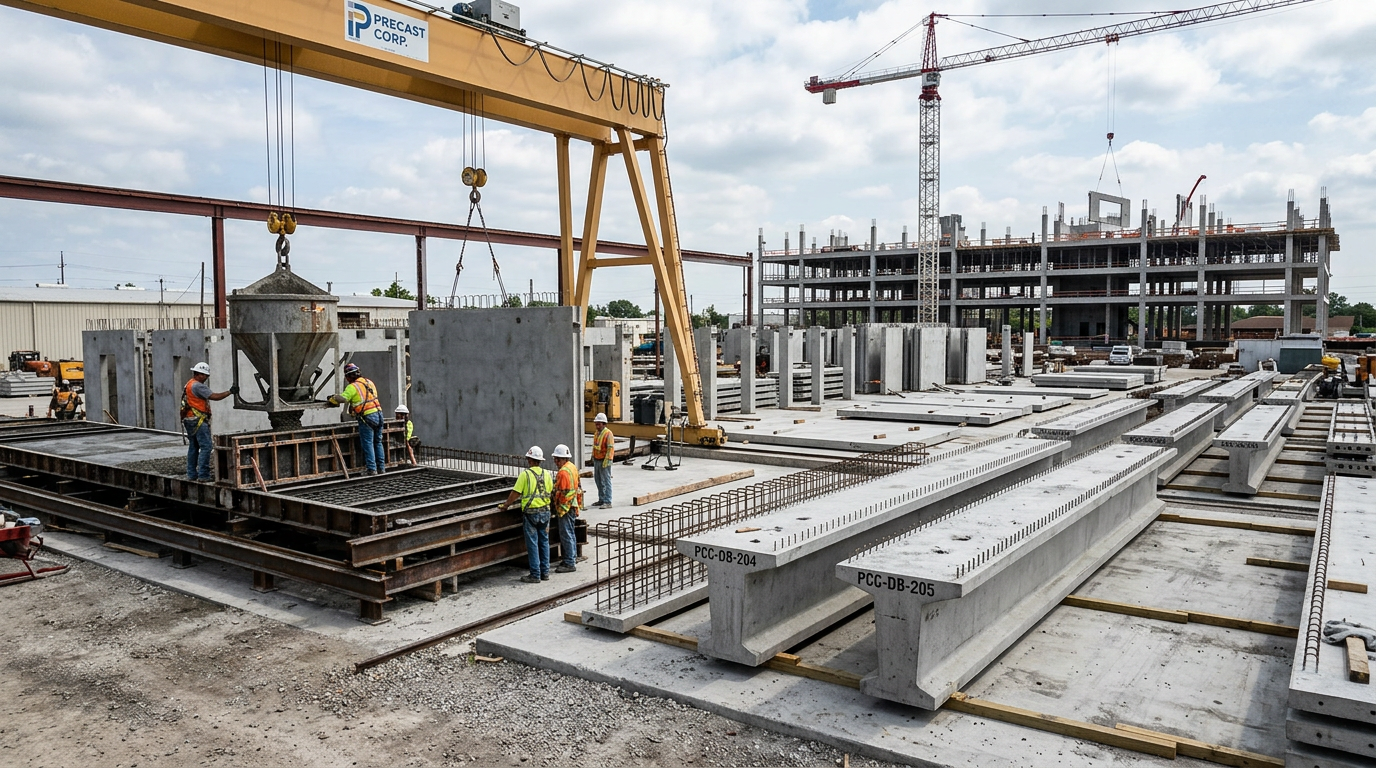
Plant production keeps formwork, reinforcement, casting, curing, and staging in one controlled workflow before components are delivered to the jobsite.
The best way to understand how precast concrete is made is to look at the process from form setup to final inspection. Each step affects the strength, durability, appearance, and jobsite performance of the finished product.
1. Mold Preparation
The process starts with mold preparation. The mold determines the shape, dimensions, edges, texture, and surface finish of the precast component. Steel molds are often used for repeat production because they are durable and hold tight tolerances. Wood or fiberglass forms may be used for custom shapes, architectural details, or specialty pieces.
Before concrete is placed, the form is cleaned, checked, and coated with a release agent. Crews also install blockouts, chamfers, lifting hardware, embedded plates, connection points, and other project-specific details.
This step is easy to underestimate, but it can make or break the finished product. A poorly prepared mold can lead to bad edges, incorrect dimensions, misaligned inserts, or surface defects. In practical precast work, this is where the difference between average production and professional production becomes obvious.
2. Reinforcement Placement
Once the mold is ready, reinforcement is placed according to engineered drawings. This may include rebar cages, welded wire reinforcement, prestressing strand, anchor plates, lifting devices, or other embedded items.
Proper placement matters because reinforcement must sit in the correct location inside the concrete. If it shifts during casting, the component may not perform as designed. Spacers, chairs, and supports are often used to keep steel and inserts in position while concrete is placed.
This is one of the most important parts of how precast concrete is made, especially for structural and prestressed products such as bridge girders, piles, caps, and beams.
3. Mixing and Pouring
The concrete mix is batched according to the approved design. Cement, aggregates, water, and admixtures are measured carefully so the concrete meets the required strength, workability, durability, and finish requirements.
After mixing, the concrete is placed into the prepared form. Crews must pour it carefully to avoid segregation, trapped air, and displacement of reinforcement or embedded items. The mix needs to be workable enough to flow around steel and inserts, but not so wet that it compromises strength or durability.
This is where how precast concrete is made becomes a balance between production efficiency and quality control. Faster is not always better if the mix, placement, or consolidation is wrong.
4. Consolidation and Finishing
After placement, the concrete is consolidated to remove trapped air and help the mix flow around reinforcement. Depending on the product, this may involve internal vibrators, external form vibration, vibrating tables, or other consolidation methods.
Finishing depends on the final use of the product. A structural bridge girder does not need the same surface appearance as an architectural wall panel. A deck slab may need a specific texture, while a column or cap may require cleaner exposed surfaces.
The goal is not just to make the product look acceptable. Proper consolidation and finishing help improve durability, reduce voids, and create a component that meets project requirements.
5. Curing
Curing is the process of maintaining the right moisture and temperature conditions so the concrete can gain strength properly. In precast production, curing may happen indoors, under blankets, with controlled heat, with steam, or with moisture-retaining compounds.
The important point is that curing is not just waiting for concrete to dry. Concrete does not gain strength by drying out; it gains strength through hydration. If moisture or temperature conditions are poorly managed, the concrete may crack, lose durability, or fail to reach the required strength on schedule.
This is another reason how precast concrete is made is different from ordinary field placement. A plant environment gives producers more control over strength development before the product is stripped, lifted, shipped, or installed.
6. Quality Control and Inspection
Quality control should happen throughout production, not just after the piece is finished. Common checks may include fresh concrete testing, reinforcement inspection, strength testing, dimensional checks, and finish inspection.
| Quality Check | What It Confirms | Why It Matters |
|---|---|---|
| Fresh Concrete Testing | Workability, air content, temperature, and consistency | Helps confirm the batch is suitable for placement. |
| Reinforcement Inspection | Correct steel, strand, spacing, embeds, and lifting hardware | Helps ensure the product matches the engineered design. |
| Strength Testing | Concrete strength at release, shipping, or specified age | Prevents handling or loading before the product is ready. |
| Dimensional Checks | Length, width, depth, camber, openings, and tolerances | Helps the component fit correctly in the field. |
| Finish Inspection | Surface quality, cracks, honeycombing, and edge condition | Supports durability, appearance, and project acceptance. |
Generic values like “4,000 to 6,000 psi” or “2 to 4 inch slump” should not be treated as universal standards. Requirements vary by product, project, agency, and specification. For broader industry context, the Precast/Prestressed Concrete Institute provides technical resources for precast and prestressed concrete structures. A better explanation is that testing must confirm the specific performance requirements for that product.
Applications of Precast Concrete
Precast concrete is used across many construction sectors because it allows major components to be produced before or during site preparation. This can reduce field labor, shorten installation windows, and improve consistency.
- Bridges: Girders, caps, deck slabs, beams, and piling.
- Highways: Barriers, drainage structures, sound walls, and transportation components.
- Marine construction: Prestressed piles, caps, and structural members designed for harsh exposure conditions.
- Commercial and industrial projects: Wall panels, columns, stairs, equipment supports, and structural framing.
- Sports and public facilities: Seating risers, stairs, ramps, and other repeatable structural components.
For more related context, Heldenfels’ pages on bridge girders and highway and bridge construction are strong internal resources for this topic.
Environmental and Construction Benefits
A good precast operation can reduce waste, improve material control, and limit jobsite disruption. Reusable forms, controlled batching, efficient curing, and planned deliveries can all support more efficient construction.
The environmental benefit should not be overstated, though. Precast is not automatically sustainable just because it is made in a plant. The benefit comes from disciplined production, reduced rework, long service life, efficient material use, and durable components that do not need frequent replacement.
That is why how precast concrete is made affects more than strength. It also affects waste, schedule, transportation planning, long-term maintenance, and the overall efficiency of a project.
Why the Manufacturing Process Matters
The main reason precast works so well is repeatability. When a producer makes similar components again and again, the team can refine the process, catch issues earlier, and deliver more consistent results. That is especially valuable for infrastructure projects where tolerances, strength, and timing are critical.
Understanding how precast concrete is made also helps owners and contractors ask better questions. Is the producer experienced with the product type? Are they using approved drawings and mix designs? Are quality checks documented? Are lifting points and embeds inspected before casting? Are products stored and shipped correctly?
Those questions matter because the finished piece is only as good as the process behind it.
Conclusion: The Value of a Controlled Precast Process
Precast concrete gives construction teams a practical way to improve speed, consistency, and durability. By manufacturing components in a controlled environment, producers can better manage the variables that affect concrete quality, from mix design and reinforcement to curing and inspection.
For Heldenfels Enterprises, this topic fits naturally because the company works with precast and prestressed concrete products used in highway, bridge, marine, industrial, sports, and commercial projects. The process is not just about pouring concrete into a form. It is about producing reliable structural components that are ready to perform once they reach the jobsite.
The bottom line is simple: how precast concrete is made determines how well it performs. When the process is controlled, tested, and handled by an experienced precast producer, the result is a stronger, more consistent, and more efficient construction solution.
Build with Proven Precast Experience
Heldenfels Enterprises manufactures and installs precast and prestressed concrete products for highway, bridge, marine, industrial, sports, and commercial projects.
Contact Heldenfels