
Precast Bridge Deck Systems: How They Accelerate Construction and Improve Work-Zone Safety
See how precast bridge deck systems can shorten onsite construction, reduce traffic disruption and support efficient bridge project delivery.
Precast bridge deck systems allow bridge owners and contractors to shift significant portions of deck construction away from the jobsite and into a controlled manufacturing environment. For suitable projects, this can shorten onsite construction, reduce traffic disruption and limit the time workers and motorists spend around active work zones.
These systems can include full-depth or partial-depth precast concrete deck panels, along with the connections, joints and other details needed to integrate the deck with the supporting bridge structure. Their effectiveness depends on appropriate engineering, fabrication, transportation and field installation rather than prefabrication alone.
What Are Precast Bridge Deck Systems?
Precast bridge deck systems use concrete deck elements that are manufactured offsite or near the project, transported to the bridge and connected to the supporting structure. The Federal Highway Administration identifies prefabricated deck elements as part of Prefabricated Bridge Elements and Systems , or PBES, which can support accelerated bridge construction by reducing onsite construction and mobility impacts.
Common concrete deck configurations include:
- Full-depth precast deck panels, which provide the full structural deck thickness.
- Partial-depth precast deck panels, which can function as permanent formwork and become part of the completed deck after additional concrete is placed.
- Specialized precast deck configurations, which may incorporate post-tensioning, different reinforcement strategies or project-specific connection systems.
Full-depth precast decks generally use a series of panels sized according to structural requirements, bridge geometry, handling and transportation considerations.
Precast concrete deck slabs are therefore an important component of many precast bridge deck systems, but the completed system also includes the connections, joints, supporting-structure interfaces and field work required to create a functioning bridge deck.
The Core Promise: Unlocking Speed and Safety
The primary advantage of precast bridge deck systems is their ability to move time-consuming construction activities away from the bridge site. Instead of completing every stage of deck construction in sequence in the work zone, project teams can manufacture deck elements while other site and structural work progresses.
For suitable projects, this approach can create a more controlled workflow, shorten onsite construction periods and reduce worker and motorist exposure to active traffic and construction operations.
The Challenge of Traditional Cast-in-Place Methods
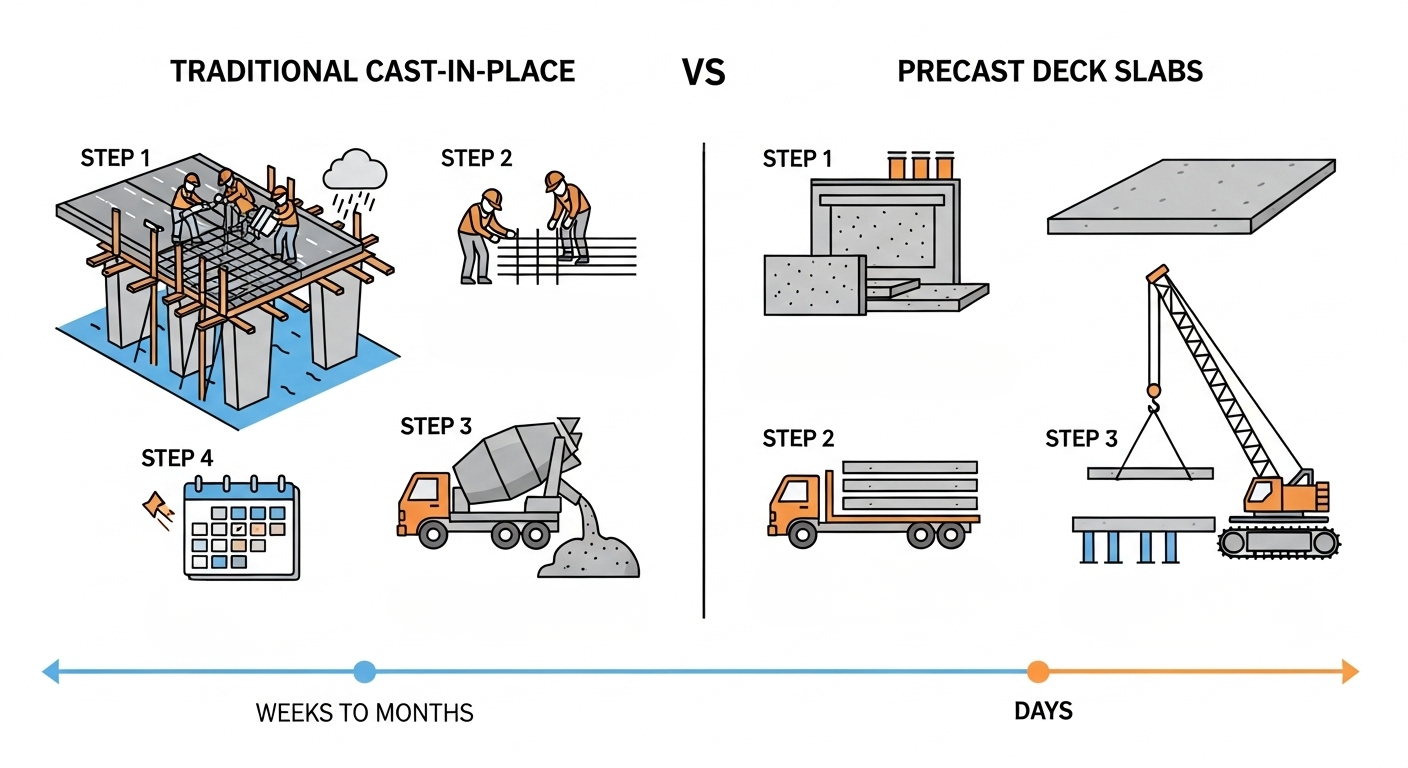
Conventional cast-in-place construction involves building extensive formwork onsite, tying reinforcing steel in place, placing concrete and allowing it to cure and develop the required strength before subsequent construction or traffic opening can proceed.
This process is labor-intensive and exposes a larger portion of the work to weather and other field conditions. It may also require workers to spend extended periods over traffic, waterways or other difficult locations.
Where traffic disruption or onsite construction time is a major project constraint, these factors can make deck construction a critical part of the overall bridge schedule.
The Precast Advantage: Building Better, Faster and Safer from the Ground Up

Precast deck panels can be lifted onto the supporting structure as part of a coordinated bridge deck installation, reducing the amount of deck construction performed onsite.
The precast advantage stems from changing where and when bridge deck construction takes place. Instead of completing each stage piece by piece at the bridge site, project teams can manufacture deck components under controlled conditions and deliver them when the supporting structure is ready.
A Foundation of Quality: Material Consistency and Structural Integrity
Manufacturing bridge deck elements in a controlled environment allows concrete batching, placement, curing, reinforcement, dimensions and inspections to be managed consistently.
This can reduce some of the variability associated with field construction and help fabricated elements meet specified dimensional and material requirements.
However, plant production alone does not guarantee long-term performance. The durability of precast bridge deck systems also depends on structural design, joints, connections, drainage, installation quality, exposure conditions and maintenance throughout the bridge’s service life.
Precast vs. Cast-in-Place Bridge Deck Construction
Cast-in-place bridge deck work is generally performed through a sequence of onsite activities such as formwork installation, reinforcing steel placement, concrete placement and curing.
With precast construction, much of that work can occur away from the bridge while foundations, abutments, bridge girders or other portions of the structure are being prepared.
This parallel workflow is one reason precast bridge deck systems are used as part of accelerated bridge construction.
The choice is still project-dependent. Cast-in-place construction may remain appropriate where transportation, crane access, unusual geometry, staging limitations or other site conditions make precast installation less practical.
Accelerating Project Timelines: The Engine of Efficiency
Speed is one of the most significant reasons transportation agencies consider prefabricated bridge construction. Accelerated bridge construction uses planning, design, materials and construction methods to reduce onsite construction time when building, rehabilitating or replacing bridges.
Shifting Work Offsite: Concurrent Activities and Reduced Delays
The greatest schedule benefit can come from completing multiple activities concurrently.
While crews perform foundations, abutments, girder work and other site preparation, precast deck elements can be manufactured separately. This can reduce the amount of sequential deck work required after the supporting structure is ready.
Precast bridge deck systems may therefore be particularly useful where bridge owners need to limit closure periods or complete substantial work during defined traffic-control windows.
Actual schedule savings vary according to bridge geometry, panel configuration, fabrication lead time, crane access, transportation, field connections, curing requirements and other project conditions.
Streamlined Installation: Rapid Deployment on Site
Once the panels reach the project, cranes are commonly used to lift and position them on the supporting structure. The number of panels installed during a work period depends on factors such as panel dimensions, lifting capacity, bridge access, staging and connection requirements.
Setting panels is only part of the installation process.
Depending on the specific precast bridge deck system, field work may include:
- Surveying and panel fit-up
- Leveling or temporary support
- Panel-to-girder connections
- Shear connector pockets
- Grouted joints or shear keys
- Post-tensioning where specified
- Closure pours
- Final riding-surface or overlay work where required
Connection details vary according to the system and may be used to transfer loads between panels and the supporting bridge structure. Proper detailing and field execution are therefore important parts of installation.
Enhanced Project Management and Scheduling
Because much of the deck production takes place in a controlled environment, fabrication can be less exposed to weather than conventional field-cast deck construction.
That does not make the schedule immune to delays. Transportation permits and routes, plant capacity, crane availability, site access, weather during erection, traffic-control restrictions and field connection work can all affect project timing.
Effective use of precast bridge deck systems therefore requires coordination between designers, fabricators, contractors, transportation teams and field crews well before installation begins.
How Precast Construction Can Reduce Work-Zone Exposure
Safety advantages are closely tied to the reduction in work performed within the active bridge construction zone.
Reducing onsite construction can reduce the amount of time construction crews and motorists are exposed to work-zone hazards. Shifting formwork, reinforcement placement and concrete production into a controlled manufacturing facility can also reduce certain labor-intensive operations at the bridge itself.
Precast construction does not eliminate construction risk. Its potential safety advantage comes from reducing certain onsite activities and exposure periods while replacing them with carefully planned transportation, lifting, erection and connection work.
Erection still involves heavy lifting, rigging, working at height, temporary stability, traffic management and other hazards that require project-specific controls.
The more accurate advantage is therefore reduced exposure to some onsite hazards, not inherently risk-free construction.
Reduced Traffic Disruption
One of the strongest applications for precast bridge deck systems is where minimizing disruption to road users is a major project objective.
Shorter onsite construction periods can reduce the duration of:
- Lane closures
- Full road closures
- Traffic detours
- Temporary staging
- Work-zone exposure for motorists
- Impacts on nearby communities and businesses
Prefabricated bridge construction is commonly used where reducing onsite work and mobility impacts is an important project objective. The amount of disruption avoided still depends on bridge configuration, construction staging, installation method and the traffic-control plan.
Engineered for Performance: Precast Deck Design and Quality

Controlled plant production allows concrete, reinforcement, dimensions and curing conditions for precast bridge deck components to be monitored before delivery to the bridge site.
Performance depends on more than the deck panels themselves. Concrete quality, reinforcement, connections, joints, field installation and long-term exposure conditions all contribute to how the completed deck performs.
Structural Integrity and Durability
Controlled plant production allows concrete batching, placement, curing, reinforcement, dimensions and inspections to be managed consistently.
When mixture design, reinforcement, curing, durability provisions and workmanship are appropriately specified, this environment can support consistent material properties and durable precast elements.
Durability of the completed deck also depends on joints, connections, drainage, exposure conditions, protective systems and maintenance. Water and chloride intrusion at poorly executed connections can affect long-term performance, making field quality control particularly important.
Connections, Joints and Grouting
Connections are a critical part of precast bridge deck systems because loads must be transferred between individual deck elements and the supporting structure.
Depending on the design, panels may use grouted shear keys, shear connectors, reinforced closure pours, post-tensioning or other engineered details.
Proper fit-up, dimensional tolerances, material selection, grout placement and field quality control are especially important at these interfaces.
The Precast/Prestressed Concrete Institute’s guidance on precast bridge decks identifies panel-to-girder connections, transverse joints, haunches, temporary support, fabrication and construction operations among the considerations for full-depth precast decks.
Integrated Features
Prefabrication can also allow certain project-specific features to be incorporated into deck elements before delivery. Depending on the design, these may include curb profiles, drainage features or connection provisions for barriers and railings.
Integrating suitable features during production can reduce some additional field operations, although the final details depend on the bridge design and owner requirements.
Technology and Material Options
Modern bridge projects can use digital coordination tools to improve precast design and installation planning.
Where appropriate, digital models may help project teams review:
- Bridge geometry
- Panel dimensions
- Tolerances
- Lifting requirements
- Crane positioning
- Delivery sequencing
- Potential installation conflicts
Projects may also specify high-performance concrete, corrosion-resistant reinforcement, specialized grout, ultra-high-performance concrete or other materials where appropriate to the structural design and exposure conditions.
These technologies are options rather than defining features of every precast bridge deck system.
Rehabilitation and Bridge Deck Replacement
Prefabricated deck construction is not limited to new bridges.
Precast deck elements can also be considered for rehabilitation and bridge deck replacement where deteriorated sections must be replaced while limiting traffic impacts.
On an existing bridge, project teams must account for field dimensions, existing girder geometry, structural capacity, connection details and erection access before fabrication.
Accurate surveying and coordination can be especially important because existing structures may not match original drawings or idealized dimensions exactly.
Are Precast Bridge Deck Systems Suitable for Every Project?
No. Precast bridge deck systems are project-specific solutions rather than a universal replacement for cast-in-place bridge decks.
Factors that may affect feasibility include:
- Panel transportation dimensions and weight
- Crane capacity and reach
- Staging and laydown space
- Bridge skew and roadway geometry
- Existing structural conditions
- Dimensional tolerances
- Utility conflicts
- Fabrication lead times
- Connection and closure-pour requirements
- Traffic-control constraints
- Owner and state DOT specifications
These issues should be evaluated during design and constructability planning, not after fabrication begins.
Measuring Project Performance
The benefits of prefabricated construction should be evaluated through project-specific results rather than assumed in advance.
Useful schedule and construction metrics may include:
- Total onsite construction duration
- Number and duration of traffic closures
- Panel installation rates
- Weather-related delays
- Time required for field connections
- Time between deck installation and reopening
Safety performance can also be tracked using established contractor and project safety metrics alongside worker-hours and motorist exposure within active work zones.
The Role of Precast Bridge Deck Systems in Modern Infrastructure
Precast bridge deck systems provide owners, engineers and contractors with another option for building, rehabilitating and replacing bridge decks where onsite construction time and traffic impacts are important considerations.
Their key advantage is not simply that the concrete is precast. The value comes from coordinating design, manufacturing, transportation, erection and connections so that more work can be completed away from the bridge site and the remaining field work can be performed efficiently.
For the right project, this can support accelerated construction, controlled manufacturing and reduced work-zone exposure.
The final decision should still account for structural requirements, site access, bridge geometry, traffic management, connection design, lifecycle considerations and owner specifications.
Planning a Bridge Project with Precast Components?
Heldenfels Enterprises manufactures precast and prestressed concrete products for highway and bridge construction in Texas. Talk with our team about your project specifications, scheduling and delivery requirements.
Discuss Your Project