
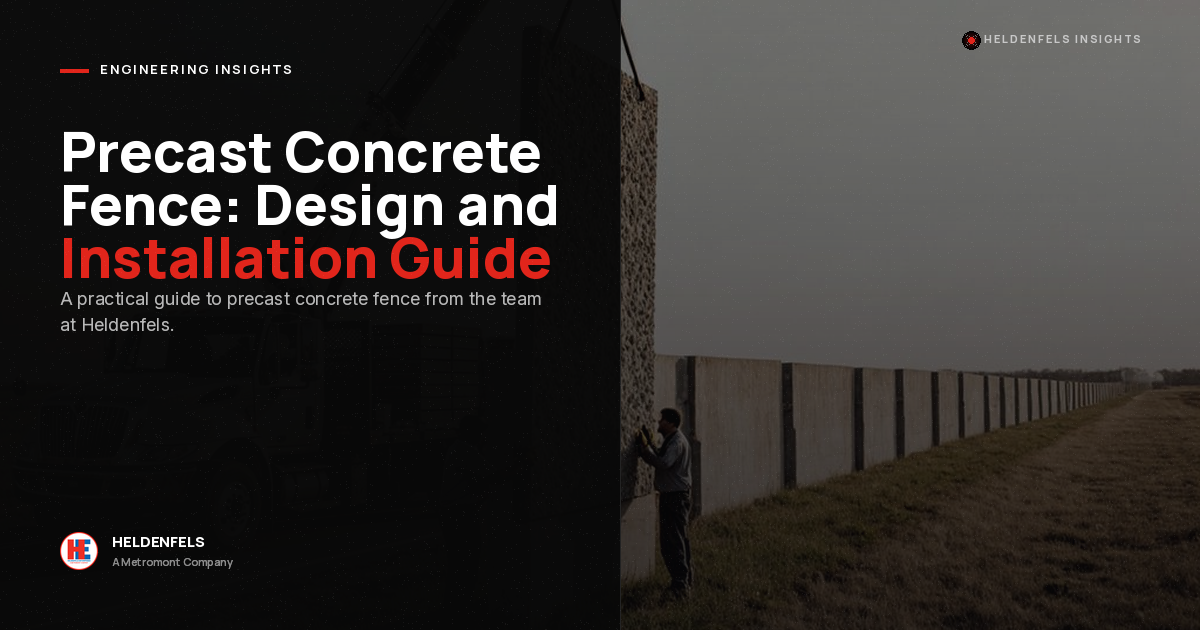
Precast Concrete Fence: The Ultimate Expert Guide to Design and Installation
On fencing and concrete forums, one question keeps resurfacing: how hard would a precast concrete fence be to install, and is it actually worth it over wood or block? After more than a century of manufacturing precast in Texas, here is our honest answer. It is not a weekend project, because the panels weigh as much as a small car. But for a professional crew with the right lifting equipment, it is one of the fastest perimeter systems in construction, and once it is up, it will likely outlast the person who ordered it.
This guide walks through what these fencing systems are, the design decisions to settle before anything gets cast, and what installation day really looks like, so you can decide whether the system fits your property.
Key Takeaways
- Precast fencing is a panel-and-column system: columns anchor into drilled footings, and textured panels drop into slots between them
- Panels typically weigh 800 to 4,000 pounds each, so installation requires a boom truck or small crane, not a post-hole digger and a free Saturday
- An experienced three-person crew can set 100 to 300 linear feet per day, several times faster than laying block
- Design choices to lock in early: height, texture, color, wind load engineering, and soil conditions at the fence line
- A properly installed system delivers a 50-plus year service life with almost no maintenance
What Is a Precast Concrete Fence, Exactly?
A precast concrete fence is a perimeter wall built from factory-cast components rather than materials assembled piece by piece in the field. The system has two parts. Reinforced columns, sometimes called posts or pilasters, are set into drilled concrete footings at regular intervals, usually 8 to 15 feet apart. Horizontal panels then slide into vertical slots cast into the sides of each column, stacking or standing to the finished height.
Because every component is cast in steel forms at a plant, the detail work happens under controlled conditions. Form liners imprint realistic stone, brick, stucco, or board textures on both faces of each panel, and integral pigments color the concrete all the way through. The same plant discipline that governs our precast wall panels applies here: consistent mix designs, steam-controlled curing, and dimensional checks before anything ships. If you want to see what that factory process involves, we have a full walkthrough of how precast concrete is made.
Heights commonly run from 4-foot garden walls to 12-foot security and sound walls. The tall end of that range is the same product family used for highway sound barriers, scaled for ranches, subdivisions, equipment yards, and commercial perimeters.
Why Property Owners Are Switching from Wood and Block
The typical caller is not comparing materials in the abstract. One rancher we spoke with was pricing his third wood fence replacement along the same stretch of farm-to-market road in twenty years: the first fence rotted at the posts, the second lost forty feet of pickets to a spring windstorm. At roughly that point, the math changes. A fence you build once beats a cheaper fence you build three times.
Concrete fencing wins on four fronts:
- Weather and pests. Concrete does not rot, warp, burn, or feed termites. Properly engineered systems are designed for sustained wind loads that flatten wood privacy fences, a serious consideration across the Texas plains and Gulf Coast.
- Sound attenuation. Mass blocks noise. A solid panel wall meaningfully cuts road and equipment noise in a way no wood or vinyl fence can, which is why transportation agencies build their sound walls from the same material.
- Security. A 4,000-pound panel between two anchored columns does not kick in, pry open, or sag off its hinges. For equipment yards and substations, that matters.
- Lifetime cost. The upfront price runs higher than wood. But spread over a 50-plus year service life with little more than an occasional rinse, the cost per year of service is usually the lowest of any fencing material.

The replacement cycle that drives most calls: rotted posts and storm-downed sections that wood fencing repeats every few years.
Design Decisions to Settle Before Anything Gets Cast
Precast rewards planning and punishes improvisation. Once panels are cast, they are cast. These are the decisions we walk owners through before a form gets filled.
Height, Texture, and Color
Pick height by purpose: 4 to 6 feet for boundary and garden walls, 6 to 8 feet for privacy and noise, 8 to 12 feet for security and sound control. Texture and color should be chosen from physical samples, not photographs, because sunlight and weathering read differently than a screen. Remember that both faces are finished, so your neighbor’s side looks as good as yours, which makes HOA approvals noticeably easier.
Engineering for Wind and Soil
A solid wall is a sail. Footing depth and column spacing must be engineered for the local design wind speed and the soil at the fence line, and expansive clays common across Texas deserve particular respect. A geotechnical look at the soil is money well spent on long runs. This is the same engineering discipline we apply when designing precast equipment foundations for industrial sites: the structure above only performs as well as the ground connection below.
Site Logistics
Delivery trucks and lifting equipment need access along the fence line. Call in utility locates before anyone drills, confirm the surveyed property line, and check local permit requirements, since many jurisdictions treat any wall over 6 or 7 feet as an engineered structure requiring sealed drawings.
How Hard Is Precast Concrete Fence Installation?
Here is the honest answer to the forum question. The work itself is straightforward; the loads are not. Nothing about the sequence below is conceptually difficult, but every step involves components far beyond what people can lift, which is why this is a crew-and-crane job rather than a DIY one.
- Layout and survey. The fence line is staked, column centers are marked at the engineered spacing, and grade changes are mapped so panels can step or follow the slope.
- Drill the footings. An auger rig drills caisson holes at each column location, typically 3 to 6 feet deep depending on wall height, wind design, and soil.
- Set the columns. Each column is lowered into its hole, braced plumb in two directions, and concreted in. Alignment here decides everything, because the panel slots must line up down the entire run.
- Cure. Footings reach working strength in a few days. Crews often leapfrog, drilling and setting ahead while earlier sections cure.
- Fly the panels. A boom truck or small crane lifts each panel off the trailer and lowers it into the slots between columns. With two workers guiding and one rigging, a panel lands about every few minutes.
- Finish. Caps go on the columns, joints get grouted or sealed where specified, and disturbed ground along the line is dressed out.
The pace is the surprise. An experienced three-person crew with a boom truck routinely sets 100 to 300 linear feet of finished wall in a day. A comparable masonry wall involves footings, block laying, mortar curing, and finishing over a span of weeks. On one recent perimeter, the crew had 200 feet of 8-foot stone-textured wall standing before lunch on the first panel day.

Column-setting day: bracing each column plumb in two directions so the panel slots align down the whole run.
Cost and Longevity Against the Alternatives
Material costs vary by region, height, and finish, so treat the comparison below as a planning framework rather than a quote. The pattern, however, holds almost everywhere.
| System | Upfront Cost | Install Speed | Expected Life | Maintenance |
|---|---|---|---|---|
| Wood privacy | Low | Fast | 10 to 20 years | Staining, post and picket replacement |
| CMU block wall | High | Slow, weeks of field labor | 40 to 60 years | Repointing, crack repair, painting |
| Precast panel system | Moderate to high | Very fast, days not weeks | 50 or more years | Occasional washing, sealant checks |
Quality hinges on the plant behind the panels. The Precast/Prestressed Concrete Institute audits and certifies producers on mix control, curing, and dimensional tolerance, and certified production is the difference between panels that fit their slots for half a century and panels that crack in year five. The same plant-versus-field logic applies across other site structures too; our guide to precast retaining walls covers how factory-cast systems handle the heavier job of holding back earth.
The Bottom Line
So, how hard is it? Hard enough that you should not attempt it with a rented post-hole digger, and easy enough that a properly equipped crew will finish your perimeter in a fraction of the time masonry takes. A precast concrete fence is a buy-once decision: engineer the footings for your wind and soil, choose finishes from physical samples, insist on certified plant production, and the wall you set this season will still be standing straight for the next generation.
Heldenfels Enterprises has manufactured precast and prestressed concrete in Texas since 1909, from bridge girders to wall systems, with in-house engineering and PCI-certified production. If you are weighing a precast perimeter for a ranch, facility, or development, we are glad to talk through the engineering before you commit a dollar.
Planning a Precast Perimeter?
Talk to a Texas precast manufacturer with more than a century of plant-cast experience. We will help you get the engineering right the first time.
Contact Our Team