Precast Concrete Wall Panels: Your Guide to Their Diverse Applications
Durable, efficient, and predictable wall systems for commercial, industrial, infrastructure, and specialty construction projects.
In modern construction, speed only matters when quality keeps up. That is why precast concrete wall panels have become a practical choice for projects that need durable, efficient, and predictable wall systems. Instead of forming and curing every wall on-site, these panels are produced in a controlled manufacturing environment, delivered to the project, and installed when the structure is ready.
For owners, contractors, engineers, and architects, the real advantage goes beyond faster installation. Precast concrete wall panels help reduce weather-related delays, improve quality consistency, simplify jobsite sequencing, and support long-term performance in demanding building conditions.
This is exactly where Heldenfels Enterprises brings value. As a manufacturer and installer of precast and prestressed concrete structures for highway, marine, industrial, and building construction markets, we understand that wall panels need to do more than fill space. They need to perform structurally, install efficiently, and stand up to real-world project demands.
What Are Precast Concrete Wall Panels?
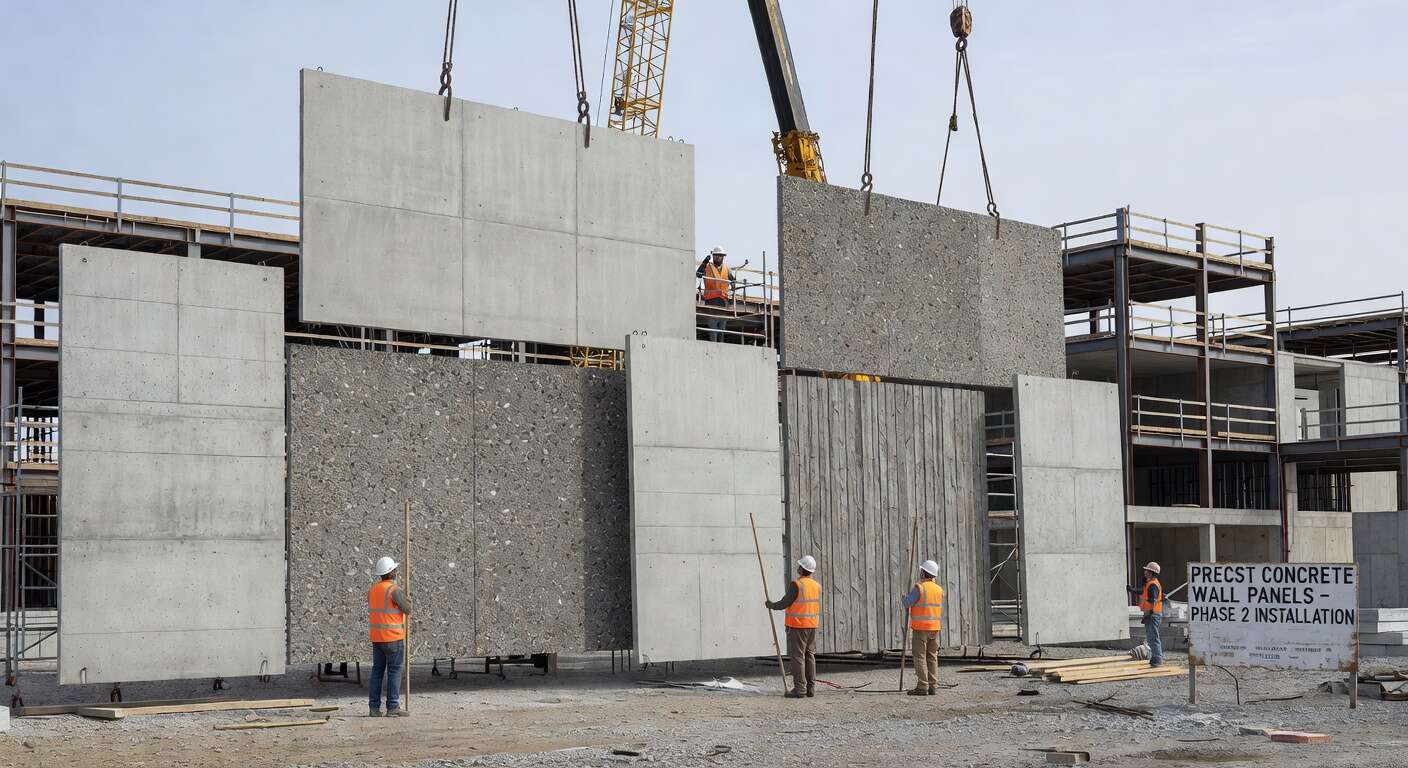
Precast concrete wall panels are factory-made concrete wall sections produced before they arrive at the jobsite. They are cast in reusable forms, reinforced or prestressed depending on project needs, cured under controlled conditions, and shipped once they reach the required strength.
Unlike cast-in-place walls, which depend heavily on jobsite conditions, precast panels are produced in a plant where quality, dimensions, finishes, reinforcement, insulation, embedded hardware, and connection points can be controlled more precisely.
That matters because wall systems do more than separate indoor and outdoor space. They can affect structure, fire resistance, sound control, thermal performance, safety, weather protection, and long-term maintenance.
Why Precast Wall Panels Are Used in Modern Construction
The biggest reason project teams choose precast concrete wall panels is predictability.
While crews prepare the site, foundation, or supporting structure, panels can be manufactured off-site. Once delivered, they can be installed quickly with cranes and coordinated erection sequencing. This parallel workflow can help shorten construction schedules and reduce the number of field operations required.
That is not just a convenience. On industrial, commercial, and infrastructure projects, fewer jobsite variables can mean fewer delays, fewer conflicts between trades, and better control over the final result.
Key Benefits of Precast Concrete Wall Panels
Precast is not automatically the right choice for every project, but when speed, durability, and consistency matter, it is hard to ignore. The biggest advantage of precast concrete wall panels is that they help project teams reduce uncertainty while still delivering a strong, high-performing wall system.
Faster Project Schedules
Because precast concrete wall panels are manufactured off-site, production can often happen while other site work is underway. Once the panels arrive, installation can move quickly, especially when crane access, staging, and erection sequencing are planned early.
Better Quality Control
Plant production allows for more consistent curing, reinforcement placement, dimensional accuracy, and finish control. That makes precast a strong option for projects where performance and repeatability matter.
Long-Term Durability
Concrete resists rot, pests, and many forms of weather-related damage. For facilities exposed to heavy use, harsh weather, fire risk, or industrial conditions, durability can reduce long-term maintenance headaches.
Design and Performance Flexibility
Depending on the project, precast concrete wall panels can be load-bearing or non-load-bearing, insulated or non-insulated, structural or architectural. Heldenfels’ prestressed wall panels can also be designed for demanding requirements such as fire-rated applications and blast-resistant construction.
Types of Precast Concrete Wall Panels
Not every project needs the same wall system, and treating all precast panels as interchangeable is a lazy mistake. The right choice depends on the project’s structural demands, insulation needs, finish expectations, installation conditions, and long-term performance goals.
Below are the most common types of precast concrete wall panels used across commercial, industrial, infrastructure, and specialty construction.
Solid Concrete Panels
Solid panels are monolithic concrete sections used where strength, impact resistance, and durability are priorities. They are common in industrial buildings, retaining walls, infrastructure work, utility structures, parking facilities, and heavy-duty enclosures.
Insulated Sandwich Panels
Insulated sandwich panels include concrete layers with rigid insulation between them. These precast concrete wall panels can combine structure, insulation, and finished wall surfaces in one system.
They are especially useful for buildings where thermal performance matters, including warehouses, data centers, food processing facilities, and climate-controlled industrial spaces.
Architectural Wall Panels
Architectural panels are designed to provide both performance and visual appeal. They can include textures, reveals, exposed aggregate, colors, coatings, and custom finishes.
This is where bad design can ruin a good product. Concrete does not automatically look attractive. But when panel joints, finishes, proportions, and transitions are handled properly, architectural precast can create a durable and polished exterior.
Prestressed Wall Panels
Prestressed panels use tensioned steel strands to improve strength and span capacity. This allows panels to handle demanding structural requirements while maintaining efficient wall profiles.
Heldenfels’ prestressed wall panels are relevant for shear walls, retaining walls, industrial perimeter walls, stadium passages, marine barriers, commercial buildings, and institutional projects.
Precast Concrete Wall Panels for Industrial Projects
Industrial construction is one of the strongest applications for precast concrete wall panels because these projects need walls that perform under real pressure. Owners are not looking for decorative trends first. They need wall systems that can support schedule demands, safety requirements, equipment protection, and long-term durability.
For industrial facilities, precast wall systems can help with:
- Fast enclosure: Panels can be manufactured off-site while other site work moves forward.
- Heavy-use durability: Concrete can stand up to demanding operating environments better than many lighter wall systems.
- Fire separation: Wall panels can support fire-rated design requirements where safety and code compliance matter.
- Equipment protection: Strong wall systems help protect critical machinery, utilities, and production areas.
- Weather resistance: Precast can provide a tough exterior envelope for facilities exposed to harsh conditions.
- Lower maintenance: Durable concrete systems can reduce repair needs over the life of the facility.
Heldenfels serves industrial applications such as data centers, power facilities, LNG plants, wastewater treatment plants, semiconductor manufacturing facilities, food processing plants, warehouses, and distribution centers. In these environments, precast concrete wall panels can support building enclosure, structural performance, and protection requirements.
That is the stronger message: this is not about vague “modern construction trends.” Precast concrete wall panels solve practical problems on demanding industrial jobsites.
Commercial and Institutional Applications
Commercial and institutional projects need wall systems that can balance durability, appearance, installation speed, and long-term maintenance. That is why precast concrete wall panels can be a strong fit for buildings where performance matters, but the exterior still needs to look clean and professional.
Common applications include:
- Office buildings: Durable exterior walls with architectural finish options.
- Schools and universities: Wall systems that can support fire resistance, sound control, and reduced maintenance.
- Municipal buildings: Strong, low-maintenance panels for public facilities.
- Retail spaces: Clean exterior finishes without relying on overly complicated cladding systems.
- Storage facilities: Durable wall assemblies that can be installed efficiently.
- Mixed-use developments: Flexible panel systems that can support both performance and design goals.
- Public facilities: Long-lasting walls for libraries, community centers, maintenance buildings, and similar projects.
For schools and public buildings, concrete wall panels can support fire resistance, acoustic performance, and long-term durability. In office and retail projects, architectural finishes can create a polished exterior while keeping the wall system practical and low-maintenance. To avoid redesign, schedule issues, and installation constraints, panel sizes, openings, embeds, finishes, connections, transportation limits, and crane access should be reviewed before the design is finalized.
Parking, Infrastructure, and Specialty Uses
Parking structures are a natural fit for precast concrete wall panels because they demand strength, repetition, weather resistance, and fast installation. Precast systems can help create durable structures that stand up to constant vehicle traffic and outdoor exposure.
Infrastructure and specialty applications can include retaining walls, sound barriers, tunnel elements, bridge-related components, marine structures, utility enclosures, and protective barriers.
In these settings, the main value is repeatable quality. A panel manufactured in a controlled environment can be easier to inspect, transport, sequence, and install than a wall built entirely under changing field conditions.
Design Options for Precast Concrete Wall Panels
The idea that concrete has to look plain is outdated. Well-designed precast concrete wall panels can support a wide range of architectural finishes.
Common options include:
- Smooth finishes
- Exposed aggregate
- Textured surfaces
- Formliner patterns
- Reveals and shadow lines
- Integral color
- Stains or coatings
- Coordination with glass, metal, masonry, or other exterior materials
The important part is planning. Panel layout, joint spacing, corners, transitions, openings, and finishes should be designed intentionally. If precast is treated as a last-minute substitution, the result usually looks cheap.
Installation and Project Coordination
Precast concrete wall panels require careful coordination before they ever reach the jobsite. Transportation routes, crane access, panel weight, erection sequencing, temporary bracing, embedded plates, connection design, and site staging all affect installation.
This is where early manufacturer involvement matters. Heldenfels’ wall panel page notes that prestressed concrete wall panels typically take about 6 to 8 weeks before they are ready to leave the facility, depending on the project. That lead time should be built into the schedule early, not discovered late.
Good planning turns precast into an advantage. Poor planning turns it into a bottleneck.
Sustainability and Long-Term Value
Sustainability claims around concrete should be handled honestly. Concrete has environmental impacts, especially because of cement production. Pretending otherwise is weak marketing.
The stronger argument is that precast concrete wall panels can support sustainability through durability, reduced jobsite waste, quality control, long service life, and improved thermal performance when insulated systems are used correctly.
For owners, the long-term value usually comes from fewer repairs, better resistance to fire and weather, reduced maintenance, and a wall system that performs for decades. A cheaper wall system that creates years of repair problems is not actually cheaper.
For additional U.S.-based guidance, the National Precast Concrete Association provides resources on precast concrete sustainability and manufacturing practices.
Why Work With Heldenfels Early?
The best time to involve Heldenfels is during design, not after major decisions have already been made.
Precast affects wall layout, structural design, transportation, lifting points, crane access, embedded connections, bracing, panel sequencing, and finish expectations. Early coordination gives the project team a better chance to optimize the system instead of forcing it into a design that was not planned for precast.
For more technical details, our precast prestressed wall panels page is the most relevant internal resource. Readers can also review our industrial precast concrete solutions to see how wall panels fit into larger structural, enclosure, and safety systems.
Final Thoughts on Precast Concrete Wall Panels
Precast concrete wall panels are not just a faster way to build walls. They are a smarter way to coordinate structure, enclosure, durability, installation, energy performance, and long-term value.
For Heldenfels Enterprises, the best message is not vague construction hype. The stronger positioning is specific: engineered precast and prestressed systems for demanding Texas construction markets, including industrial, infrastructure, marine, commercial, and specialty projects.
When the contractor, design team, and precast manufacturer coordinate early, precast concrete wall panels can reduce schedule risk, improve quality, and deliver the kind of durable performance that owners actually care about.
Plan Your Precast Wall Panel Project With Heldenfels
Get the right wall system into the conversation early so your project can move faster, install cleaner, and perform better over the long term.
Get in touch with us