
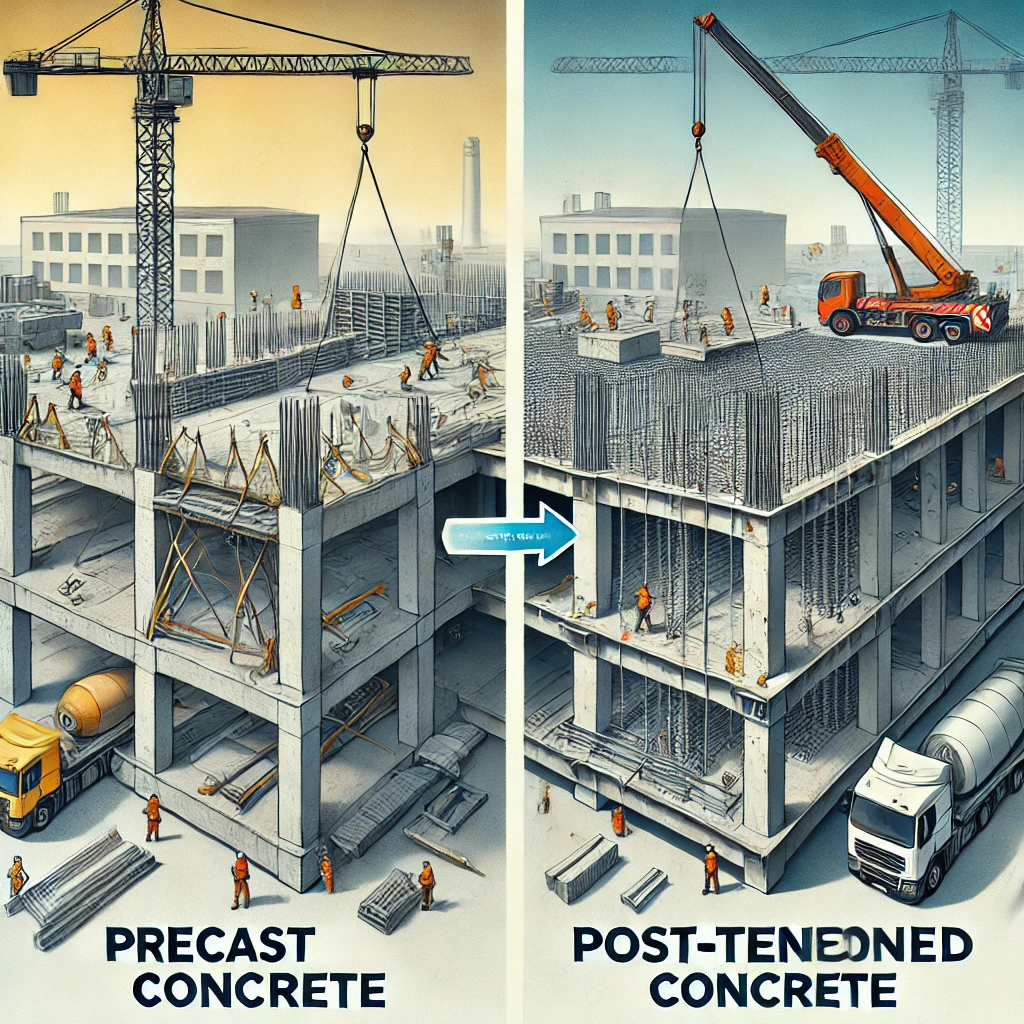
Precast vs. Post-Tensioned Concrete: Key Differences for Structural Projects
Choosing between precast vs post-tensioned concrete dictates your project’s logistics, lifetime maintenance, and structural layout from day one.
Choosing between precast vs post-tensioned concrete dictates your project’s logistics, lifetime maintenance, and structural layout from day one. Failing to understand how these heavy civil structural methods differ can result in massive design inefficiencies or unnecessary site delays.
While many engineering blogs treat precast vs post-tensioned concrete as a simple either/or decision, the reality of modern infrastructure design is far more integrated. To make the most cost-effective choice for your next build, you have to look at where the concrete is poured, how tension is applied, and how the construction environment impacts your timeline.
What is Precast Concrete?
Precast concrete refers to structural elements that are cast in a controlled, off-site manufacturing facility and then transported to the job site for assembly. Because the pouring and curing happen inside a specialized plant, it eliminates environmental variables like rain, extreme humidity, or freezing temperatures.
During production, high-strength steel cables are typically tensioned before the concrete is poured. Once the concrete cures around these cables and achieves its design strength, the cables are cut. This transfers a compressive force into the element, allowing it to withstand heavy loads. At Heldenfels, we use this exact plant-based prestressing process to build massive precast structural columns up to 80 feet tall.
Once cured, these elements are shipped directly to the construction site. This workflow allows for rapid installation, making it a staple for highway bridges, industrial structures, marine environments, and stadium risers.
The Structural Benefits of Precast Concrete
When analyzing precast vs post-tensioned concrete, the advantages of plant-manufactured elements center entirely around quality control, safety, and project speed.
- Unmatched Material Durability: Because the components are poured indoors, plant technicians carefully monitor mix proportions, water-to-cement ratios, and aggregate quality. This produces highly consolidated, dense concrete that resists water infiltration and chemical attacks far better than field-poured mixes.
- Parallel Project Timelines: With precast manufacturing, your structural elements are built simultaneously while your site crews are still clearing land and digging foundations. This parallel workflow can shave months off a traditional construction schedule.
- Reduced Site Labor and Enhanced Safety: Assembling components on-site requires a much smaller field crew than pouring wet concrete. This drastically limits trade clutter on the job site and reduces the safety risks associated with working around raw, untensioned cables or setting up temporary scaffolding at extreme heights.
What is Post-Tensioned Concrete?
Post-tensioned concrete is typically a form of cast-in-place concrete where the steel reinforcement is tensioned after the concrete has been poured and has begun to set on-site. Instead of using bare steel cables embedded directly in the mix, workers lay out hollow plastic or metal ducts containing unstressed steel tendons before pouring the wet concrete.
Once the concrete is poured on-site and achieves approximately 75% of its final structural strength, hydraulic jacks are used to pull the tendons to an extreme tension. The tendons are then securely anchored to the outer edges of the concrete slab. This internal tension counteracts the downward forces that the finished structure will face, allowing engineers to design incredibly thin concrete profiles.
It is a common technique used to eliminate supporting columns in high-rise commercial structures and to prevent shifting in residential foundation slabs built on expansive soils.
The Structural Benefits of Post-Tensioned Concrete
While precast dominates in heavy, repetitive structural applications, post-tensioning excels at maximizing architectural flexibility and reducing raw material weight.
- Thinner Slabs and Reduced Dead Load: Post-tensioning counteracts deflection so efficiently that engineers can drastically reduce the thickness of concrete floor plates. Thinner slabs mean the overall weight (dead load) of the building drops, which allows for smaller, less expensive foundations.
- Longer Clear Spans with Fewer Columns: Because the internal steel tendons can be draped in sweeping parabolic curves inside the forms, post-tensioned slabs can span massive horizontal distances without intermediate vertical supports. This is vital for maximizing parking space density or keeping office floors entirely open.
- Superior Crack Control: The extreme compressive force locked inside a post-tensioned slab keeps the concrete under constant pressure. If micro-cracks attempt to form due to structural loads or soil movement, the internal tension pulls the concrete back together, preventing cracks from widening.
Precast vs Post-Tensioned Concrete: The Core Engineering Differences
Understanding how a project will perform over a 50-to-100-year service life requires analyzing how precast vs post-tensioned concrete systems behave under real-world conditions.
Casting Location and Quality Control
The physical environment where your concrete cures determines its ultimate durability. Precast concrete occurs inside an indoor facility using highly accurate, repeatable steel forms. This allows for rigorous testing of the concrete mix and precise placement of internal reinforcement.
Conversely, traditional post-tensioned concrete is cast on the job site. This exposes the curing process to unpredictable weather, wind, and fluctuating temperatures, which can introduce microscopic surface cracks if not meticulously managed by field crews.
Structural Profiles and Clear Spans
Post-tensioning allows for thinner slabs and longer clear spans because the tension paths can be draped in parabolic curves inside the forms. This helps maximize vertical clearance and eliminates the need for dense columns.
While precast elements can also achieve immense clear spans, they generally require deeper structural profiles (such as thick I-girders or box beams) to support identical heavy loads over long distances.
Site Logistics and Timeline
When evaluating precast vs post-tensioned concrete for your project timeline, site footprint is a major factor. Post-tensioning requires waiting for the concrete to gain strength before stressing, which can slow down vertical construction cycles. It also requires ample on-site space for concrete ready-mix trucks, pumping equipment, and tensioning jacks.
Precast manufacturing bypasses on-site curing delays entirely. While foundations are being dug on the job site, the precast elements are already being fabricated in the plant. When they arrive at the site, they are lifted directly from the truck bed into place by a crane, minimizing the on-site construction footprint.
The Industry Insight: Why It Isn’t Always a Choice
Our Perspective from the Field: In heavy civil infrastructure, the debate over precast vs post-tensioned concrete is often a misconception. The truth is, the most robust engineering designs frequently combine both methodologies into a single system.
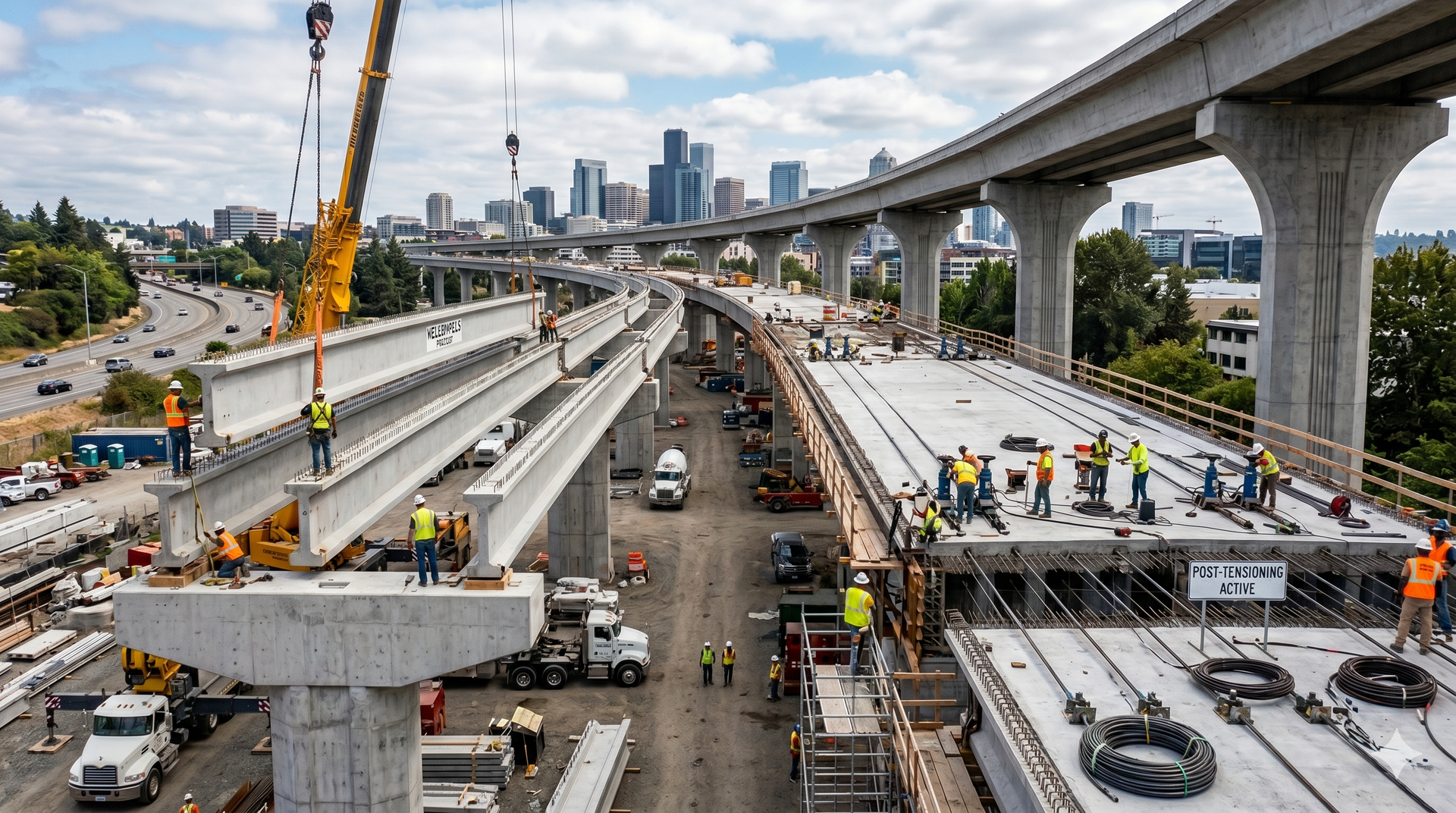
For example, when constructing large-span concrete segmental bridges, a factory-controlled environment is vital to cast the individual bridge pieces. However, shipping a single 300-foot concrete span down a Texas highway is physically impossible.
To solve this, crews cast manageable, high-durability precast segments in the plant. Those segments are transported to the bridge site, hoisted into position by cranes, and aligned end-to-end. Crews then thread high-strength steel tendons through internal ducts running across all the pieces and apply post-tensioning on-site.
This hybrid application combines the unmatched quality control of a precast plant with the immense continuous structural strength of post-tensioning. It proves that precast vs post-tensioned concrete are complementary engineering tools rather than opposing choices.
Comparing the Systems Side-by-Side
To streamline your planning, this quick-reference table summarizes how precast vs post-tensioned concrete compare across key operational attributes:
| Feature / Attribute | Precast Concrete | Post-Tensioned Concrete (Cast-in-Place) |
|---|---|---|
| Casting Location | Controlled factory plant environment | Directly on the construction job site |
| Tensioning Timing | Usually pre-tensioned before concrete is poured | Post-tensioned after concrete sets & gains strength |
| Primary Structural Benefit | Superior quality control, rapid site assembly | Maximizes thin slab profiles, eliminates columns |
| Ideal Project Scale | Bridges, marine piles, stadium risers, multi-unit housing | High-rise commercial buildings, slab-on-grade foundations |
| Logistics / Footprint | Requires heavy shipping and site crane coordination | Requires on-site space for concrete mixers and tensioning jacks |
Long-Term Maintenance and Durability Factors
Every structural asset requires rigorous long-term maintenance planning because your choice between precast vs post-tensioned concrete directly impacts your operational budget decades down the road. To optimize your asset management strategy, you must evaluate how both fabrication methods handle structural protection and long-term durability:
- Precast Concrete Density: Because precast plants utilize low-water mixes and high-frequency consolidation, the finished concrete is incredibly dense. This high density inherently resists moisture penetration and protects internal steel from rust, which is a primary reason state departments of transportation heavily favor precast elements for aggressive environments.
- Post-Tensioned Moisture Vulnerability: With post-tensioned systems, long-term durability depends entirely on protecting the internal steel tendons from moisture infiltration. In unbonded systems, the tendons rely strictly on a protective grease coating and plastic sheathing; if moisture bypasses this barrier, tendon corrosion can snap the cables and compromise the structural integrity of the slab.
- Bonded Mitigation Systems: Modern commercial infrastructure actively mitigates these corrosion risks by shifting toward grouting. This creates bonded post-tensioning systems, which the Federal Highway Administration (FHWA) notes provide excellent long-term corrosion resistance when properly installed in the field.
Evaluating these long-term maintenance factors during the initial design phase ensures your structural investment remains secure, predictable, and cost-effective over its entire operational lifecycle.
Summary: Which Option Fits Your Project?
When deciding on precast vs post-tensioned concrete, let your project’s constraints dictate the answer:
- Choose Precast Concrete if your job site has a tight footprint, a compressed schedule, or demands the highest possible material durability against harsh marine or highway environments.
- Choose Post-Tensioned Concrete if you are building a commercial high-rise requiring minimized floor-to-floor heights, need to eliminate columns for open interior spaces, or are pouring a slab-on-grade foundation on highly expansive soil.
Take the Next Step in Your Project Planning
Evaluating precast vs post-tensioned concrete requires looking closely at your project specs, transportation access, and structural loads. If you are designing heavy civil, industrial, or marine infrastructure in Texas, matching your design to local manufacturing capabilities is critical to controlling costs.
Review our comprehensive guide on precast prestressed bridge girders to see how factory-controlled prestressing handles demanding structural spans, or reach out to our engineering team directly to evaluate the structural specs of your upcoming project.