
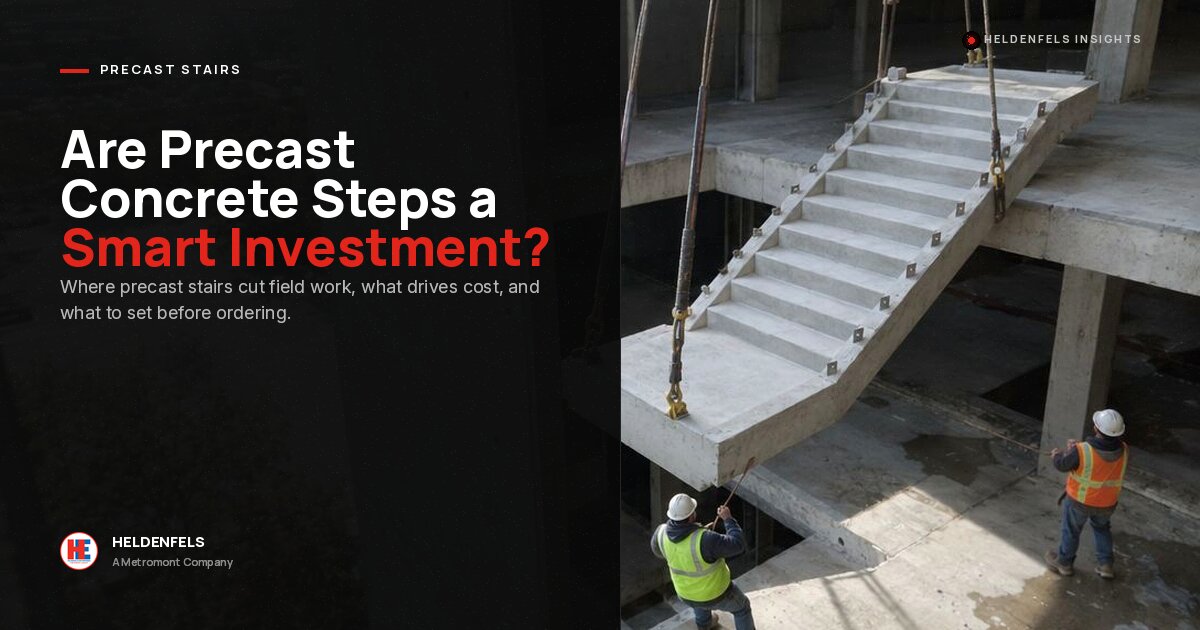
Are Precast Concrete Steps a Smart Investment? Project Value Explained
Explore how precast concrete steps can deliver lasting durability, lower maintenance, and practical value for residential and commercial projects.
Time and cost savings vary by project, with repetitive stair packages often offering greater value than one-off units with complex designs or difficult access. The decision should consider the project’s design, site conditions, logistics, and installation requirements. Precast concrete steps are often most practical when designs are finalised early and the site can efficiently accommodate delivery and installation.
What Makes Precast Concrete Steps a Smart Project Investment?
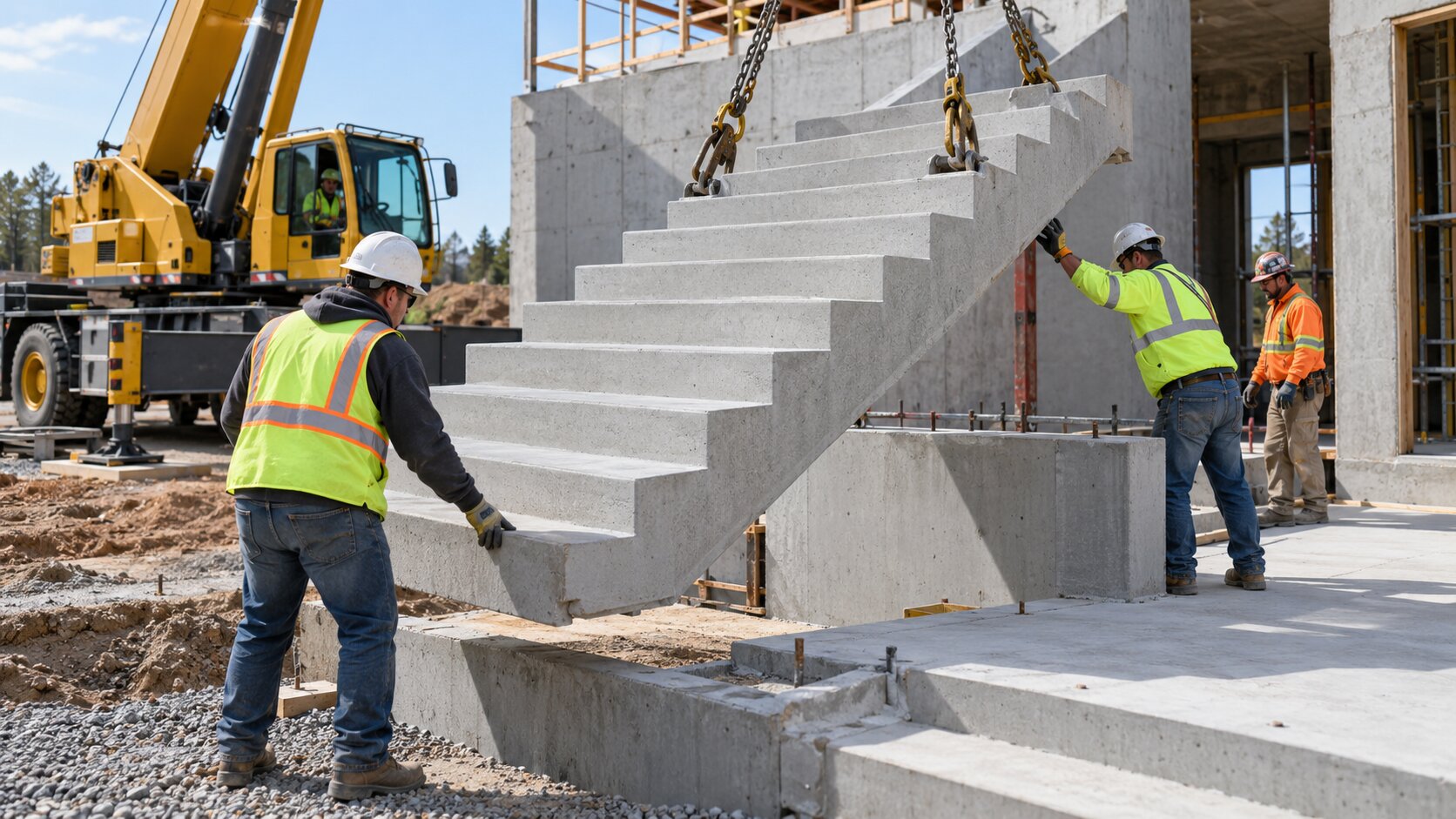
Precast stair installation can reduce on-site forming work by delivering a manufactured staircase ready for placement.
The business case for precast concrete steps starts with moving a major portion of stair construction away from the jobsite. Instead of forming, reinforcing, pouring, finishing, and curing the stair entirely in place, a precast unit is manufactured before delivery and arrives as a finished structural component ready for erection once supporting conditions are prepared.
The Precast/Prestressed Concrete Institute notes that precast is manufactured off-site in controlled conditions and delivered to projects ready for installation. This approach can reduce the amount of staging and field activity required while allowing production to occur separately from other jobsite work. PCI guidance on high-performance precast construction
Savings in time and cost vary by project, with repetitive stair packages generally offering more potential value than one-off units with complex designs or difficult access. The investment decision should therefore consider the project’s specific design, site, logistics, and installation requirements. Precast concrete steps are often most practical when designs are finalised early, units can be efficiently produced, and the site can handle delivery and erection.
Where Can Precast Reduce Field Work and Schedule Pressure?
Cast-in-place stairs require several operations at the final location. Forms must be built and supported, reinforcement placed, concrete delivered and placed, surfaces finished, and the concrete allowed to develop the required strength before subsequent work can proceed as planned.
Precast shifts much of that activity to a manufacturing facility. Production can occur while foundations, framing, site work, or other construction activities are progressing. Once the stair units and receiving structure are ready, erection becomes a coordinated installation operation rather than another full concrete placement sequence.
This can be particularly valuable on projects where congestion, access restrictions, sequencing, or labour availability makes field work difficult. Removing form construction and a portion of wet concrete work from the active site can simplify coordination around other trades.
Precast does not remove scheduling risk completely. Shop drawings, design approvals, fabrication, transportation, crane availability, bearing locations, embeds, and erection sequencing still have to be coordinated. A late design change can be more disruptive once a unit is already in production.
Our precast concrete stairs at Heldenfels typically require about six to eight weeks before they are ready to leave the facility, while every project is different. The schedule benefit depends on early release and coordination, not on ordering late and expecting an instant unit.
Precast vs. Cast-in-Place: Where Is the Value?
The value of precast concrete steps depends on the project’s design, site conditions, schedule, and overall construction requirements. Rather than comparing material prices alone, it is more useful to look at how each method affects fabrication, labour, logistics, installation, and other work on the jobsite.
| Consideration | Precast Concrete Steps | Cast-in-Place Steps |
|---|---|---|
| Standardisation | Can be advantageous when multiple stair units have similar dimensions, reinforcement, finishes, and connection details. | May require repeated forming and field preparation for each stair or section. |
| Construction Speed | Units are cast and developed to the specified strength before delivery, allowing installation after they arrive on-site. | Requires forming, reinforcement, concrete placement, finishing, and curing at the project site before the stairs can be used or loaded as designed. |
| Quality Consistency | Off-site production can make repeated dimensions, finishes, and manufacturing processes easier to control consistently. | Quality depends more heavily on site conditions, field workmanship, concrete placement, finishing, and curing. |
| Design Flexibility | Works well for standardised or repeatable designs, but transportation, lifting, and manufacturing requirements need to be considered. | Can be practical for highly irregular geometries or stairs that need to closely follow existing site conditions. |
| Site Constraints | Requires adequate access for delivery, lifting equipment, and placement of the units. | Can be useful where crane access is impractical or transporting large precast units would be difficult. |
| Labour and Field Work | Can reduce some on-site forming, placement, and curing activities, depending on the system. | Requires more field operations, including forming, reinforcement installation, concrete placement, finishing, and curing. |
| Logistics | Requires planning for fabrication, transportation, lifting, staging, connections, and site preparation. | Avoids transporting large finished stair units but requires materials, labour, equipment, and coordination at the project site. |
| Project Cost | Should be evaluated based on the complete installed scope, including fabrication, detailing, freight, lifting, erection, connections, and site preparation. | Should include forms, shoring where required, reinforcement, concrete placement, finishing, curing, field labour, and supervision. |
| Best Value Assessment | Can provide value when repetition, installation speed, and reduced field operations outweigh manufacturing and logistics costs. | Can provide value when site conditions, unique geometry, or limited repetition make on-site construction more practical. |
Neither method is automatically more economical, so the comparison should focus on total installed costs rather than material prices alone. Precast can reduce some jobsite work but still involves fabrication, transportation, lifting, and connections, while cast-in-place construction requires forming, labour, curing, and site coordination. Comparing the complete scope of both options provides a clearer picture of their overall value.
What Actually Drives the Cost of Precast Stairs?
Several variables can materially change the cost and value of a precast stair package.
Geometry and Repetition
Repeated units can make precast more efficient by allowing production setups and detailing to be standardised and reused. Custom landings, unusual widths, varying floor heights, and one-off designs may require more coordination and reduce these benefits. This makes precast particularly practical for projects with many similar stair units, such as parking structures, stadiums, and institutional buildings.
Structural Requirements and Connections
Stairs must be designed for the project’s loads and coordinated with the supporting structure. Bearing details, reinforcement, connections, embeds, tolerances, landings, and structural interfaces all affect fabrication and installation. These details should be finalised before production because precast stair units cannot be freely modified on-site after delivery.
Finishes and Embedded Features
Surface finishes, tread treatments, nosings, railing provisions, inserts, and sleeves should be coordinated before casting. Finalising these details early can reduce drilling, patching, and other modifications after installation. These architectural, structural, and safety requirements should therefore be considered when specifying precast stairs.
Transportation and Erection
The stair still has to reach the site and be placed. Unit size and weight, haul route restrictions, delivery windows, laydown space, crane reach, lifting points, erection sequence, and access around the building can all influence installed cost.
A design that is efficient in the plant but difficult to transport or lift may not provide the expected project value. Logistics should therefore be evaluated while the units are still being designed.
Which Projects Are Well Suited to Precast Stairs?
Precast concrete steps are especially useful when stairs are a repeatable and structurally coordinated part of a larger commercial, institutional, or industrial project. Their value can be particularly relevant in projects where construction speed, durability, access, and coordination between trades are important.
Common applications include:
- Multi-story buildings: Precast stair units can be incorporated into the structural and construction sequence early, helping coordinate installation with other building systems.
- Stadiums and entertainment venues: Stairs and circulation components can be coordinated with larger precast seating or structural systems.
- Parking garages: Precast stairs can provide durable vertical circulation while supporting efficient, coordinated erection.
- Institutional facilities: Repeated stair configurations can make off-site production practical, particularly when schedules and structural coordination are important.
- Industrial projects: Precast stairs may be suitable where durable access, controlled construction sequencing, or reduced field concrete work is beneficial.
Suitability still depends on the structure, loads, exposure, site access, and project requirements. While precast concrete steps are also common in residential applications, the commercial value is better illustrated through larger structural projects where repeatability and coordinated installation can provide practical benefits.

Finished concrete steps provide a durable, clean and practical access solution for commercial building entrances.
What Should Be Defined Before Ordering Precast Concrete Steps?
Early information improves both pricing and constructability. Before releasing precast concrete steps for fabrication, the project team should resolve the requirements that affect the unit itself and the way it will be installed.
Key inputs include:
- Floor-to-floor dimensions and required stair geometry
- Stair width, landing dimensions, and interface elevations
- Structural loads and applicable project design criteria
- Bearing locations and connection requirements
- Railing, guard, sleeve, insert, and embed locations
- Required tread, nosing, and surface finishes
- Interior or exterior exposure conditions
- Coordination with adjacent walls, floors, framing, and openings
- Tolerances at interfaces with other construction
- Shipping limitations and delivery sequence
- Crane access, reach, capacity, and lifting plan
- Available laydown or staging space
- Required erection sequence
- Submittal, approval, fabrication, and installation dates
This information allows the precaster and project team to identify conflicts before concrete is cast. Early coordination is also where project value is protected. If a railing post, landing elevation, structural opening, or bearing detail changes after fabrication, the cost of correcting it can outweigh savings achieved elsewhere.
For geometry, railing, finish, and safety considerations, our precast concrete steps design and safety guide provides a more focused review. Field planning can then be addressed separately through our professional precast step installation guide. Keeping those subjects separate lets this article focus on the financial and construction decision rather than duplicating the existing technical guides.
How Does Factory Production Affect Quality and Predictability?
One of the strongest arguments for precast is not that a plant automatically creates a perfect product. It is that manufacturing can be organised around established production and quality-control procedures in a controlled setting.
The National Precast Concrete Association describes quality control as an important part of precast plant operations and maintains a formal manual intended to establish consistent manufacturing requirements and practices. NPCA Quality Control Manual for Precast Concrete Plants
Factory production can improve consistency, but it does not replace competent engineering, inspection, proper handling, or well-coordinated field installation.
For stairs, repeatable forms and preplanned reinforcement, embeds, connections, and finishes can help deliver consistent units across a project. That consistency can matter where multiple flights must align with repeated floor elevations or architectural details.
Quality still depends on the actual design, specifications, manufacturer, production controls, handling, erection, and field interfaces. “Factory made” should not be treated as a substitute for competent engineering or inspection.
A project team evaluating precast concrete steps should review the required submittals, shop drawings, qualifications, testing, tolerances, and inspection requirements that apply to the project rather than relying on generic claims about precast quality.
What About Durability and Long-Term Cost?
Durability can add long-term value to precast stairs, especially in buildings with frequent use, but service life varies by project. Factors such as concrete quality, reinforcement protection, exposure, drainage, detailing, connections, maintenance, and surface wear all affect performance.
Long-term planning should include regular inspection for cracking, spalling, corrosion, movement, joint issues, and unusual wear. The value of precast concrete steps is best evaluated by considering durability alongside initial cost, maintenance, and construction schedule rather than relying on a universal lifespan claim.
When Is Precast the Better Investment?
Precast concrete steps deserve serious consideration when the project can benefit from off-site production, repeatable units, coordinated erection, reduced field forming, and predictable detailing. They are especially practical when stairs can be integrated into the structural design and procurement schedule before construction reaches the point where the units are needed.
They may be less compelling when access prevents economical lifting, the geometry is highly irregular, late design changes are likely, or a one-off field-poured stair can be built more efficiently without disrupting other work.
For Texas commercial, stadium, parking, institutional, and other large-scale projects, Heldenfels manufactures precast concrete stairs and works with project-specific dimensions, embedded features, finishes, delivery, and installation requirements.
Comparing Precast with Cast-in-Place Stairs?
Discuss the drawings, project schedule, site logistics, and stair requirements before finalising the construction approach.
Get in touch with our team now