
Construction Materials Steel vs Precast Concrete: A Complete, Proven Guide to Which Wins
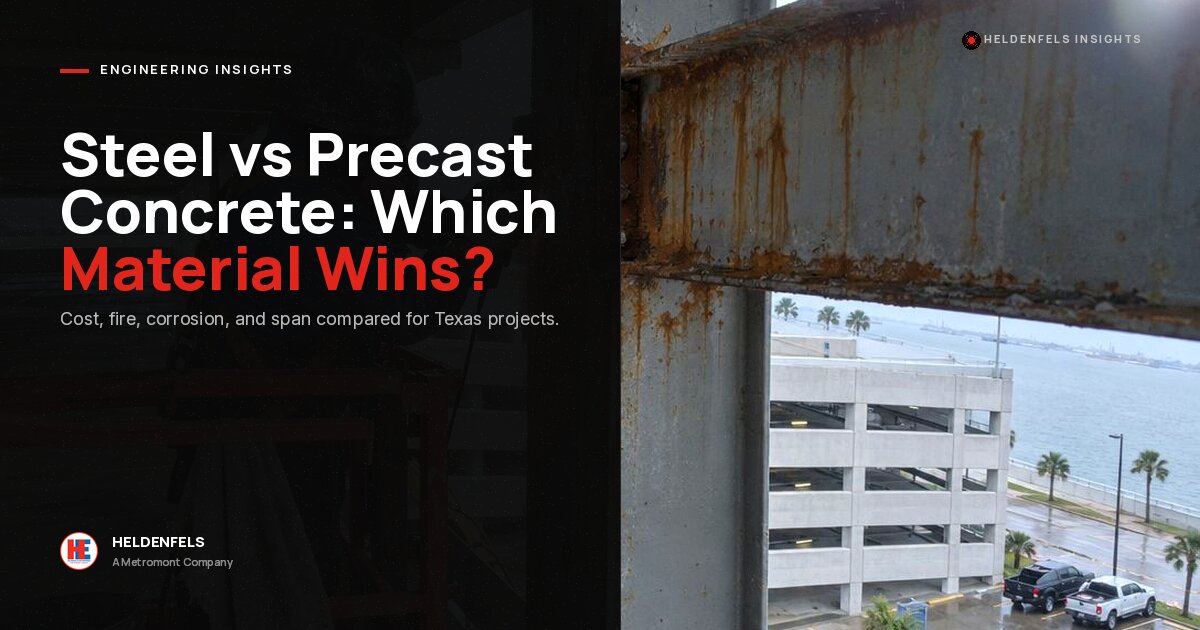
Picture two parking garages built the same year, one block apart, a short walk from the bay in Corpus Christi. One is framed in structural steel. The other is precast concrete: columns, beams, and double-tee decks. Twenty-five years later, the steel garage has a painter on a lift grinding rust bloom off a beam connection for the third time, while the precast garage next door needs little more than joint sealant and a routine inspection. That isn’t a knock on steel. The construction materials steel and precast concrete each win in different places, and the bid-day price is only the first number that matters.
A practical comparison of steel and precast concrete on cost, durability, fire, speed, and span, written for owners, engineers, and contractors making the call.
- Steel has the better strength-to-weight ratio, which makes it the natural choice for very long clear spans, light roofs, and buildings that will be modified later.
- Precast concrete is noncombustible and corrosion resistant out of the box, so it avoids the fireproofing and repainting costs that follow steel through its life.
- Comparing price per ton or per piece is misleading. Compare total installed cost plus decades of maintenance.
- In the Texas climate, especially near the Gulf, corrosion and maintenance often decide the question.
- Many of the best projects use both: precast where durability and fire matter, steel where span and weight matter.
Why Steel Showed Up Late to the Building Game
History forums keep asking why ancient builders never framed buildings in metal. The answer is cost. For most of human history, steel was a specialty material made in small batches for blades and tools. Builders used what they could produce in bulk: stone, brick, timber, and, in Rome, a remarkably durable concrete. The unreinforced concrete dome of the Pantheon has been standing for nearly 1,900 years.
Steel only became a structural material after the Bessemer process made it cheap to produce in quantity in the 1850s. Within a few decades it was carrying skyscrapers and long railroad bridges. Precast concrete matured later. Prestressing, which squeezes concrete with tensioned high-strength steel strand so it can span long distances without cracking, became practical in the middle of the twentieth century. Heldenfels Brothers opened a prestressed concrete plant in Corpus Christi in 1955, and the two materials have been competing for the same projects ever since.
There’s a twist: precast prestressed concrete already contains steel. So the real comparison is exposed structural steel shapes versus steel that is encased, protected, and put to work inside concrete.
Construction Materials Steel vs Precast: The Real Cost Picture
The number on a bid tab leaves out a lot. A steel frame quote usually covers fabrication and erection. It often doesn’t include the fireproofing the building code will require, the coatings needed in corrosive environments, or the repainting cycles those coatings will demand over the life of the structure.
Steel pricing is also volatile. Mill prices swung sharply in 2021 and 2022, and contractors holding fixed bids absorbed painful increases. Concrete pricing moves too, but cement, aggregate, and plant labor have historically been more stable inputs, and a precast producer can lock in a schedule and price for an entire job once shop drawings are approved.
Precast has its own costs. The pieces are heavy, so trucking and crane capacity matter, and very large members need permits and planned delivery routes. Precast also asks for more design coordination up front, because openings, embeds, and connections are cast in at the plant rather than cut in the field.
The fair way to compare: Add up fabrication, erection, fire protection, corrosion protection, and the maintenance you expect over the structure’s design life. Then divide by the years it will actually serve. That number, not the price per ton, should drive the decision.
Durability and Maintenance in the Texas Climate
Back to those two garages. Steel corrodes when moisture and oxygen reach it, and salt air speeds that up dramatically. Along the Gulf Coast, exposed steel needs a high-performance coating system or galvanizing, and coatings wear out. Connections, where water collects and paint is hardest to apply well, tend to fail first. Repainting an occupied structure means lifts or scaffolds, containment, surface prep, and closed parking bays.
In precast, the reinforcing steel sits inside dense, plant-cured concrete with a specified amount of cover, which keeps moisture and chlorides away from it. For marine work, producers add epoxy-coated reinforcing, corrosion-inhibiting admixtures, and low-permeability mixes. Precast isn’t maintenance free: joints, bearing pads, and sealants still need inspection. But there’s no paint film to renew, and properly detailed members are commonly designed for a service life of 75 years or more.
Bridges show the same pattern. Steel girders are subject to fatigue cracking at welded details and need periodic painting, which is a recurring line item in state bridge maintenance budgets, especially in marine environments. Our prestressed bridge girders are designed for a service life measured in generations, with no coating to maintain.
Fire Performance: Steel’s Hidden Line Item
Steel doesn’t burn, but it does weaken in heat. Structural steel loses roughly half of its strength at temperatures around 1,100°F, which a building fire can reach quickly. That is why building codes require most steel frames in occupied buildings to be protected with spray-applied fire-resistive material, intumescent paint, or board encasement. Those systems add cost, need inspection, and get damaged easily by later trades running pipe and conduit.

Precast concrete is noncombustible and carries its fire protection in its own mass. Fire ratings come from member thickness and concrete cover over the reinforcement, so a two-hour or longer rating is designed into the piece rather than applied afterward. On warehouses, data centers, parking structures, and industrial facilities, that can take an entire trade off the schedule. More detail is in our guide to fire resistant construction materials.
Speed, Spans, and Weight
Steel’s biggest advantage is its strength-to-weight ratio. A steel member weighs far less than a concrete one carrying the same load. That means lighter foundations, smaller cranes, and longer clear spans. For bridges with very long main spans, steel girders and trusses are often the practical choice, while the short and medium spans that make up most highway overpasses and creek crossings are where prestressed concrete girders dominate.
On schedule, both materials are prefabricated, which is why both appear in accelerated bridge construction programs from the Federal Highway Administration. Precast has one more edge: elements are cast while site work is underway, then arrive ready to set, with no field fireproofing or painting to follow. Our precast structural columns come out of the plant with corbels, embeds, and finishes already in place, so the frame goes up and the next trade can follow right behind.
Where Steel Usually Wins
- Very long clear spans such as aircraft hangars, arenas, and long-span bridges.
- Buildings that will change, where future openings, added floors, or reconfigured bays are likely.
- Weak soils or weight-limited sites, where a lighter frame saves real money in the foundation.
- Light roof structures, where joists and deck are efficient and fire ratings are modest.
Where Precast Usually Wins
- Coastal, marine, and chemical exposures, where corrosion would drive steel maintenance.
- Fire-sensitive occupancies such as parking structures, warehouses, and critical facilities.
- Repetitive elements, where reusable forms make every additional piece cheaper.
- Highway bridges in typical span ranges, plus piles, bent caps, and foundations.
- Structures expected to serve for generations, the theme behind our list of durable construction materials.
Here’s how the construction materials steel and precast concrete stack up on the factors that drive most decisions:
| Factor | Structural Steel | Precast Concrete |
|---|---|---|
| Strength-to-weight | Excellent; lighter frames and foundations | Heavier; mass helps with sound, vibration, and fire |
| Fire | Needs applied fire protection in most occupied buildings | Noncombustible; rating built into thickness and cover |
| Corrosion | Needs coatings or galvanizing, plus recoating | Reinforcement protected by dense concrete cover |
| Clear span | Best for very long spans | Strong in short and medium spans with prestressing |
| Future changes | Easy to cut, extend, or reinforce | Harder to modify after installation |
| Price stability | Exposed to mill price swings | More stable inputs; priced per job |
Often the Best Answer Is Both
Steel versus precast sounds like a winner-take-all contest, but many of the best-performing structures mix the two. A common example is a steel-framed office building with precast hollow-core plank floors: the steel delivers long, open bays, while the plank drops in fast, needs no shoring or formwork, and brings built-in fire resistance to every floor. Bridges do the same thing in reverse, setting steel girders on precast piers, bent caps, and abutments so the substructure goes in quickly and stands up to water and soil for decades.

Deciding element by element, rather than building by building, usually beats forcing one material everywhere.
Choosing Between Construction Materials Steel and Precast Concrete
Before you commit, run your project through these questions:
- How long does the structure need to last? A 20-year industrial shed and a 100-year bridge call for different math.
- What is the exposure? Salt air, chemicals, wet soil, and deicing products all favor precast.
- What fire rating does the code require? Price the fireproofing before you compare frames.
- How long are the spans, and how heavy can the frame be? Very long spans and weak soils favor steel.
- Will the building change? If you expect major modifications, steel is easier to adapt.
- Who carries the maintenance budget? Owners who will hold the asset for decades should weigh lifecycle cost most heavily.
Answer those honestly and the winner usually becomes clear. If it doesn’t, bring in a precast engineer early, while you can still compare real options instead of redesigning a finished steel scheme.
Weighing Steel Against Precast on Your Next Project?
With Texas roots dating to 1909 and prestressed concrete production going back to 1955, Heldenfels Enterprises, a Metromont Company, manufactures and installs precast, prestressed concrete from our plants in San Marcos and Corpus Christi. If you are comparing construction materials steel and precast for a bridge, a parking structure, or an industrial facility, our engineers can help you price both on a lifecycle basis.
Contact Us About Your Project