
Bamboo Construction Materials vs Precast Concrete: A Complete, Proven Sustainability Comparison
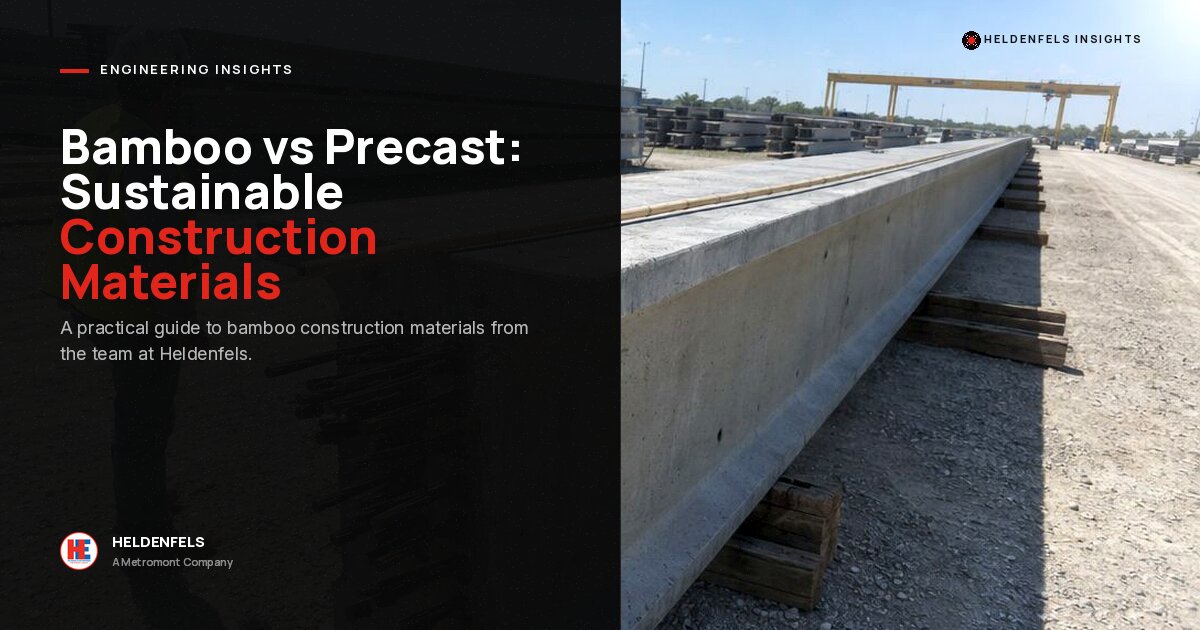
Lay a 20-foot bamboo pole across the top flange of a 120-foot prestressed bridge girder in our casting yard and the comparison looks lopsided. One is a grass that reached harvest size in about four years and pulled carbon out of the air the whole time. The other is cement, aggregate, and high-strength steel strand, built to carry highway traffic for 75 years or more. Engineers keep asking a fair question: if bamboo construction materials are this strong and this renewable, why aren’t we building with them? Short answer: both materials are sustainable in some situations and wasteful in others, and what usually decides it is how long the structure has to last.
Bamboo and precast concrete, compared on carbon, durability, codes, and real-world applications. No greenwashing in either direction.
- Bamboo grows fast, stores carbon, and has impressive tensile strength along the grain, which is why it keeps coming up in sustainability conversations.
- Its weak points are decay, insects, fire, inconsistent properties, and hollow round culms that are hard to connect.
- Precast concrete carries real embodied carbon from cement, but it pays that back through a long service life, low maintenance, and plant efficiency.
- The right comparison is impact per year of service, not impact per ton of material.
- Bamboo fits light, sheltered, low-rise work. Precast fits heavy, wet, fire-sensitive, and long-life structures.
Why Aren’t We Building With Bamboo?
The question shows up regularly in structural engineering forums, and bamboo’s strengths are real. Pound for pound, its fibers have tensile strength that compares well with mild steel. It is light, flexible, and grows in dense stands that can be harvested every few years without replanting. In parts of Latin America and Southeast Asia, bamboo houses and bridges have stood for generations.
Strength isn’t the obstacle. A bamboo pole is a natural, irregular, biological product, while modern structural engineering in the United States runs on predictable materials, published design values, and long service lives. Each of those expectations is harder to meet with a culm (the hollow bamboo stalk) than with a manufactured member.
How Bamboo Construction Materials Stack Up on Sustainability
Bamboo’s environmental case is strongest at the start. It absorbs carbon while it grows, needs little fertilizer, and regrows from its root system after harvest. A round culm used close to where it was grown, with minimal processing, has a very small footprint.
That picture changes once bamboo becomes a product. Most structural bamboo used in North America is engineered: strips are split, boiled or treated, dried, and pressed together with adhesives into laminated or strand-woven boards. Each step adds energy, resin, or kiln time. Then the material usually crosses an ocean, because the commercial species grow in tropical and subtropical regions, not in Texas. By the time engineered bamboo reaches a jobsite here, a good share of its head start has been spent.
Precast concrete starts from the opposite position. Cement production is responsible for roughly 7 to 8 percent of global carbon dioxide emissions, and we will not pretend otherwise. But a precast plant has more ways to cut that footprint than a field pour does: supplementary cementitious materials such as fly ash and slag, mix designs tuned to the exact strength required, reusable steel forms, and very little scrap. Prestressing also lets a beam carry the same load with less concrete. We cover those levers in detail in our guide to sustainable precast concrete options.
The fair way to compare: Divide the embodied impact of a structure by the years it will actually serve. A low-carbon material that has to be replaced three times is not low-carbon. A higher-carbon material that serves for a century with little maintenance often comes out ahead.
Durability: The Number That Changes the Math
Service life is where bamboo struggles most. Bamboo is rich in starch, which makes it attractive food for powderpost beetles, termites, and fungi. Left outdoors untreated and in contact with soil, it can lose much of its strength within a few years. Under a good roof and off the ground, it lasts far longer.
Treatment helps. Borate solutions are the most common preservative, and properly treated bamboo can last decades in a dry, protected setting. The catch: borates are water soluble. Expose treated bamboo to repeated rain or standing water and the preservative slowly leaches out, taking the protection with it. On the humid Gulf Coast, with heavy rains and active termite pressure, that is a serious design limitation.

Fire is the other concern. Bamboo is combustible, and its sealed hollow sections can burst when heated. Concrete is noncombustible and keeps much of its strength in a fire, which is one reason it ranks near the top of our list of durable construction materials.
| Factor | Bamboo | Precast Concrete |
|---|---|---|
| Renewability | Harvestable in roughly 3 to 5 years | Made from abundant minerals; cement is energy intensive |
| Embodied carbon | Very low as raw culms; higher once engineered and shipped | Moderate; reduced with optimized mixes and prestressing |
| Moisture and insects | Vulnerable without treatment and dry detailing | Dense, low-permeability concrete that insects cannot damage |
| Fire | Combustible | Noncombustible |
| Property consistency | Varies by species, age, moisture, and position on the stalk | Tested batch by batch in a controlled plant |
| Typical role | Light framing, pavilions, finishes, low-rise housing | Bridges, foundations, industrial and marine structures |
Codes, Consistency, and the Connection Problem
Engineers design with numbers they can trust. For every precast member that leaves a plant, concrete strength, strand properties, and dimensions are specified, tested, and documented. Bamboo’s properties vary with species, growing conditions, harvest age, moisture content, and even how far up the stalk a piece was cut. International design standards for bamboo do exist, and the International Bamboo and Rattan Organisation has done valuable work promoting them. But mainstream U.S. building codes still treat structural bamboo as an alternative material that needs special approval, which slows permitting and raises engineering cost.
Then there are the joints. A bamboo culm is round, tapered, and hollow, with solid nodes at intervals. Drill a bolt hole through it and tighten the nut, and the thin wall tends to crush or split along the grain, because the fibers all run lengthwise with very little holding them together sideways. Builders work around this with cement mortar packed into the hollow section at the joint, lashing, or custom steel fittings. All of these work. All of them are also labor-intensive, hard to inspect, and difficult to repeat at scale.

Precast connections work the other way around. Embedded plates, grouted ducts, and bearing seats are designed and cast into the member before it leaves the plant, so the joint is part of the product rather than something improvised in the field.
What About Bamboo as Rebar?
Bamboo is sometimes proposed as a substitute for steel reinforcing in concrete. Decades of testing show why that is rarely a good idea in permanent structures. It absorbs water from fresh concrete and swells, then shrinks as it dries, which breaks the bond and cracks the surrounding concrete. Its stiffness is roughly a tenth of steel’s, so the concrete cracks well before the bamboo carries much load. The result is a member that deflects more and lasts less.
Where Each Material Makes Sense
Choosing between bamboo construction materials and precast is rarely either-or. Each does a different job well.
Where Bamboo Fits
- Sheltered, lightweight structures such as pavilions, shade canopies, and garden buildings where loads are light and the material stays dry.
- Low-rise housing in regions where bamboo grows locally, especially where its light weight and flexibility help in earthquakes.
- Interior finishes such as flooring, paneling, and millwork, where engineered bamboo is a durable, attractive option.
Where Precast Fits
- Heavy loads and long spans, including bridge girders, beams, and structural frames.
- Ground contact, water, and salt exposure, such as foundations, piles, and marine structures.
- Fire-sensitive and mission-critical facilities, from power plants and data centers to battery energy storage foundations.
- Structures expected to serve for generations, where replacement cycles would wipe out any up-front carbon savings.
That second list describes most of the work we do. Our industrial construction applications include equipment foundations and facilities that cannot afford to fail, and our sustainable building systems bring the same plant-controlled quality to structural frames and wall panels. Some of the smartest projects use both: a precast structure carries the loads and stands up to the weather, and bamboo finishes go inside, where they look good and stay dry.
The Bottom Line on Bamboo Construction Materials
Bamboo has earned its place in the sustainability conversation. Used locally, with minimal processing, in a sheltered, light structure, it is hard to beat. But most bamboo construction materials available in the United States are imported, engineered products, and their durability, fire performance, and code status limit them to a narrow set of uses.
Precast concrete makes the opposite trade. It starts with a larger carbon footprint and earns it back by lasting, often 75 to 100 years with little maintenance, while keeping waste and field disruption low. For bridges, foundations, and industrial structures in the Texas climate, that service life is what makes a material sustainable in practice.
Building for the Long Haul in Texas?
With Texas roots dating to 1909 and prestressed concrete production going back to 1955, Heldenfels Enterprises, a Metromont Company, manufactures and installs precast, prestressed concrete from our plants in San Marcos and Corpus Christi. If you are weighing materials on a project where service life, fire resistance, and lifecycle impact all matter, our engineers can help you compare the options.
Contact Us About Your Project