
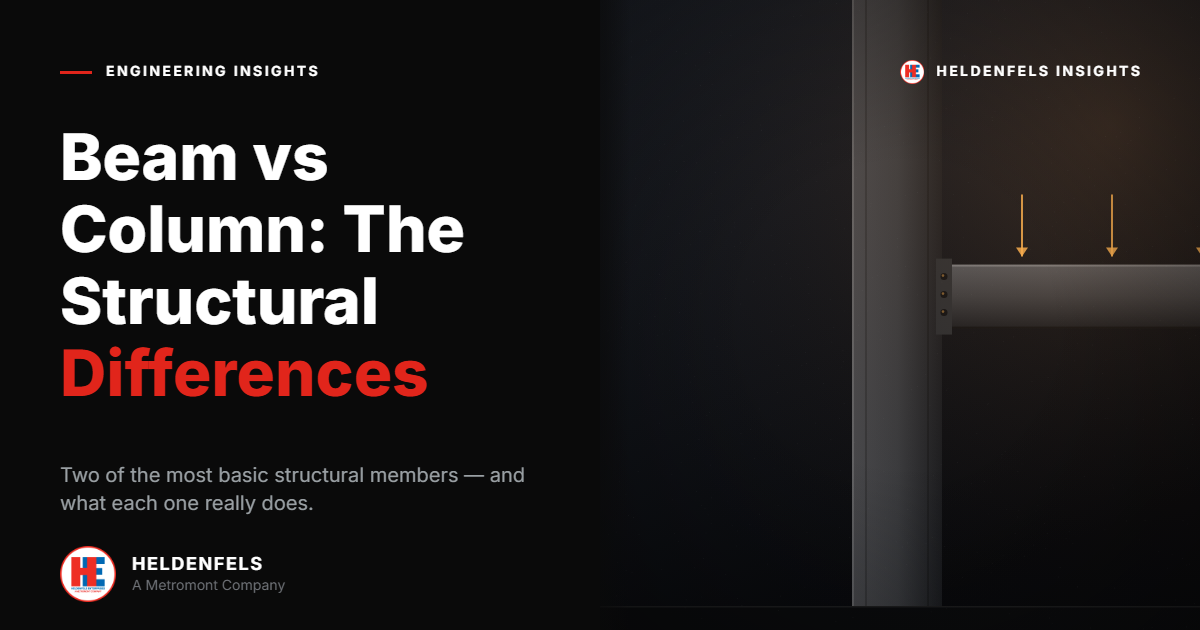
Beam vs Column: Understanding Their Difference and Structural Roles
Understand the key structural differences between beams and columns in precast construction.

Horizontal beams transfer loads to vertical columns, creating a strong concrete structural frame.
The difference between a beam and a column: a beam spans horizontally between supports and carries loads across that span, mainly resisting bending and shear. A column stands vertically and carries those loads down to the foundation, mainly resisting axial compression and buckling. Beams move load sideways to their supports; columns move it down.
In structural engineering, beams and columns are two essential load-carrying elements used in buildings, bridges, industrial facilities, and marine structures. They work together within a structural system, but each serves a different purpose.
A beam delivers its load to supports such as columns, walls, girders, or foundations. A column picks up load from beams, slabs, decks, or roof systems. In precast and prestressed concrete construction, selecting the right beam or column type can improve load capacity, installation speed, constructability, and long-term performance.
What is a Beam?
A beam is a structural member that spans between supports and carries loads across that span. In buildings, beams may support floors, walls, roofs, or other structural elements. In bridges and transportation infrastructure, beams and girders support traffic loads, deck systems, and other superimposed loads.
Beams are designed to resist:
- Bending moments, which occur when loads cause the beam to flex.
- Shear forces, which act near supports and concentrated load points.
- Deflection, or downward movement under load.
- Torsion or axial force, in some structural conditions.
In a practical beam vs column comparison, beams are the members most associated with spanning open spaces and transferring loads horizontally or across a distance. Their size, shape, reinforcement, prestressing, support conditions, and connection details must match the project’s load requirements and applicable design standards.
Heldenfels manufactures precast and prestressed concrete beam systems for infrastructure, bridge, industrial, and building applications, including precast slab beams, precast prestressed box beams, and precast bridge girders.
Types of Beams in Construction
- Simply Supported Beam – A simply supported beam rests on supports at both ends. It is commonly used in bridges, buildings, and other structures where loads must be transferred efficiently to supports.
- Cantilever Beam – A cantilever beam is fixed at one end and extends freely at the other. Common examples include balconies, canopies, and certain overhang conditions.
- Fixed Beam – A fixed beam is restrained at both ends, which helps reduce rotation and can improve stiffness under load.
- Continuous Beam – A continuous beam extends over more than two supports. This can improve structural efficiency and reduce bending demands compared with a single-span member.
- T-Beam – A T-beam has a T-shaped cross section and is commonly used in reinforced or prestressed concrete systems where the flange and web work together to resist bending.
- Box Beam – A box beam has a hollow rectangular or box-shaped cross section. In precast prestressed concrete construction, box beams are often used for bridges, overpasses, pedestrian structures, parking structures, and industrial platforms because they provide strong load-carrying performance with efficient depth.
Key Functions of Beams
Beams are used to:
- ✅ Carry loads across open spans.
- ✅ Transfer loads from slabs, decks, roofs, or walls to columns, walls, girders, or foundations.
- ✅ Help control deflection and serviceability.
- ✅ Support bridge decks, elevated roadways, floors, and roof systems.
- ✅ Create an open space below by reducing the need for closely spaced vertical supports.
In any beam vs column discussion, the beam’s main role is to move loads across a span and deliver them to supporting members. This makes beams critical in structures that require open areas, long spans, elevated decks, or efficient load transfer.
What is a Column?
A column is a vertical structural member that carries loads downward through a structure. Columns primarily resist axial compression, but real-world columns may also resist bending moments, shear forces, lateral loads, and eccentric loading depending on the structural system.
Columns are essential because they provide a clear load path from elevated structural elements down to the foundation. In industrial facilities, bridges, marine structures, and large commercial buildings, columns must be engineered for strength, durability, alignment, connection performance, and installation efficiency.
In a beam vs column comparison, columns are the members most associated with vertical support and load transfer to the foundation. Heldenfels manufactures precast structural columns for demanding industrial and infrastructure applications where precision, quality control, and reliable load-bearing performance are critical.
Types of Columns in Construction
- Reinforced Concrete Columns – Reinforced concrete columns use steel reinforcement to improve strength, ductility, and resistance to combined axial and bending forces.
- Steel Columns – Steel columns are common in high-rise buildings, industrial structures, and long-span framing systems because of their high strength-to-weight ratio.
- Timber Columns – Timber columns are used in residential, commercial, and mass timber construction where wood is part of the structural system.
- Masonry Columns – Masonry columns are built from brick, block, or stone. They may be structural, architectural, or both, depending on the design.
- Precast Concrete Columns – Precast concrete columns are manufactured off-site in a controlled plant environment, then transported and erected on-site. This process can improve quality control, speed installation, and reduce on-site forming and curing work.
- Prestressed Concrete Columns – Prestressed concrete columns use steel strands or tendons to introduce beneficial compression into the concrete. This can improve performance in certain structural applications.
Key Functions of Columns:
Columns are used to:
- ✅ Support beams, slabs, decks, roofs, and upper levels.
- ✅ Transfer loads to foundations or substructure elements.
- ✅ Provide vertical stability.
- ✅ Resist compression, bending, and buckling demands.
- ✅ Form part of a complete structural frame.
Column design must account for more than just material strength. Engineers also consider column height, slenderness, cross-sectional shape, reinforcement, load eccentricity, lateral restraint, connection details, and foundation conditions.
Beam vs Column: Key Differences
A clear beam vs column comparison helps explain how these structural elements behave under load. Beams and columns may be connected in the same frame, but their design requirements are not the same.
| Feature | Beam | Column |
|---|---|---|
| Typical Orientation | Horizontal or spanning | Vertical |
| Primary Role | Carries loads across a span | Transfers loads downward to the foundation |
| Main Forces | Bending, shear, deflection, sometimes torsion | Compression, bending, shear, and buckling effects |
| Common Materials | Reinforced concrete, prestressed concrete, steel, timber | Reinforced concrete, precast concrete, prestressed concrete, steel, timber, masonry |
| Common Shapes | Rectangular, I-shaped, T-shaped, box-shaped, slab beam | Square, rectangular, circular, custom precast shapes |
| Main Design Concern | Bending strength, shear strength, deflection control | Axial capacity, slenderness, buckling, combined axial and moment resistance |
| Structural Role | Transfers loads to supports across a span | Carries loads from upper structure to foundation |
| Governing Standards | ACI 318 (buildings), AASHTO LRFD Bridge Design Specifications (bridge beams and girders) | ACI 318 (buildings), AASHTO LRFD Bridge Design Specifications (bridge columns and piers) |
| Precast Examples | Box beams, slab beams, bridge girders, raker beams | Precast structural columns |
How Beams and Columns Work Together in Construction
Beams and columns function together to support structures efficiently:
- Beams transfer horizontal loads from walls, slabs, and roofs to columns.
- Columns carry the vertical weight down to the foundation.
- Without beams, structures would lack lateral support, and without columns, weight distribution would be inefficient.
Modern buildings use reinforced concrete beams and columns for superior strength and longevity. In steel-frame buildings, I-beams and steel columns are common due to their high load-bearing capacity and durability.
Beam vs Column | Orientation, Load, Deflection
The beam vs column difference becomes clearer when looking at orientation, load behavior, and failure risk. Beams usually span horizontally or at an incline between supports, while columns usually stand vertically and carry loads downward.
Orientation
Beams usually span horizontally or at an incline between supports. Columns usually stand vertically and carry loads downward.
Load Behavior
Beams commonly carry transverse loads, meaning loads applied across the member’s length. These loads create bending and shear.
Columns commonly carry axial compression, meaning loads act along the member’s length. However, columns may also experience bending, shear, and lateral forces caused by wind, seismic effects, impact, eccentric loading, or frame action.
Structural design loads are determined using applicable codes and standards. For example,ASCE/SEI 7 provides minimum design load criteria for buildings and other structures, including load types such as dead, live, wind, seismic, snow, rain, flood, and other environmental loads.
The member itself is then designed to a material standard. Concrete beams and columns in buildings follow ACI 318, Building Code Requirements for Structural Concrete, which covers flexure, shear and deflection in beams and axial load, slenderness and combined axial load and bending in columns. Bridge beams and girders are designed to the AASHTO LRFD Bridge Design Specifications. For precast and prestressed members, the PCI Design Handbook is the industry’s design reference for the elements and their connections.
Deflection and Failure
Beams typically deflect by bending. If they are overloaded or poorly designed, they may fail through excessive deflection, flexural cracking, shear failure, or connection failure.
Columns are different. Shorter columns may be controlled by compressive strength, while slender columns may be controlled by buckling. Many real-world columns must be designed for combined axial load and bending, not pure compression alone.
That is why beams and columns cannot be selected by appearance alone. Their design depends on geometry, loading, material properties, support conditions, connection requirements, and the structure’s overall load path.
Choosing the Right Beam or Column
Selecting the right beam or column depends on the project’s engineering requirements, site conditions, construction schedule, and long-term performance goals. In any beam vs column decision, engineers must evaluate how each member contributes to the full structural system.
Important factors include:
- Load Requirements – Heavier loads, longer spans, and demanding service conditions may require reinforced or prestressed concrete members with specific geometry and reinforcement details.
- Span Length – Longer spans often require deeper beams, prestressed beams, girders, or box beam systems to control deflection and bending stresses.
- Building or Structure Type – A bridge, industrial facility, marine structure, warehouse, stadium, and commercial building may each require different beam and column systems.
- Construction Speed – Precast beams and columns can reduce on-site labor, forming, and curing time, helping accelerate the construction schedule.
- Durability Requirements – Marine, industrial, transportation, and heavy civil projects often require durable components capable of resisting harsh exposure conditions and long-term service demands.
- Connection Design – The performance of a beam-column system depends heavily on connection details, bearing conditions, tolerances, and erection sequencing.
Building Strength Through Beams and Columns
The beam vs column difference comes down to structural role: beams carry loads across a span, while columns transfer loads downward to the foundation. Together, they create the load path that helps keep precast and prestressed concrete structures stable, efficient, and durable. Heldenfels manufactures precast and prestressed concrete components for highway, bridge, marine, industrial, and building construction throughout Texas and beyond.
Need the Right Beam or Column System for Your Project?
Heldenfels manufactures precast and prestressed concrete components for bridge, highway, marine, industrial, and building projects. If you are evaluating beam and column options for an upcoming structure, our team can help you compare load requirements, span conditions, constructability, and long-term performance.
Request a QuoteFrequently Asked Questions
What is the main difference between a beam and a column?
A beam is typically a horizontal structural member that carries loads across a span and transfers them to columns, walls, or other supports. A column is a vertical structural member that carries loads downward to the foundation.
Can a structural element be both a beam and a column?
Not in its primary structural role. A member is usually designed either as a beam, which mainly resists bending and shear, or as a column, which mainly resists compression and buckling. The correct classification depends on how the member carries load within the structure.
How does bending differ in beams compared to columns?
Beams are primarily designed to resist bending moments and shear forces caused by loads applied across their length. Columns mainly carry compressive forces, but they may also experience bending when loads are eccentric or when lateral forces act on the structure.
Why is it important to distinguish between beams and columns in design?
Beams and columns behave differently under load, so they require different design checks. Correctly identifying each member helps engineers evaluate bending, shear, compression, buckling, connections, and overall structural safety.