
Signature Building Systems: Proven Precast Design Trends Reshaping Modern Construction
A look at how today’s precast concrete delivers superior performance, sustainability, and architectural freedom, and why design teams keep choosing it for their most ambitious projects.
When people talk about signature building systems, they usually mean the structural and enclosure approach that gives a project its identity: how it stands up, how it keeps weather out, and how it looks from the street. For a growing share of commercial, institutional, and infrastructure work, that signature is precast concrete. What was once seen as a purely utilitarian material has become one of the most flexible, high-performance ways to build, and the design trends emerging around it are changing what architects and contractors expect from a finished structure.
At Heldenfels Enterprises, we have manufactured precast components for projects across Texas and beyond since our founding in 1909, and the pace of innovation in the last decade has been remarkable. This guide walks through the precast design trends shaping modern construction, the performance advantages behind them, and where the technology is headed next.
What Signature Building Systems Mean in Modern Precast
A building system is more than a single product. It is the coordinated set of columns, beams, floors, and wall enclosures that work together to carry load, resist fire and weather, and define the architecture. Precast lets all of those elements be designed as an integrated kit of parts rather than assembled piece by piece in the field.
That integration is the heart of why precast has become a go-to for commercial building systems. A single insulated wall panel can combine structure, insulation, vapor control, and finished facade in one prefabricated unit. Floors can span long distances on hollowcore plank or double tees with no interior columns interrupting the space. The result is a structure that goes up faster, performs better, and gives designers more room to express intent.
Manufacturing happens in a controlled plant rather than on an exposed job site. Components are cast in reusable steel or fiberglass molds, cured under managed conditions, and inspected before they ever reach the project. That control is what allows precast to hit tight tolerances and consistent finishes that are difficult to guarantee with cast-in-place work.

A typical insulated sandwich panel runs 8 to 10 inches across two concrete wythes with a layer of rigid foam between them.
Design Trends Shaping Today’s Precast Building Systems
Total-Precast Structures
The clearest trend is building more of the structure from precast. Instead of mixing trades and materials, project teams are specifying total-precast frames where structural precast columns, beams, double tees, and wall panels all come from a single coordinated source. This reduces interfaces between trades, shortens the schedule, and puts responsibility for fit and tolerance with one manufacturer. Parking structures, stadiums, and multi-story commercial buildings are particularly well suited to this approach.
High-Performance Insulated Enclosures
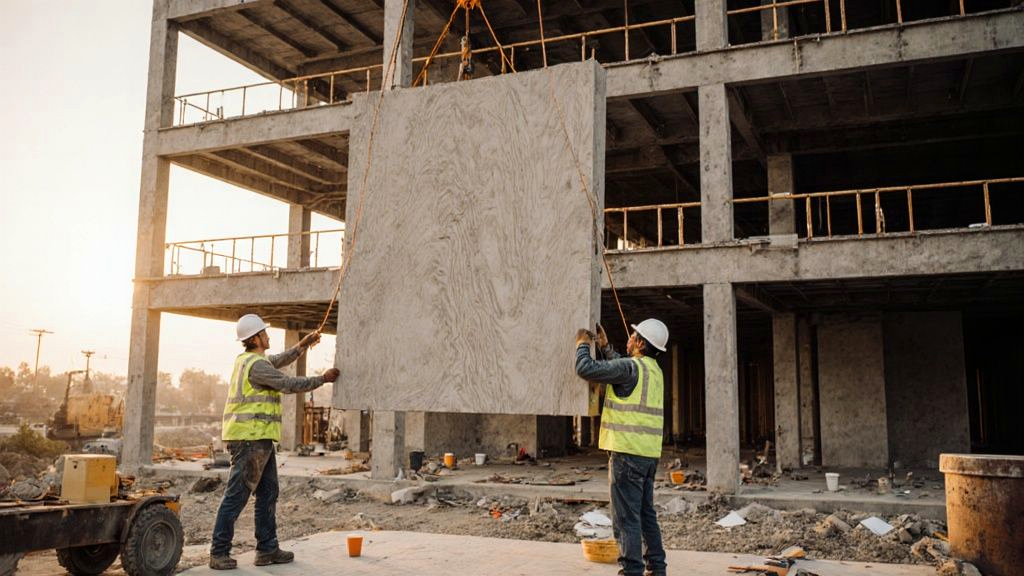
Insulated sandwich panels are one of the most important developments in the category. By placing rigid foam between two concrete wythes, a single panel delivers structure, continuous insulation, and a finished exterior. Panels can be designed as load-bearing or non-load-bearing, and the same platform can be engineered for enhanced performance such as blast resistance where a project demands it. For owners chasing energy targets, continuous insulation built into the wall is a meaningful advantage over assemblies that rely on framing cavities.
Richer Architectural Finishes
Precast is no longer limited to a gray industrial look. Form liners, acid etching, sandblasting, exposed aggregate, and integral pigments let manufacturers produce facades that mimic stone, brick, or board-formed concrete at a fraction of the field labor. Complex geometries, curved profiles, and varying seating angles for stadium risers are all achievable because the geometry lives in the mold. This is where signature building systems truly earn their name: the enclosure becomes the architecture.
Digital Design and BIM Coordination
Building information modeling has changed how precast is designed and delivered. Detailed 3D models allow clash detection, embed coordination, and connection design to be resolved before any concrete is cast. Integral connections that speed field assembly are modeled and verified up front, which reduces the field corrections that historically consumed schedule. Digital workflows also feed directly into plant scheduling and automated batching, tightening the link between design intent and finished product.

Form liners and surface treatments let precast facades mimic stone, brick, or board-formed concrete with far less field labor.
Performance Advantages That Set Precast Apart
Trends are only worth following when they translate into real performance. The reason precast keeps winning specifications comes down to a handful of durable advantages that hold across project types.
Speed to Enclosure
Because components are produced off-site while site work proceeds in parallel, the structure can be erected and enclosed in a fraction of the time a comparable cast-in-place or framed building would take.
Fire and Weather Resistance
Concrete is inherently noncombustible and resilient against wind, moisture, and impact, which supports occupant safety and lowers long-term insurance and maintenance exposure.
Long Clear Spans
Double tees and hollowcore plank span long distances without interior columns, giving owners flexible, open floor plates that adapt as needs change.
Consistent Quality
Plant production under managed curing conditions yields consistent strength, tight tolerances, and finishes that are hard to match with field-poured concrete.
Matching the System to the Project
No single component fits every job. The strength of a precast platform is that the same design vocabulary scales across very different structures, and the right mix of elements depends on span, load, and the look the team is after.
| Precast Element | Best-Fit Application | Key Benefit |
|---|---|---|
| Structural columns & beams | Multi-story frames, parking, stadiums | Carry heavy loads with fast erection |
| Double tees & hollowcore plank | Floors and roofs needing open spans | Long clear spans without interior columns |
| Insulated sandwich panels | Building enclosures and facades | Structure, insulation, and finish in one unit |
| Architectural facade pieces | Signature exteriors and detailing | Custom geometry, texture, and color |
| Box beams | Highway, pedestrian, and marine spans | Compact, high-strength, durable profile |
The biggest design wins happen when the precast manufacturer is engaged early, while the structural and architectural concepts are still flexible. That is when an integrated building system can be tuned for span, finish, and schedule all at once.
Sustainability and the Future of Precast Construction
Sustainability has moved from a nice-to-have to a core design driver, and precast has a strong story to tell. As industries work to reduce carbon footprints and resource consumption, the durability of concrete becomes an environmental asset: a structure built to last a century replaces fewer materials over its life than one rebuilt every few decades. You can explore that side of the conversation in our overview of sustainable precast construction.
Several factors strengthen the sustainability case. Reusable steel and fiberglass molds reduce formwork waste compared with single-use site forms. Controlled plant batching minimizes material overuse and lets producers optimize mix designs, increasingly incorporating supplementary cementitious materials to lower embodied carbon. Continuous insulation in sandwich panels improves operational energy performance for the life of the building. Concrete’s thermal mass further moderates indoor temperature swings, easing the load on heating and cooling systems.
Looking ahead, expect the trends already underway to deepen. Lower-carbon concrete mixes are advancing quickly, digital fabrication is tightening the link between model and mold, and standardized connection details are making total-precast systems even faster to erect. Industry bodies such as the Precast/Prestressed Concrete Institute continue to publish research and certification standards that push quality and performance forward across the sector.
Choosing the right structural approach early also matters for load paths and longevity. Understanding the different types of load-bearing columns helps design teams pair the right precast elements with the demands of each project, so the finished building performs as intended for decades.
The Bottom Line on Signature Building Systems
Modern precast has earned its place at the center of how ambitious projects get built. Total-precast frames, high-performance insulated enclosures, expressive architectural finishes, and digital coordination have turned a once-utilitarian material into a flexible, high-performance platform that delivers on speed, durability, and design freedom at the same time.
The teams that get the most from these systems treat precast as an integrated solution rather than a collection of parts, and they bring the manufacturer into the conversation early. Do that, and the result is a structure that stands up faster, performs longer, and looks exactly the way the architect imagined.
Planning a Precast Project?
Heldenfels Enterprises designs and manufactures integrated precast building systems for projects across Texas and beyond. Let’s talk about how precast can shape yours.
Start the Conversation →