
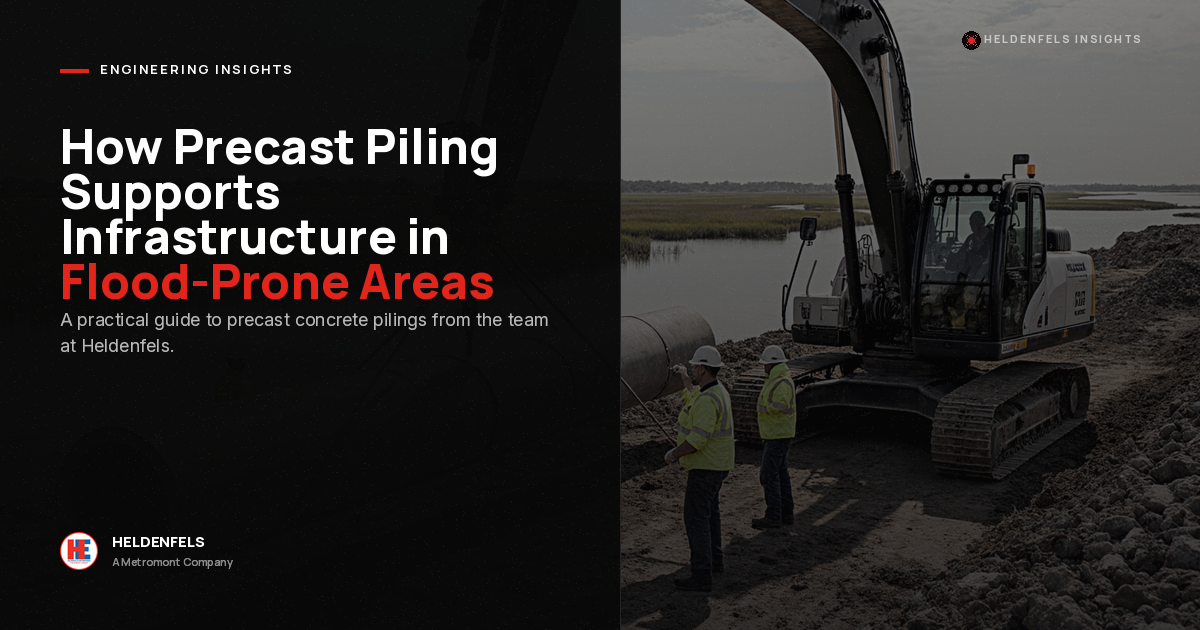
How Precast Concrete Pilings Strengthen Infrastructure in Flood-Prone Areas
Precast concrete pilings provide deep, durable foundation support for bridges, marine structures, and industrial infrastructure exposed to flooding, saturated soils, erosion, and moving water.
Precast concrete pilings help support bridges, piers, wharfs, marine facilities, and industrial structures built in areas where water can weaken surface soils or expose foundations to erosion. For flood-prone infrastructure, the foundation is not just another construction detail. It is the part of the project that decides whether the structure can handle saturated ground, moving water, heavy loads, and long-term exposure.
This is where precast concrete piling becomes a practical deep foundation option. Instead of relying on shallow soil near the surface, precast pilings transfer structural loads into deeper, more stable ground. For contractors, engineers, public agencies, and project owners, that can mean better durability, faster installation, tighter quality control, and fewer surprises once the work moves on site.
How Precast Piling Supports Infrastructure in Flood-Prone Areas

Precast concrete piling can help support flood-prone bridges, marine facilities, and waterfront infrastructure where deeper foundation support is required.
Flood-prone sites can weaken surface soils, expose foundations to erosion, and create added risks from scour, corrosion, tidal changes, storm surge, and limited construction access. Precast concrete pilings help manage these conditions by acting as deep foundation members manufactured in a controlled plant environment before being transported and installed on site. Once installed, they transfer structural loads past weaker surface soils and into deeper, more stable bearing layers.
That matters because flood-prone infrastructure is usually expected to perform under difficult conditions. A pier, bridge, wharf, industrial platform, or waterfront access structure cannot be treated like a standard slab-on-grade project. The foundation system must be selected with water exposure, soil movement, installation access, and long-term maintenance in mind.
For heavy-duty marine and infrastructure applications, we manufacture prestressed concrete piles used for deep foundation support across Texas. These piles are designed for demanding environments where strength, durability, and consistency are essential.
Key Benefits of Precast Pilings in Flood-Prone Areas
| Feature | Why It Matters in Flood-Prone Infrastructure |
|---|---|
| Deep foundation support | Transfers loads below weak or saturated surface soils. |
| Controlled manufacturing | Improves consistency before the pile reaches the jobsite. |
| Prestressed strength | Helps support demanding marine, bridge, and industrial loads. |
| Faster installation | Reduces dependence on long on-site curing windows. |
| Durability in wet environments | Supports structures exposed to moisture, tides, and changing water levels. |
| Project predictability | Helps contractors plan around schedule, access, and quality requirements. |
One thing I would not overlook is schedule risk. In flood-prone or coastal work, weather does not care about your project timeline. Precast concrete pilings do not remove every site challenge, but they do shift a major part of the quality-control process into a plant environment before the site is fighting mud, water, access limits, or a tight marine construction window.
Why Flood-Prone Sites Need Stronger Foundation Planning
Flooding does more than put water around a structure. It can change the way the ground behaves.
When soils are saturated, they may lose strength or become less predictable. Flowing water can erode soil around foundations. In bridge and marine projects, scour is a serious issue because it can remove supporting material around piles, piers, and abutments. The Federal Highway Administration’s bridge scour resources explain why scour, stream stability, sediment transport, and countermeasures are important considerations for bridges and transportation structures near waterways. That is why waterway foundations require careful design, evaluation, and protection.
That does not mean every flood-prone site automatically needs the same foundation system. It does mean the design team has to ask harder questions early:
- What soil layers are actually capable of carrying the load?
- How deep could erosion or scour affect the foundation?
- Will the structure face tidal forces, wave action, or storm surge?
- Is the site exposed to saltwater or aggressive chemicals?
- Can construction equipment access the area safely?
- How much installation time is available before weather becomes a problem?
- Will the finished structure need to support vehicles, cargo, equipment, or heavy industrial loads?
These questions matter because flood-prone infrastructure usually fails from a chain of problems, not one isolated weakness. Poor soil support, undersized foundation elements, corrosion exposure, weak connections, drainage problems, and erosion can all work together. A strong pile foundation helps reduce one major risk by anchoring the structure into more reliable support below the surface.
What Makes Precast Concrete Pilings Different?
Precast concrete pilings are manufactured, reinforced, cured, and inspected in a controlled plant environment before reaching the jobsite. For prestressed piles, high-strength steel strands are tensioned before casting and released once the concrete reaches the required strength. This places the pile into compression, helping it resist stresses from handling, driving, service loads, and environmental exposure.
This is one reason precast concrete piling is commonly considered for demanding infrastructure applications. The pile is not formed in a wet excavation or poured under unpredictable field conditions. The project team receives a manufactured component built to meet specific design requirements.
For flood-prone sites, that plant-based control can be valuable. Site conditions may be messy, but the pile itself does not have to be produced in the mess.
Controlled Quality Before Installation
Quality control is one of the biggest advantages of precast concrete. The manufacturing team can monitor mix design, reinforcement placement, curing, dimensions, strength development, and finish before the product is shipped.
That does not replace engineering, inspection, or proper installation. A badly designed or poorly installed pile is still a problem. But controlled manufacturing gives the project a stronger starting point than relying entirely on field-formed concrete in difficult conditions.
For infrastructure owners, this can support better long-term performance. For contractors, it can reduce uncertainty. For engineers, it provides a more consistent product to design around.
Where Precast Concrete Pilings Are Used in Flood-Exposed Infrastructure
Precast concrete pilings are especially relevant where structures must carry significant loads near water, over water, or in soils affected by moisture. Common applications include:
- Bridges and bridge approaches
- Piers and docks
- Wharfs and ship berths
- Industrial marine facilities
- Pipe racks
- Ramps and access structures
- Bulkheads and waterfront infrastructure
- Erosion protection systems
- Coastal and river-adjacent structures
- Heavy civil and transportation infrastructure
We support marine and industrial projects with precast and prestressed concrete components used in docks, piers, wharfs, ship berths, ramps, erosion protection, and related marine applications. That service relevance matters for this topic. This is not a random informational article disconnected from what the company actually does.
A contractor looking at flood-prone infrastructure does not just need a definition of precast concrete piling. They need to know whether the manufacturer understands marine exposure, transportation demands, installation sequencing, and infrastructure-grade performance. That is where company-specific experience should be clear in the article.
How Precast Pilings Help Manage Erosion and Scour Risk
Scour happens when moving water removes soil or sediment around a foundation. It is a major concern for bridges and waterfront structures because the foundation can lose support even if the structure above still looks sound.
Precast concrete pilings help by extending the foundation deeper than the most vulnerable surface soils. The exact pile depth, spacing, size, and reinforcement must be determined by qualified engineers based on geotechnical and hydraulic conditions. No responsible contractor should treat precast concrete piling as a one-size-fits-all answer.
The better way to think about it is this: precast concrete pilings give the design team a durable deep foundation tool. They can help support structures where shallow foundations may be more vulnerable to erosion, saturation, or changing ground conditions.
For bridge and waterway projects, scour evaluation should be part of the design conversation. The foundation must still account for site-specific flow conditions, soil type, expected flood levels, and possible erosion depth. Precast pilings are strong, but they still need proper engineering.
Precast Concrete Pilings vs Other Foundation Materials
Timber, steel, cast-in-place concrete, drilled shafts, and precast concrete piles can all work depending on the site, load requirements, budget, design life, and installation method. The weak move is choosing a pile system based only on upfront cost. Flood-prone infrastructure needs lifecycle thinking because maintenance, durability, and failure risk matter just as much as the initial price.
Timber Piles
Timber piles can be suitable for some applications, especially where loads are moderate and environmental conditions are appropriate. However, they may be vulnerable to biological decay, marine borers, impact damage, and long-term deterioration depending on exposure.
Steel Piles
Steel piles can provide high strength and efficient installation. They may be a good fit for certain deep foundation conditions. In marine or corrosive environments, however, corrosion protection becomes a serious design and maintenance consideration.
Cast-in-Place Concrete
Cast-in-place foundations can be effective, but they rely heavily on field conditions. In wet, flood-prone, or access-constrained sites, formwork, dewatering, curing, and placement quality can become harder to control.
Precast Concrete Pilings
Precast concrete piling offers a strong balance of controlled production, durability, installation efficiency, and structural performance. Prestressed piles can be especially useful for marine, bridge, and industrial applications where the foundation must support heavy loads and resist demanding service conditions.
That does not make precast the automatic winner every time. It does make it a serious option when the project needs consistency, strength, and long-term performance in water-exposed conditions.
Why Plant-Manufactured Pilings Can Improve Project Predictability
Flood-prone infrastructure projects often face tight construction windows because of tides, weather, site access, crane setup, delivery logistics, and public agency scheduling. Precast concrete pilings can help because they are manufactured before the site is ready for installation. While approvals, access planning, and site preparation are underway, the piles can be produced to the approved design and delivered when the project is ready.
This can improve project predictability in several ways:
- Less dependence on field curing
- More consistent product dimensions
- Earlier quality checks before delivery
- Faster installation once equipment is mobilized
- Better schedule coordination for repeat pile quantities
- Reduced risk from poor on-site concrete placement conditions
Again, this is not magic. If shop drawings are delayed, logistics are poor, or site conditions change, the project can still lose time. But precast gives the team a cleaner manufacturing path compared with building every foundation element from scratch in difficult field conditions.
For readers who want a broader explanation of how plant production works, we also have a related blog on what precast concrete is and why it matters. This article gives useful background on why controlled production is such a major advantage in modern construction.
Design Factors Engineers Consider Before Using Precast Pilings
A good foundation decision starts with site data. Precast concrete pilings should be selected and designed based on actual engineering requirements, not because the phrase sounds durable. Before specifying precast piles for flood-prone infrastructure, engineers and project teams typically evaluate:
Soil Conditions
The geotechnical report helps identify soil layers, bearing capacity, groundwater conditions, settlement risk, and the depth needed to reach suitable support. Flood-prone sites often require closer attention because surface soils may be soft, loose, saturated, or variable.
Hydraulic Conditions
For bridges, piers, wharfs, and marine structures, water movement matters. Engineers may need to consider flood levels, current velocity, tidal conditions, wave action, and scour potential.
Structural Loads
The pile system must support dead loads, live loads, lateral loads, impact loads, uplift, and other project-specific forces. A wharf handling cargo, for example, creates different foundation demands from a light pedestrian pier.
Exposure Environment
Saltwater, chlorides, sulfates, industrial chemicals, and constant wet-dry cycling can affect long-term durability. The concrete mix, reinforcement strategy, cover, and detailing must match the exposure conditions.
Pile Size and Length
Pile size depends on load demands, installation conditions, handling requirements, and design criteria. Heldenfels lists prestressed concrete pile sizes from 12 inches to 30 inches, giving project teams options for different load and site requirements.
Installation Method
Driven piles, jetting assistance, predrilling, or other installation approaches may be considered depending on soil conditions and project constraints. Installation planning must also account for vibration, noise, nearby structures, access, and equipment capacity.
Connections and Caps
The pile is only one part of the system. Pile caps, deck slabs, beams, and connections must be properly detailed so the structure performs as a complete system.
The Role of Precast Pilings in Marine Infrastructure
Marine infrastructure is one of the strongest use cases for precast concrete pilings because these structures are constantly exposed to water, movement, and difficult maintenance conditions. Piers, docks, wharfs, ship berths, and industrial waterfront structures need foundations that can handle moisture, wave action, tidal changes, heavy loads, and long-term chloride exposure.
Precast and prestressed concrete can give project teams a practical advantage because the piles are manufactured for strength and consistency before reaching the site. When the piles, caps, deck slabs, beams, and other precast components are properly coordinated, the project can move faster and deliver better long-term performance in flood-prone coastal environments.
The Role of Precast Pilings in Highway and Bridge Projects
Flood-prone infrastructure is not limited to coastal projects. Bridges, overpasses, causeways, drainage structures, and transportation corridors may all interact with water. Heavy rainfall, rising waterways, storm events, and shifting drainage patterns can put bridge foundations under pressure.
We have long-standing experience in highway and bridge precast products, including prestressed piling, precast caps, and standard TxDOT bridge girders. That is directly relevant because bridge projects often demand strict design compliance, repeatable production, and dependable delivery.
In bridge work, precast concrete piling can support foundations where surface soils are not enough. The pile system may also work with precast caps, girders, and deck components to create a coordinated structure. For public infrastructure, that coordination matters because delays and foundation issues can affect budgets, road closures, safety, and long-term maintenance planning.
A strong bridge foundation does not guarantee the entire structure will be maintenance-free. No serious builder should claim that. But it does give the project a better base for long-term performance.
Why Precast Concrete Piling Supports Long-Term Value
Flood-prone infrastructure is expensive to build and expensive to repair. Choosing a foundation system only because it looks cheaper at bid time can backfire if the structure faces settlement, corrosion, erosion, or premature maintenance.
Precast concrete piling supports long-term value in three practical ways.
- First, it improves quality control before installation. The pile is manufactured in a controlled environment, checked before shipment, and delivered as a finished structural component.
- Second, it can improve installation efficiency. Once piles arrive and equipment is mobilized, the site team is not waiting for every foundation element to be formed, poured, and cured in place.
- Third, it supports durability in demanding environments. With the right design, materials, and detailing, prestressed concrete piles can provide long service life in marine, industrial, and transportation projects.
The key phrase is “with the right design.” Precast is not a shortcut around engineering. It is a better tool when the project team uses it properly.
Common Mistakes to Avoid When Planning Pile Foundations in Flood-Prone Areas
A strong article on this topic should not pretend every problem is solved by saying “use precast.” That is lazy. Here are the mistakes that actually hurt projects:
Treating Soil Conditions as an Afterthought
A pile foundation depends on what is underground. Without reliable geotechnical information, the design team is guessing. Flood-prone sites need careful soil review because the weakest layers may be near the surface.
Ignoring Scour Potential
Water movement can remove soil around foundations. For bridges and marine structures, scour should be evaluated early. If scour depth is underestimated, the structure may lose support during major flow events.
Choosing Based Only on Initial Cost
A cheaper foundation option can become expensive if it increases installation risk, maintenance needs, or long-term repair costs. Infrastructure owners should compare lifecycle value, not just the first number on the bid.
Forgetting About Installation Access
A pile may look good on paper but still create problems if the site cannot support the required equipment, staging, delivery, or crane access. Precast concrete pilings require practical logistics planning.
Using Generic Specifications
Flood-prone infrastructure is not generic. Marine exposure, bridge loads, industrial use, and soil conditions all affect the correct pile design. Specifications should match the actual project.
When to Consider Precast Concrete Pilings for a Flood-Prone Project
Precast concrete pilings may be worth considering when a project involves:
- Weak, soft, or saturated surface soils
- Coastal, marine, or riverfront construction
- Bridge or transportation infrastructure near waterways
- Heavy structural loads
- Sites exposed to erosion or scour
- Industrial structures in wet or difficult ground conditions
- Tight construction windows
- A need for consistent manufactured components
- Long-term durability requirements
- Public infrastructure where maintenance disruption is costly
The best next step is not to assume the answer. It is to bring the precast manufacturer, engineer, contractor, and owner into the conversation early. That helps the team review pile sizes, production capacity, lead times, transportation, site access, and installation sequencing before the project gets locked into a weaker plan.
Building Stronger Flood-Prone Infrastructure Starts Below the Surface
Flood-prone infrastructure depends on what happens below the surface, where soil, water, load, and time can weaken the foundation. Precast concrete pilings give engineers and contractors a durable deep foundation option manufactured under controlled conditions. For bridges, piers, wharfs, marine facilities, and industrial infrastructure, they can improve load transfer, speed up installation, and support more predictable long-term performance.
The smarter approach is not to use precast concrete piling because it sounds modern. Use it because the site conditions, structural demands, water exposure, and project schedule justify it. When those factors line up, precast/prestressed concrete pilings can be one of the most practical foundation choices for flood-prone infrastructure.
Heldenfels manufactures precast and prestressed concrete components for highway, bridge, marine, industrial, and commercial construction across Texas. For project teams planning flood-exposed infrastructure, early coordination with an experienced precast manufacturer can help turn a risky foundation decision into a stronger, more buildable solution.
Plan Stronger Foundations for Flood-Exposed Infrastructure
Connect with Heldenfels to discuss precast and prestressed concrete components for highway, bridge, marine, industrial, and commercial construction projects across Texas.
Contact us today