

Precast Concrete Beams: What They Are and Their Key Benefits for Construction Projects
Discover how plant-cast and prestressed concrete beams speed up jobsite schedules, improve quality control, and provide lasting structural durability.
Precast concrete beams help contractors, engineers, and owners build durable structural systems with less jobsite disruption. For bridges, industrial facilities, parking structures, marine work, and commercial buildings, they can shorten field schedules while improving quality control.
That matters because beam work is rarely a small detail. Beams carry loads, shape spans, affect crane planning, influence traffic closures, and often determine how quickly the rest of a project can move. When a beam arrives already cast, cured, inspected, and ready for placement, the project team gets a structural component built for performance before it reaches the site.
Heldenfels Enterprises specializes in precast and prestressed concrete products for highway, marine, industrial, and building construction markets across Texas. For teams comparing cast-in-place framing, steel, and precast concrete beams, the real question is not whether precast is popular. The better question is whether it solves the project’s schedule, durability, access, and design problems.
What Are Precast Concrete Beams?
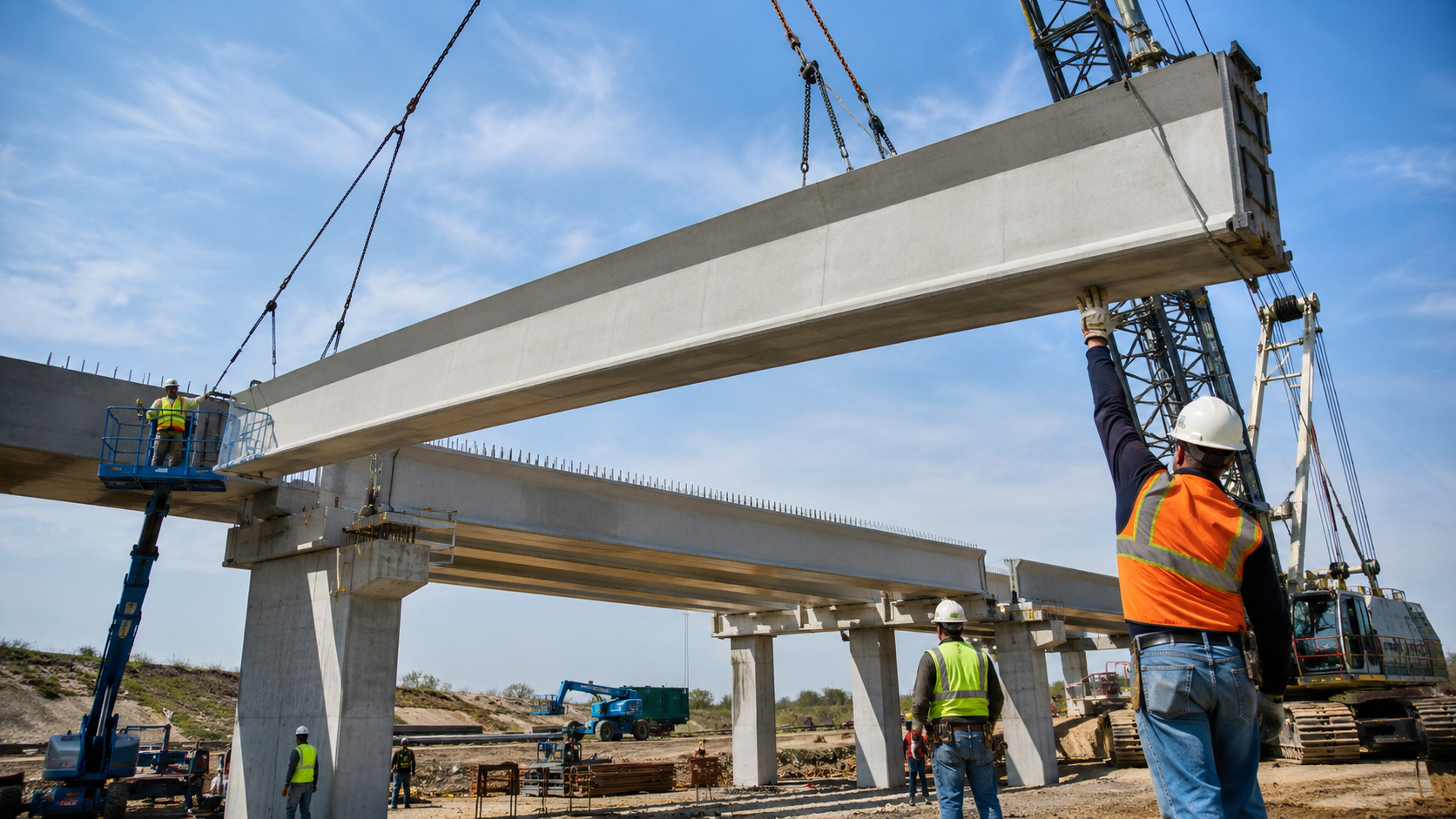
Precast concrete beams are structural members manufactured away from the final construction site, usually in a controlled production facility. After the concrete reaches the required strength, the beams are transported to the project and installed with cranes or other lifting equipment.
Cast-in-place beams are formed, reinforced, poured, cured, and stripped at the jobsite. Precast concrete beams shift much of that work into a plant setting where production teams can control forms, reinforcement placement, concrete batching, curing conditions, dimensional tolerances, and inspection procedures.
Many structural precast beams are also prestressed. Prestressing uses high-strength steel strands that are tensioned before the concrete is cast. Once the concrete gains strength, the strands are released, placing the beam into compression. That helps the beam resist tensile forces during service and can support longer spans or heavier load demands than many conventional reinforced concrete members.
Key Benefits for Construction Projects
Precast concrete beams are used because they solve several construction problems at once: schedule pressure, quality control, structural performance, and long-term durability. Instead of building every beam from scratch on site, project teams can use plant-produced members that arrive ready for installation.
The biggest benefits show up on projects where time, access, safety, and consistency matter.
1. Faster Construction With Less Jobsite Disruption
Precast concrete beams speed up construction because they are fabricated off-site while site preparation, foundations, abutments, and traffic control work continue. The Federal Highway Administration notes that prefabricated bridge elements and systems are built off-site or near-site to reduce on-site construction time and mobility impacts compared with conventional bridge construction. Once the site is ready, the beams can be delivered and erected faster than cast-in-place beams, reducing delays on highway, rail, port, and industrial projects. Fewer field pours, formwork steps, curing delays, and long closures make the jobsite easier to manage and safer to coordinate.
2. Better Quality Control Than Field-Cast Beams
Precast concrete beams offer stronger quality control because they are produced in a plant setting where forms, reinforcement, strand placement, and concrete performance can be checked before shipping. Field-cast beams are more exposed to weather, access limits, congestion, labor sequencing, and curing issues, which can make quality harder to control. That consistency matters because a beam with verified dimensions, documented production history, and known strength is easier to coordinate, inspect, and trust.
3. Strong Load-Bearing Performance
Precast concrete beams are engineered to carry structural loads efficiently, whether they support bridge decks, floors, roofs, traffic loads, equipment loads, or pedestrian areas. For longer spans and heavier loads, prestressed beams help offset tensile stresses, which is why our precast prestressed bridge girders are commonly used for Texas overpasses, river crossings, railroad bridges, and urban interchanges. Still, precast is not automatically the right choice for every structure because span length, loading, clearance, transportation limits, erection access, connection details, and budget all affect the final decision.
4. Durability for Demanding Environments
Precast concrete beams are valued for durability because properly designed members can perform well in harsh settings such as highways, coastal areas, industrial sites, and marine-adjacent structures. With the right mix design, concrete cover, reinforcement placement, and controlled curing, precast beams can provide long service life with relatively low maintenance. That matters in Texas bridge and roadway work, where heavy traffic, heat, moisture, and coastal exposure can directly affect lifecycle cost, inspection needs, repair frequency, and public disruption.
5. Efficient Installation and Safer Sequencing
Precast concrete beams improve installation efficiency because they can be lifted into place once the supporting elements are ready. Instead of building formwork, placing reinforcement, and waiting for concrete to cure over active work zones, crews can install finished members through a planned erection sequence. Crane access, delivery logistics, and lift planning still need tight coordination, but the field operation is usually more predictable than building the beam entirely on site.
6. Design Flexibility Across Project Types
Precast concrete beams can be designed in different shapes, depths, widths, reinforcement layouts, strand patterns, and connection details to match the structure. Common applications include:
- Bridge girders
- Box beams
- Slab beams
- Raker beams
- Parking structure members
- Marine components
- Industrial structural elements
For short- to medium-span bridge and roadway projects, our precast prestressed box beams are suited for strength, durability, efficient installation, and reduced beam depth where project conditions require it. This flexibility helps engineers work around site constraints such as road clearance, shallow structural depth, limited supports, and existing infrastructure.
7. Long-Term Cost Value
Precast concrete beams are not always cheaper upfront than cast-in-place concrete or steel, so the stronger argument is total project value. They can reduce costs by shortening schedules, lowering field labor needs, limiting formwork, improving quality consistency, and reducing traffic-control or jobsite disruption. The economics are strongest when the project benefits from speed, repeatability, durability, and easier installation, but less attractive when access, geometry, crane space, or delivery logistics are poor.
8. Reduced Waste and More Controlled Resource Use
Precast concrete beams can reduce jobsite waste because they are made in a controlled plant environment with reusable forms, repeatable batching, planned reinforcement placement, and standardized production processes. Still, it is too broad to claim every precast beam uses fewer raw materials, since environmental performance depends on mix design, cement content, transportation distance, lifting requirements, reinforcement design, and service life. A more accurate benefit is that precast beams can improve production efficiency, shorten on-site construction activity, and support longer-lasting structures that may require fewer repairs or replacements.
9. Fire Resistance and Resilience
Concrete is noncombustible, which gives precast concrete beams an advantage in projects where fire resistance and resilience affect material selection. Precast beams can be engineered to meet required fire-resistance ratings, depending on member size, concrete cover, reinforcement, loading, and code requirements. Beyond fire performance, they are often used in structures that must handle heavy use, weather exposure, repeated loading, and long service demands.
Where Precast Concrete Beams Make the Most Sense
Precast concrete beams are especially useful when a project needs speed, repeatability, long service life, and predictable field installation. They are commonly used in:
- Highway bridges and overpasses
- Railroad crossings
- River and waterway crossings
- Parking structures
- Marine and port facilities
- Industrial buildings
- Stadium and seating structures
- Commercial and institutional buildings
- Elevated roadways and ramps
The strongest use cases usually involve a clear schedule advantage, a demanding structural requirement, or a site where cast-in-place work would create too much disruption. It lets project teams move critical structural work off-site, then install finished members when the project is ready.
Precast Concrete Beams vs. Cast-in-Place Beams
Both precast concrete beams and cast-in-place beams can be the right choice depending on the project. The best option comes down to site access, schedule, geometry, crane availability, transportation limits, and how much quality control the project requires.
| Factor | Precast Concrete Beams | Cast-in-Place Concrete Beams |
|---|---|---|
| Best fit | Projects that benefit from off-site fabrication, controlled quality, faster erection, and repeatable structural members. | Projects with complex geometry, monolithic construction needs, tight delivery constraints, or limited crane access. |
| Construction speed | Faster in many cases because beams are produced off-site while other work continues. | Slower because forming, reinforcement placement, pouring, curing, and stripping happen on site. |
| Quality control | Stronger control in a plant environment with repeatable production and inspection processes. | More dependent on field conditions such as weather, access, labor sequencing, and curing conditions. |
| Installation needs | Requires transportation planning, crane access, lift coordination, and accurate site dimensions. | Requires formwork, shoring, reinforcement placement, concrete placement, and curing at the jobsite. |
| Design flexibility | Works well for standardized or repeatable members, but transportation and lifting limits can affect size and shape. | Useful for unusual shapes, complex connections, and structures that need monolithic concrete placement. |
| Jobsite disruption | Often reduces jobsite disruption because finished members are installed during planned erection. | Can create more disruption because more work must be performed and cured in place. |
| Main limitation | Poor access, limited crane space, difficult delivery routes, or highly unusual geometry can weaken the case for precast. | Longer field schedules and greater exposure to weather, labor constraints, and site congestion. |
The choice should not be based on the lazy assumption that one method is always better. For many transportation, industrial, marine, and commercial structures, precast concrete beams offer a strong balance of speed, strength, durability, and installation control, while cast-in-place concrete remains useful when project geometry or site constraints demand it.
Choosing the Right Precast Partner
The advantages of precast concrete beams depend heavily on the producer behind them. A strong precast partner does more than pour concrete into a form; they understand how engineering requirements, transportation limits, production tolerances, strand patterns, curing, inspection, and jobsite coordination all affect the finished structure.
That is why experience matters. Heldenfels Enterprises fabricates and installs precast prestressed concrete structures for highway, marine, industrial, and building construction markets. Our work across Texas infrastructure gives project teams access to product knowledge shaped by real field conditions, not just shop drawings.
Before choosing a precast supplier, review key factors such as:
- Relevant product experience
- Quality control procedures
- Project history
- Delivery and transportation capabilities
- Familiarity with applicable agency standards
- Ability to coordinate with contractors, engineers, and owners
For bridge work, pay close attention to:
- Available girder types
- Box beam capabilities
- Connection requirements
- Span and load requirements
- Coordination with the design team
- Jobsite delivery and erection planning
The wrong producer can turn a good precast design into a scheduling problem. The right partner helps make sure the beams are manufactured, delivered, and installed with the control the project requires.
Turn Project Requirements Into the Right Beam Choice
Remember, the right beam choice should come from the project’s actual conditions, not a generic preference for one material or method. Span length, load requirements, beam depth, site access, crane availability, delivery routes, connection details, and installation schedule all affect whether precast concrete beams are the best fit.
For transportation and infrastructure projects, a practical next step is to compare our bridge girders and box beams against the project’s span, depth, load, and erection requirements. That gives the design and construction team a clearer basis for deciding whether precast concrete beams can deliver the speed, durability, and installation control the job requires.
Optimize Your Next Structural Project
Partner with Heldenfels to bring precision, strength, and schedule efficiency to your Texas construction project. Get in touch with our engineering team today to review your project specifications.
Contact us today